Trois Crayons Magazine, February 2026
Daniel Lowe, Contributing editor
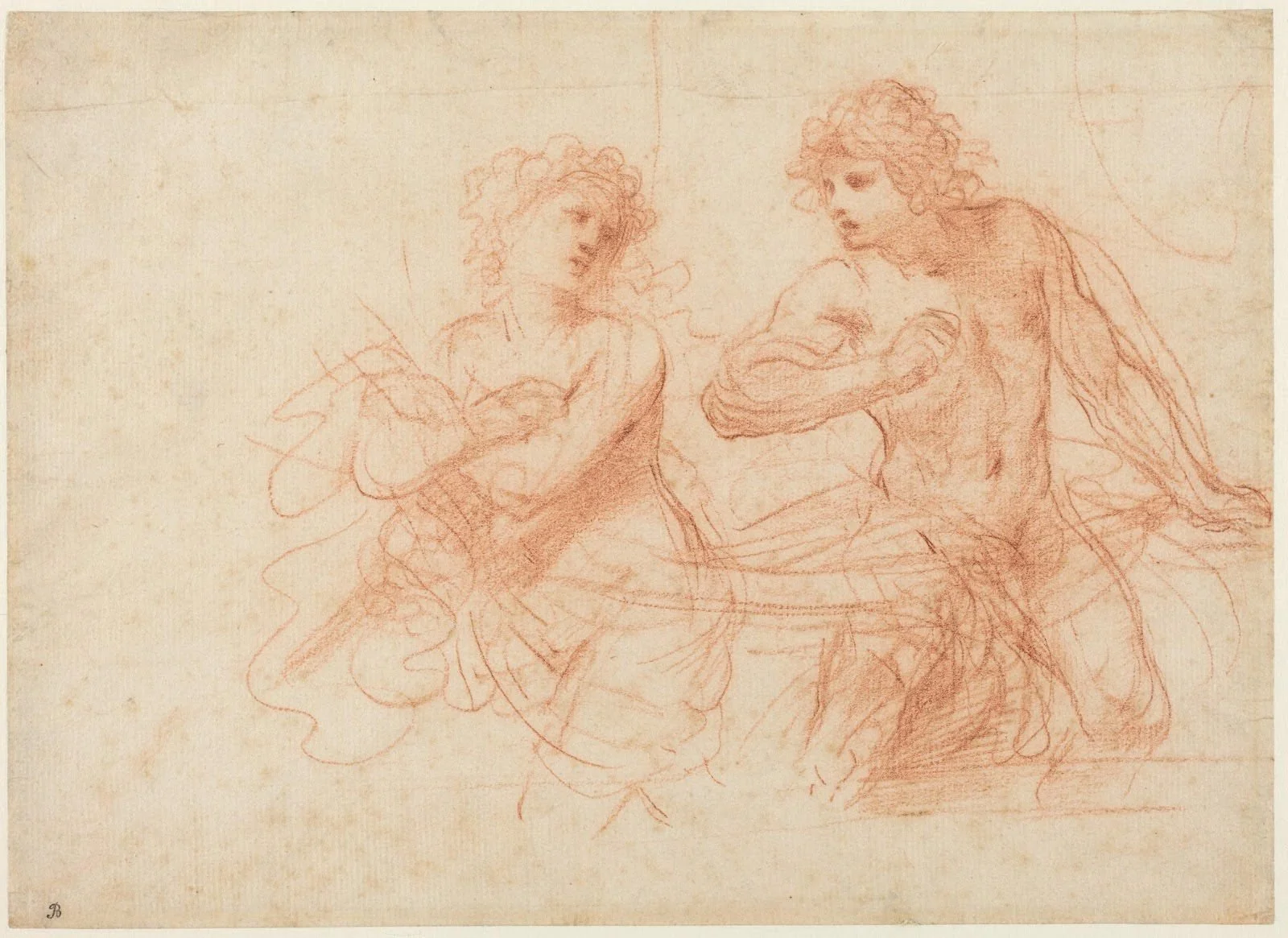
The Emilian painter and draughtsman Giovanni Francesco Barbieri, known as Guercino (1591–1666) had well-recorded distaste for England and the English. The biographer Carlo Cesare Malvasia noted that upon being invited to the court of Charles I in the mid-1620s, the artist rebuffed the sovereign’s tempting offer of market rates for every painting produced, on top of a yearly wage and paid expenses. His justification? ‘He did not wish to accept the offer, not wanting to converse with heretics (so as to not taint his angelic ways). Furthermore, he did not want to endure such a treacherous voyage, in a climate so different from his own’. (C.C. Malvasia, Felsina Pittrice, Bologna 1678, II:366, translation mine)
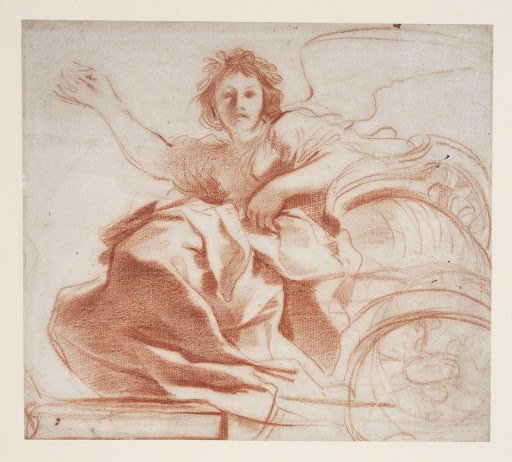
Giovanni Francesco Barbieri, called Guercino, Aurora, c. 1620. Red chalk with stumping on laid paper, 24.8 x 27.1 cm. Courtauld Gallery, London (Samuel Courtauld Trust). Image courtesy of the Courtauld.
Despite the artist’s aversion to the climate of England and the ‘heretic’ Protestantism of its inhabitants, nowhere has the work of Guercino — especially his drawings — found greater acclaim. Some significant early English collections of his sheets included that of the painter Peter Lely, William Cavendish, fourth Earl (and future first Duke) of Devonshire, the dealer William Kent; and even George III, who acquired a considerable number of Guercino drawings through his librarian Richard Dalton.
Above all of these well-known and widely studied collectors, however, one towers above the rest. I speak, naturally, of the archaeologist and traveller John Bouverie, who, in the span of just a few years, amassed what the connoisseur Henry Reveley described as ‘perhaps the finest collection of Guercino’s drawings in England’ (1820). Despite the importance of Bouverie’s collection of Guercino drawings, before Nicholas Turner and Carol Plazzotta’s seminal catalogue Drawings by Guercino from British Collections (1991), virtually nothing was known about the young English collector. The biographic profile that follows is greatly indebted to Turner and Plazzotta’s publication, and equally to an article in the Burlington Magazine on the same subject, also by Turner (1994).
John Bouverie was born around 1722 to a wealthy family. Before finishing his MA at New College Oxford, Bouverie undertook a Grand Tour between 1740 and 1742, with his tutor John Clephane. The young collector embarked on his journey with considerable financial liquidity, having inherited a large fortune following the death of his father and elder brother.
Bouverie seems to have made his first acquisition of a volume of Guercino sheets from a certain ‘Abbé Bonducci’ in Florence, cinching it from the clutches of Horace Walpole, another avid English collector. Recorded again in Italy between 1745 and 1746, Bouverie purchased another large collection of drawings of the artist from the Bolognese dealer Francesco Forni (sometimes mistakenly spelt ‘Formi’).
In 1750, having embarked on yet another Mediterranean expedition, Bouverie fell ill and died. His formidable collection of drawings — which also contained works by the likes of Rembrandt, Carlo Dolci, and a series of portrait drawings, once attributed to Holbein and currently given to Clouet and his workshop — were passed to his sister Anne (d. 1757). After bouncing through his family, the sheets were eventually inherited by the Earls of Gainsborough, who began to significantly disperse the collection, notably through a first sale at Christie’s in 1859, and subsequently through a series of larger sales in the 1920s.
Today, most of Bouverie’s drawings have been snapped up by various museums, both in the UK and further afield. Standouts include the atmospheric Landscape with a Volcano now at the Morgan Library in New York, the pen-and-ink Two seated women drying their hair in front of a fire, and the red-chalk Aurora. These last two sheets (illustrated) are bothat the Courtauld Gallery in London, the home of an important nucleus of around thirty Guercino drawings that once belonged to John.
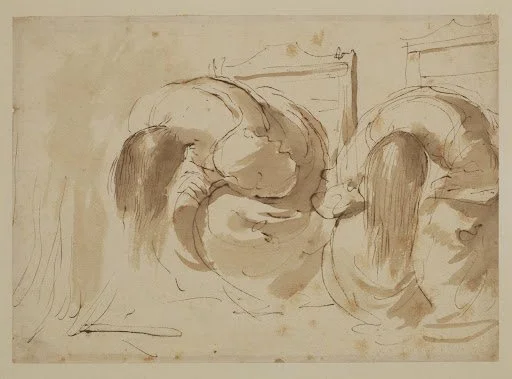
Giovanni Francesco Barbieri, called Guercino, Two seated women drying their hair in front of a fire, c. 1635. Pen and brown ink, brown wash on laid paper, 18.9 x 26.2 cm. Courtauld Gallery, London (Samuel Courtauld Trust). Image courtesy of the Courtauld.
While there is no one definitive ‘smoking gun’ for associating sheets to the Bouverie collection, here are four characteristics to look out for:
A capital B stamp in the corner of the sheet (L. 325). This mark is thought to have been applied to ex-Bouverie drawings before the 1859 sale (see the lower left-hand corner of Amnon and Tamar from the National Gallery of Art, illustrated);
Giovanni Francesco Barbieri, called Guercino, Amnon and Tamar, 1649. Red chalk on laid paper 18.9 x 26.1 cm. National Gallery of Art, Washington DC.
A number written in pencil at the lower left-hand corner of the sheet; possibly an inventory or shelf mark applied by one of the Earls of Gainsborough (see the Saint Francis receiving the stigmata from the Courtauld Gallery, illustrated);
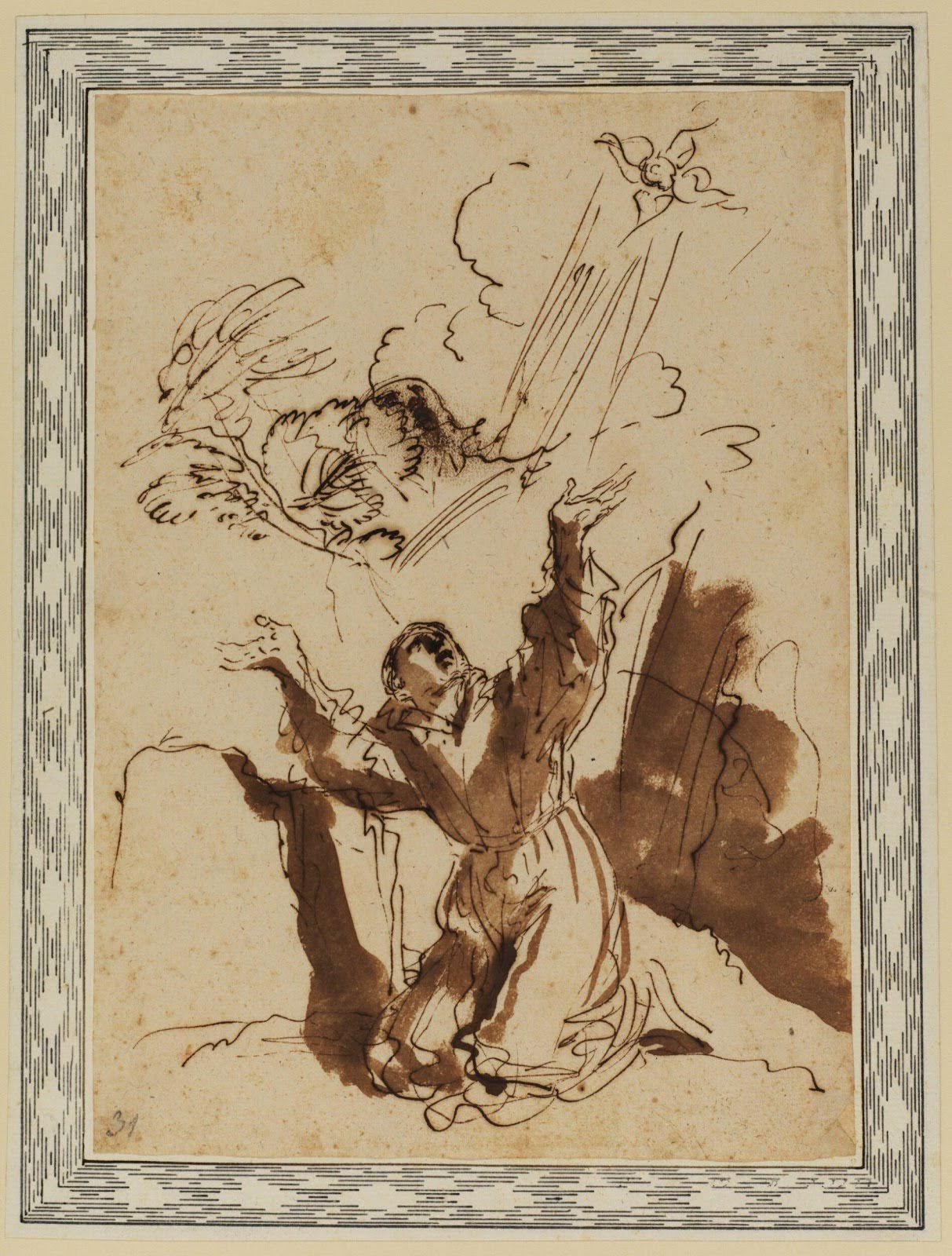
Giovanni Francesco Barbieri, called Guercino, Saint Francis receiving the stigmata, c. 1642. Pen and brown ink, brown wash on laid paper, laid down on a ‘Casa Gennari’ mount , 25.8 x 18.4 cm. Courtauld Gallery, London (Samuel Courtauld Trust). Image courtesy of the Courtauld.
Specifically for Guercino drawings: the presence of a characteristic ‘Casa Gennari’ mount, formerly thought to have been applied directly by the artist’s descendants. The mount is on Italian paper with geometric decorations made with ruled lines of ink (again, see the Courtauld Saint Francis);
The former presence of one of these mounts, indicated by regularly spaced dots of glue residue.
Though the scholarly understanding of Bouverie’s collection has greatly increased in the past few decades, some significant questions about this seminal collector remain wide open, notably around the ‘Casa Gennari’ mounts. Given that these Italian-paper backings are exclusively associated with former Bouverie sheets, one working hypothesis is that John worked with Forni or Bonducci to have them decorated before shipping them to England. However, the lengthy process of decorating each mount with a unique geometric pattern chosen to flatter the drawing seems uncharacteristic of a dealer. Qualcosa non torna, as the Italians would say.
Although there are still several questions left to answer about John Bouverie, the influence of his collection is beyond doubt. A trailblazing trend-setter, Bouverie’s passion for Guercino drawings helped make them a quintessential part of a distinct ‘English taste’, which persisted centuries after the young collector’s untimely death.