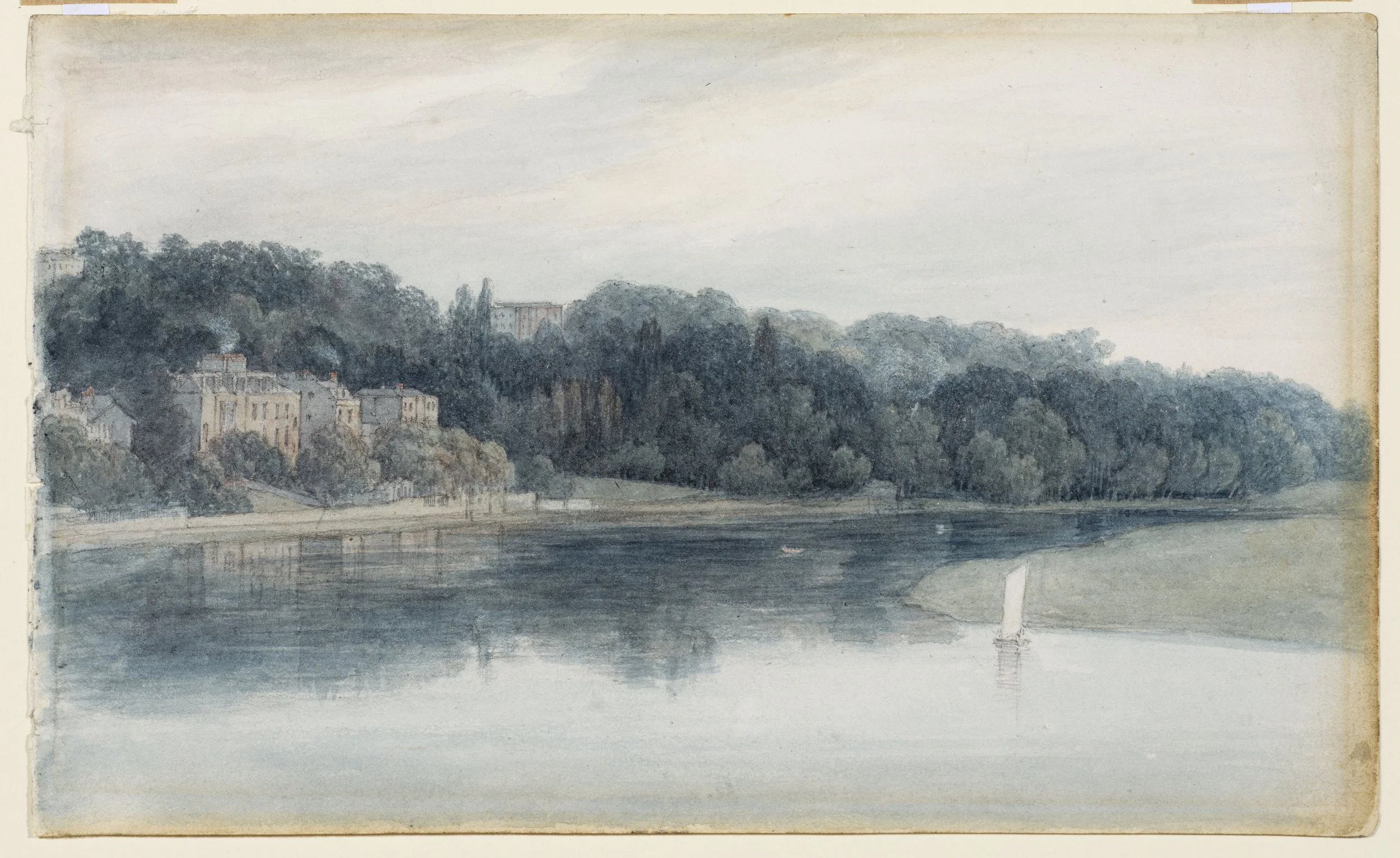
Mary Smirke (1779–1853), The Thames near Richmond
Trois Crayons Magazine, February 2026
Michiel D. van Limborch (c. 1615–1675), Portrait of a Girl, c. 1650/60, Wallraf-Richartz-Museum & Fondation Corboud, Cologne
Detail: infrared reflectogram of the signature
Rachel Sloan, Associate Curator for Works on Paper, the Courtauld Gallery, London, has
chosen our drawing of
the month
Mary Smirke (1779–1853)
The Thames near Richmond, c. 1811
Graphite, watercolour and opaque watercolour on wove paper, 127 x 205 cm. Private collection. Promised gift to the Samuel Courtauld Trust.
It is no easy task to select a single highlight from A View of One’s Own: Landscapes by British Women Artists, 1760-1860 (currently on view in the Gilbert and Ildiko Butler Drawings Gallery at the Courtauld Gallery, through 20 May). The ten artists included in the show all deserve their time in the spotlight, and it is a privilege to be able to share their drawings, which range from private topographical sketchbooks to ambitious exhibition pieces, with the public in some cases, for the first time.
One of the most compelling works in the show, however, is also one of the smallest. This view of a quiet stretch of the Thames west of London by the watercolourist and draughtswoman Mary Smirke possesses wall power in inverse proportion to its diminutive size. When I first opened the mount to examine the drawing, I was surprised to see the remnants of sewing holes along the left margin of the sheet, indicating that this meticulously composed and beautifully realised landscape had been made on a page of a sketchbook – not a format usually associated with highly finished drawings. Yet a sketchbook would have been easy to use in front of the motif, given where the artist placed herself to capture her subject: Smirke must have been working from a boat positioned mid-stream. The pallor of the partly overcast sky and the minimal water traffic – a single sailboat at right, one or perhaps two tiny skiffs further downstream – suggest that she went out early in the day, the better to capture the river at its most tranquil, all the more important as she was most likely working near the Twickenham ferry crossing. (I’m grateful to Julia DeFabo and Andrew Chater of the Orleans House Gallery for their kind assistance in identifying the location, which is rather more built up today.)
On this small sheet, Smirke used correspondingly fine brushes to render the glassy reflections of the river’s surface, the areas of sky visible between wispy clouds – an adroit use of the reserve – and the billowing foliage of the trees lining the left bank. There is something of a miniaturist’s precision and control in her touch, and at the same time an exquisite sense of atmosphere conjured by the translucent blue-grey and green washes. The scene exudes an almost palpable stillness and quiet. This potent combination of remarkable attention to detail and small size likely explains why The Thames near Richmond was hung in the most coveted space in the Royal Academy when it was exhibited there in 1812 – the Great Room.
Mary Smirke had ambitions for her art in a period when the deck was decisively stacked against female artists. She exhibited at the Royal Academy every year between 1809 and 1814, not as an honorary exhibitor, as was common for women at the time, but as a ‘full’ exhibitor, with her address always listed in the back of the catalogue for the benefit of potential buyers. The hobbling of her career follows sadly familiar lines: she ceased exhibiting after 1814 because of increasing domestic responsibilities, although she continued to draw and paint for the rest of her life. It is a truism that many successful historic women artists enjoyed access to training and further opportunities thanks to fathers, brothers and husbands who were artists themselves, but Smirke’s male relatives were as much a hindrance as a help. During her years as an exhibitor her father, the Royal Academician Robert Smirke (1752-1834), served on the hanging committee, something which proved a double-edged sword when, in 1810, he had her work removed from the exhibition because he was dissatisfied with its placement. Never mind that his daughter was thirty-one and had had her work in the Great Room the previous year – as a man, and her father, he had the final say.
It is all the sweeter, then, that despite her father’s actions, Mary Smirke returned to the Royal Academy the following year, and then the year after that, with this exquisite watercolour – and that today, it hangs once again on the walls of the north block of Somerset House, the historic home of the Royal Academy.
A View of One’s Own: Landscapes by British Women Artists, 1760-1860 at the Courtauld Gallery is open until 20 May.