THE EARLY NETHERLANDISH DRAWINGS OF THE BRITISH MUSEUM
Trois Crayons Magazine, April 2026
Olenka Horbatsch and Charlotte Wytema, curators at the British Museum, in conversation with Editor Tom Nevile
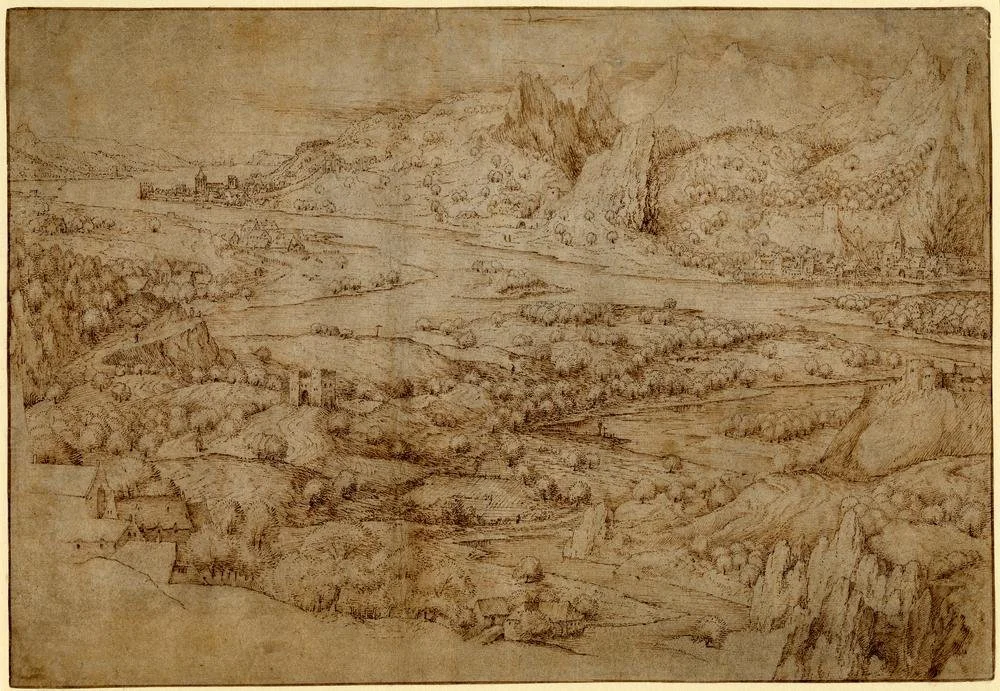
Master of the Mountain Landscapes, Solicitudo Rustica, Alpine landscape with a winding river, study for a print, c.1575-1600. British Museum, London
From 16 April, some 110 drawings from the British Museum’s outstanding collection of early works on paper from the Low Countries go on free public display for the exhibition Early Netherlandish Drawings. The culmination of a five-year research project, the exhibition and its accompanying catalogue chart the development of drawing in the Low Countries before 1600, brilliantly illuminating this still lesser seen area of the Northern Renaissance.
Curators Olenka Horbatsch and Charlotte Wytema join the editor to discuss the history of the collection, the aims of the project and their favourite drawings in the show.
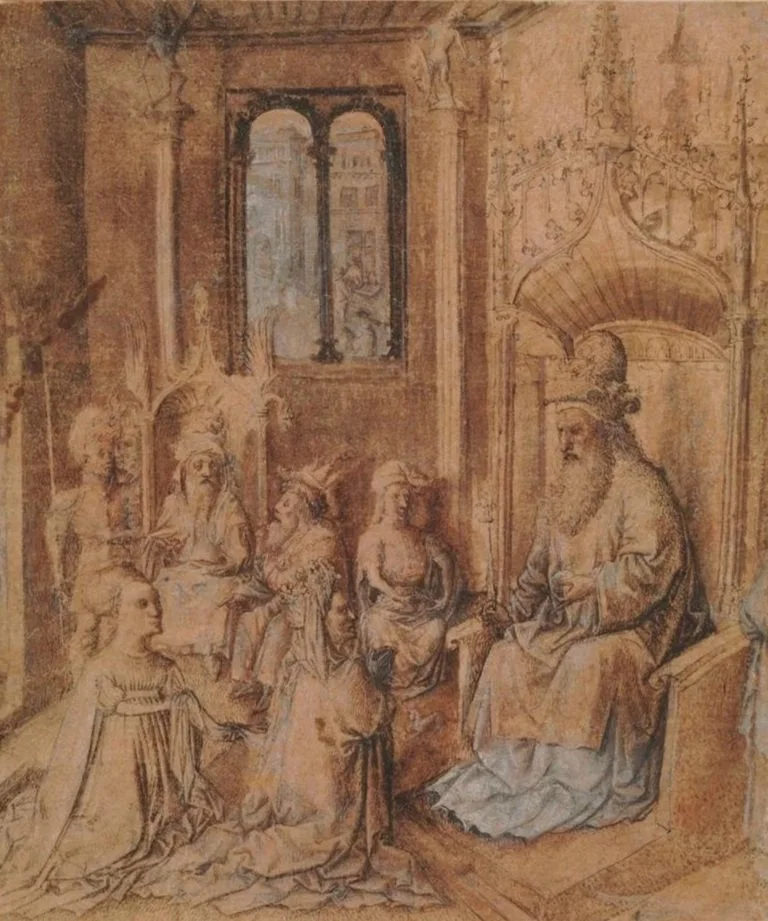
Circle of Barthélemy d’Eyck, Queen Esther before King Ahasuerus, c.1435–1440. British Museum, London
Could you begin by outlining the scale and scope of the museum’s holdings of fifteenth and sixteenth-century Northern drawings, and explain how these works entered the collection?
This exhibition examines Netherlandish drawings from around 1400 to 1600 from the British Museum. The Museum holds one of the greatest collections of works on paper in the world, which includes around 5,000 Dutch and Flemish drawings, and around 1,200 of these are made before 1600. Highlights include drawings by Rogier van der Weyden and his workshop, as well as Lucas van Leyden, Maarten van Heemskerck, Pieter Bruegel the elder and Hendrick Goltzius. The seventeenth-century collection is much better known, and the drawings of Rembrandt and Rubens are rightly celebrated. By contrast, the pre-1600 drawings have received little attention and have not been systematically researched or catalogued since A.E. Popham’s collection catalogue of 1932. Of course, certain drawings are known individually and have been exhibited more recently, but the material hasn’t been studied collectively until now.
The foundation of the Museum’s rich holdings of Netherlandish drawings goes all the way back to Sir Hans Sloane’s founding bequest of 1753. In addition to an important album of drawings by Albrecht Dürer, this included Netherlandish drawings by Jan Gossart, Jan van Scorel, Jan van der Straet, and Bartholomeus Spranger. Since then, the Museum’s collection has been expanded through gifts, bequests and acquisitions. Richard Payne Knight’s bequest of Old Master drawings in 1824 included landscapes by Pieter Bruegel, Gillis van Valckenborch and Joos de Momper. Historic collections purchased by the Museum further strengthened the Netherlandish holdings: Samuel Woodburn’s in the mid-1800s and Colonel John Wingfield Malcolm’s in 1895 were particularly important in this regard.
From the twentieth century to present day, individual drawings have a been acquired through gifts and purchases. Recent important additions include an early drawing connected to Barthélemy d’Eyck (1420–after 1470) in 1978 and an oil sketch by Joachim van Beuckelaer in 1990. We continue to add to the collection when possible: we acquired a beautiful late landscape drawing by Paul Bril in 2021 (supported by the Ottley Group).

Joachim Beuckelaer, Battle scene (Joshua's battle against the five kings to rescue Gideon). British Museum, London
The collection has not been systematically researched or catalogued since A.E. Popham’s collection catalogue in 1932. What did your own research project involve and what were its wider aims?
We selected a representative group of 180 drawings from the collection of Netherlandish drawings comprising over 1,200 sheets. To write a complete collection catalogue would take several decades! The project aims were to establish the materials and techniques of each drawing, to present the artistic and historic context of each drawing in a catalogue entry, and to address broader questions in thematic essays in the book.
The project was a close collaboration with paper conservation from the outset. We began in the conservation studio, and the group of 180 drawings were examined and evaluated by conservators. They provided up-to-date descriptions of the materials and techniques, watermarks (where present) and condition of each sheet. Where possible, drawings stuck down on historic mounts were lifted. Together, we looked at the sheets in transmitted light, raking light, and under low magnification. Any drawings that showed signs of underdrawing were closely examined under higher magnification, and in some cases, when questions remained unanswered, drawings were put forward for further non-invasive scientific analysis. We co-authored an essay in the book about these approaches to the study of drawings.
The group of 180 drawings is incredibly wide-ranging and required different research approaches. Some have an extensive bibliography, while others are virtually unknown. Examining related drawings in other collections was an important component of our research, alongside traditional art history and picture research. We also investigated related media and unearthed connections with manuscripts, tapestry, sculpture and the decorative and applied arts. Additionally, we invited a handful of scholars to examine the drawings with us and to consult on questions of attribution, dating and function. The catalogue entries incorporate the most up-to-date literature, comparative images and ideas.
The exhibition includes some 110 drawings. What curatorial story does it seek to tell? Around which narrative, thematic, or methodological threads has the display been structured?
The exhibition charts the remarkable development of Netherlandish drawing between 1400 and 1600, from preparatory studies in workshops to works of art in their own right. The early history of Netherlandish drawings can be a somewhat fragmented narrative. Fifteenth-century drawings from the region are extremely rare, for they were not collected in this period and were not typically retained beyond the workshop. The situation changed drastically by the mid-sixteenth century, when almost every artist left behind a considerable group of hundreds if not thousands of sheets. Drawings from this period are also more likely to be signed and dated. We adopted two approaches to exhibiting the drawings to account for this change: first chronological, then thematic.
The drawings from the fifteenth and early sixteenth centuries are exhibited chronologically and contextualised within their function in the workshop. Early drawings were made as part of artistic training in the workshop, to record motifs and compositions, and to design works in other media. A few artists are featured for whom a relatively large number of drawings survive, which allows for an in-depth exploration of their workshop: Rogier van der Weyden in Brussels, Jan de Beer in Antwerp, Lucas van Leyden in Leiden and Bernard van Orley in Brussels.
Thematic sections display new subjects and genres which appear in sixteenth-century Netherlandish drawings. The most typically ‘Netherlandish’ subjects derive from the vernacular tradition of proverbs, folk wisdom and festivals, and artists like Hieronymus Bosch and Pieter Bruegel drew from such themes to amuse and inspire moral reflection from their audiences. Landscape drawings can provide vital records of artists’ movements, from northern Europe to further afield. Italy was an important impetus for Netherlandish artists, and artists who travelled to Rome absorbed Italian artistic methods and fused them with local traditions in innovative ways.
The exhibition also examines drawings made as independent works of art and the rising status of the artist in the Low Countries. Artists like Hendrick Goltzius and Jacques de Gheyn II began to use more luxurious materials in their drawings, such as vellum and gold leaf.
From the earliest drawings made around 1410 in the context of manuscript illumination, to large virtuoso ‘pen works’ made as works of art around 1600, the exhibition explores the full range of drawing in the Low Countries throughout these two transformative centuries.
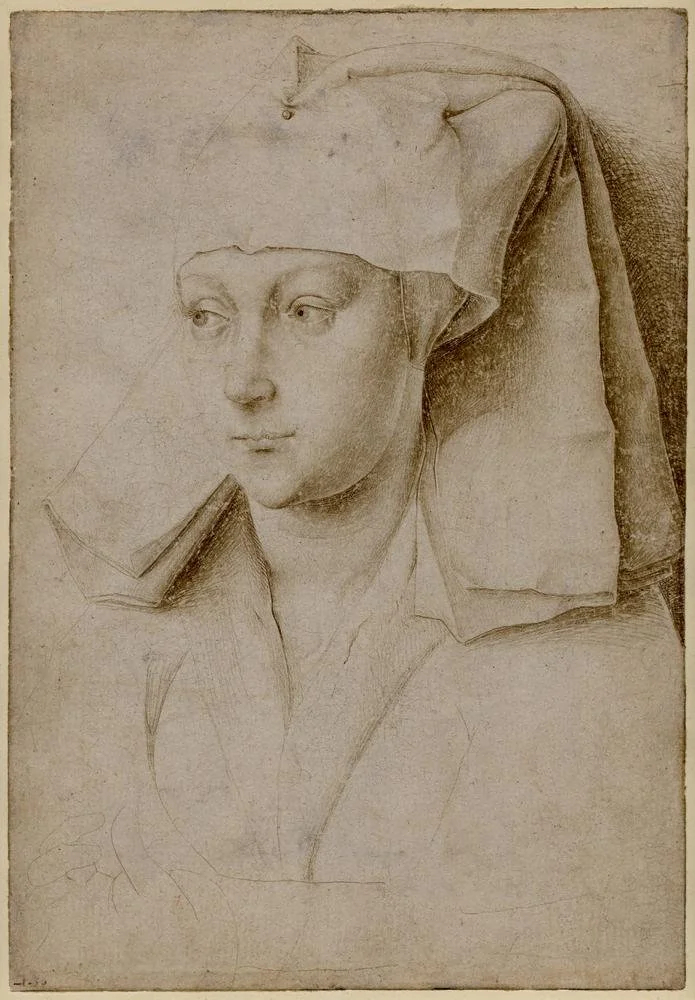
Rogier van der Weyden, Portrait of an unknown young woman, c.1435–1440. British Museum, London
The conservation campaign was evidently a significant component of the project, uncovering historic mounts, investigating inscriptions, and scanning watermarks. What were the most intriguing discoveries to emerge from this scientific process and how did they help to refine both provenance and attribution?
Scientific analysis has enabled us to place an important group of drawings directly in the workshop of Rogier van der Weyden. One of the highlights in the collection is a dazzling silverpoint portrait of a woman of exceptionally high quality. It is the only drawing accepted as by the hand of Rogier himself. There are six further silverpoint drawings associated with Rogier in the collection. Based on quality, one had been attributed to his workshop, four to his circle, and one to a late fifteenth-century follower. Scientific analysis of the drawings (which was carried out in 2017) confirmed that the application of media and composition of papers are nearly identical for all six drawings. This means they were most likely made by different hands in Rogier’s workshop.
Another remarkable discovery emerged through the analysis of the Alpine landscape with a winding river, related to a print designed by Pieter Bruegel. The drawing had been previously attributed to a later imitator of Bruegel, the Master of the Mountain Landscapes, but technical analysis has revealed traces of transfer on the sheet that are consistent with a preparatory print design. The drawing is indented for transfer, and when it was lifted from the old mount, a blackened verso was revealed. Reflectance Transformation Imaging (RTI) showed that the drawing is not only indented along the ink lines, but also with details that only appear in the related print. XRF analysis identified traces of graphite in these lines, most likely from the tool which transferred the drawing. The drawing has now been reattributed to Pieter Bruegel.
Our catalogue includes accurate material descriptions, including watermarks, as well as provenance details. It is our hope that it will lead to further discoveries as more collections undergo technical imaging.
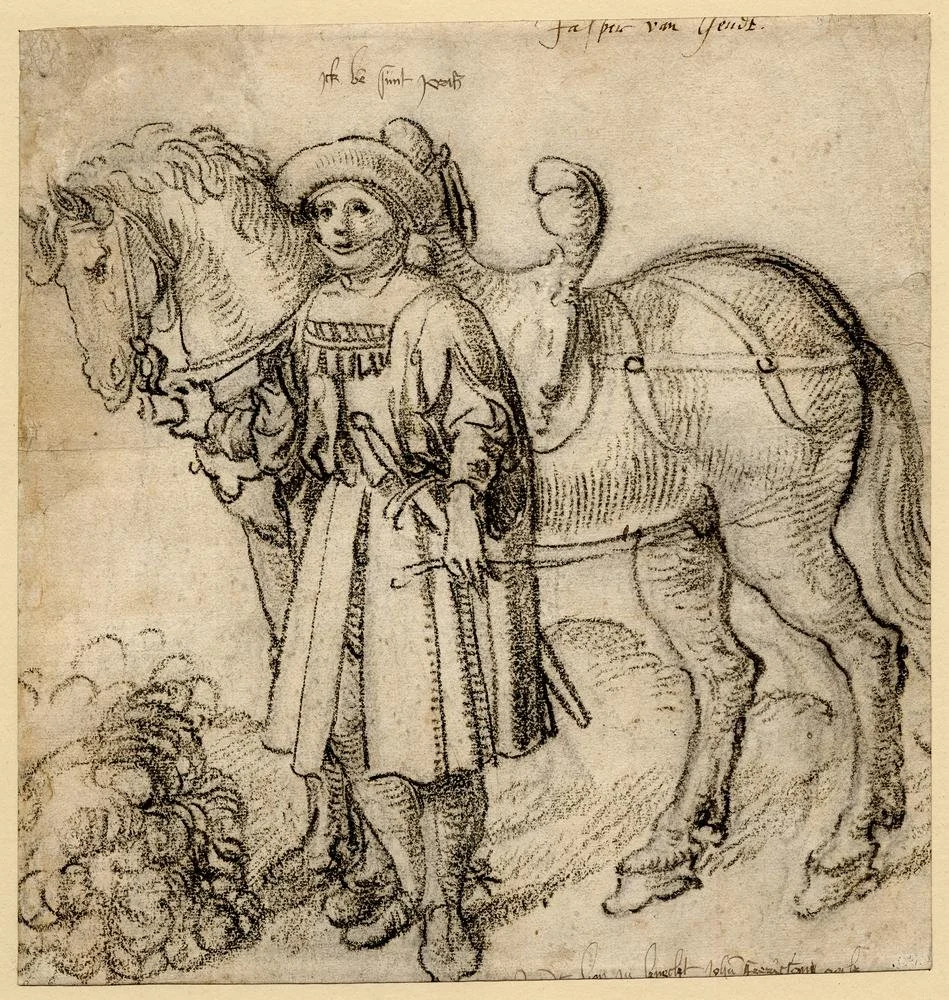
Netherlandish, A squire holding a horse, c.1520. British Museum, London
Beyond the scientific approach, was a more traditional ‘connoisseurial’ methodology utilised and did this process yield any unexpected findings or generate new attributions that are being presented to the public for the first time?
This drawing of a squire standing beside his horse was previously placed in the German school and assigned to Hans Burgkmair. Popham moved it to the Netherlandish school, based on two early sixteenth-century Dutch inscriptions on the sheet, and attributed it to the northern Netherlandish ‘Master of the Miracles of the Apostle.’ It is a remarkably accomplished drawing and has been largely overlooked until now. We discussed the drawing with several scholars and curators, and although we do not have a new name to offer, it seems to have originated in Leiden in the 1520s.
Two remarkable portrait drawings in red chalk have now been reattributed to Jan Cornelisz. Vermeyen. One is particularly striking and seems to have been drawn from life. Red chalk was still a relatively uncommon drawing medium in the Low Countries, and it was only used by artists who had knowledge of Italian artistic traditions. Ilja Veldman helped us to attribute the two portraits to Vermeyen, who is known to have made similar portrait etchings, and who likely picked up the use of red chalk during his trip to Rome with Charles V in April 1536.
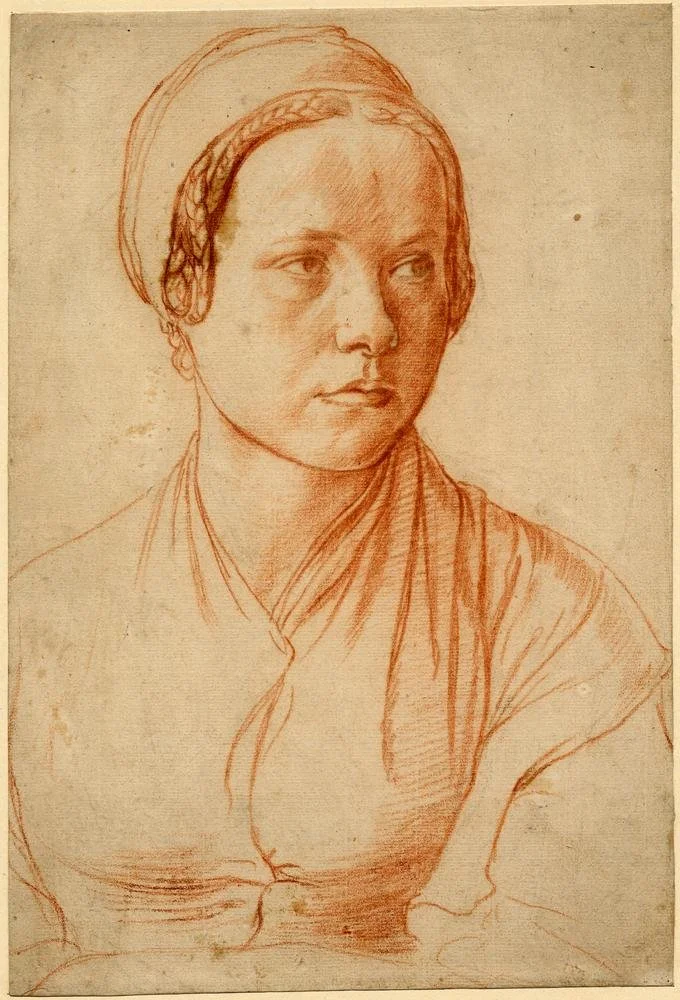
Jan Cornelisz. Vermeyen, Portrait of an unknown girl, c.1510–1562. British Museum, London
Over the last generation, there have been relatively few exhibitions devoted specifically to fifteenth-century Northern drawings. Do you see that relative scarcity as a challenge or an opportunity? Has there been a strong scholarly community around this material?
Fifteenth-century northern drawings are rare and scattered so exhibitions are few. This is an exciting opportunity to display fifteenth- and sixteenth-century drawings together, to show how the tradition developed and transformed. We hope it will instigate interest in this area, and we’ve put together a public programme of talks, workshops and a scholarly symposium to appeal to a wide range of audiences.
Fifteenth-century Netherlandish drawings are the domain of a selected few specialists, who have kindly offered their expertise during our project. Since fifteenth- and early sixteenth-century Netherlandish drawings were made in the workshop, the relationship with other media is particularly important. We’ve had to branch out and engage a wider scholarly community of experts in paintings, sculpture, manuscripts, tapestry and painted and stained glass, who have patiently answered our many queries.
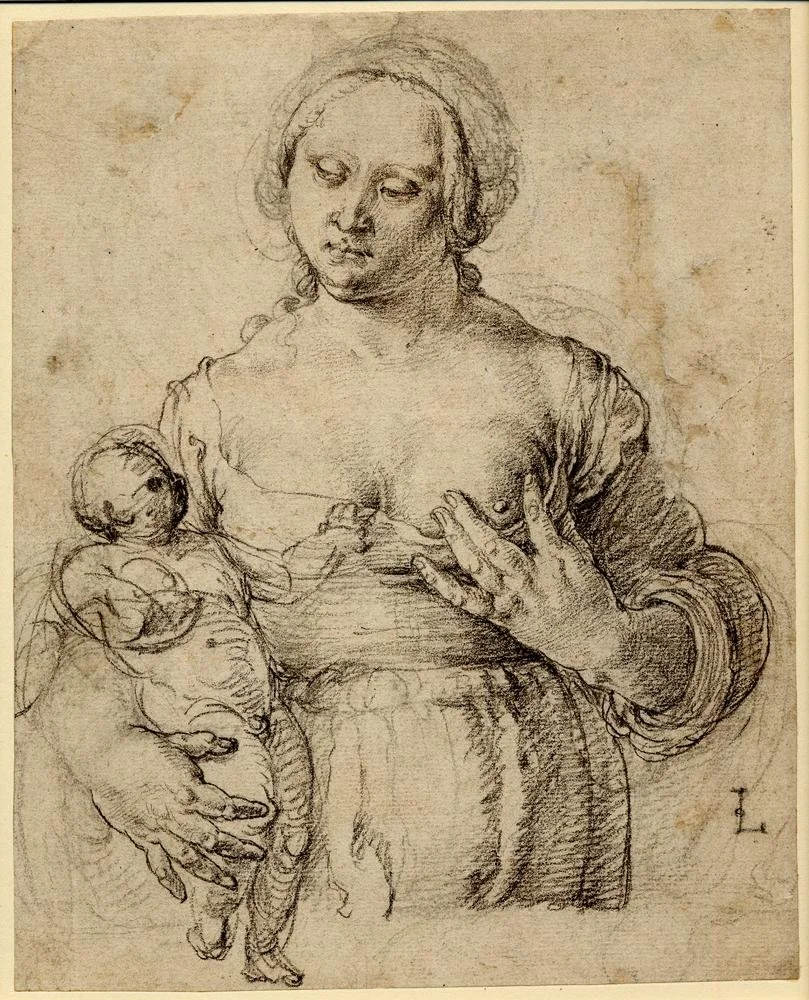
Lucas van Leyden, The Virgin, c. 1528. British Museum, London
Finally, if you had to choose a favourite drawing from the exhibition, which would it be, and why?
Charlotte: Rogier van der Weyden’s exquisite silverpoint drawing of a young woman has been one of my favourite works in the British Museum’s collection since I was a student. However, it now has serious competition with Jan Cornelisz. Vermeyen’s striking red-chalk portrait of a young woman, which I have grown to love while working on this project. It is sensitively observed and so tenderly put to paper.
Olenka: Lucas van Leyden is my favourite artist, and I hope this exhibition will make him a household name. We had a lot of fun trying to determine whether this figure is writing or drawing. But my absolute favourite is his preparatory drawing of the Virgin and Child for a painting – the exquisite shading on the Virgin’s hand in contrast to the quickly and energetically drawn child is divine.
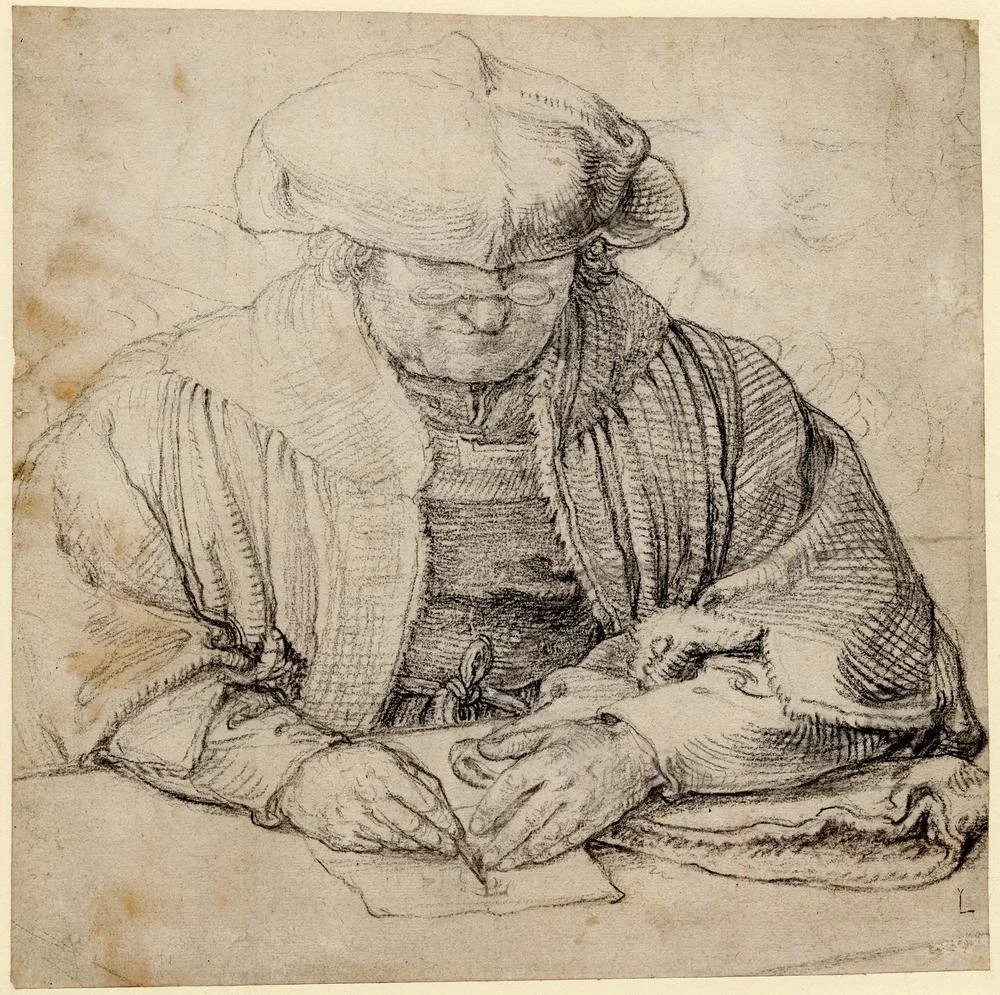
Lucas van Leyden, An old man drawing, c.1512
Early Netherlandish drawings is open until 20 September 2026 at The British Museum, Room 90. Free Entry.
All images: courtesy of The British Museum
© The Trustees of The British Museum. Shared under a Creative Commons Attribution-NonCommercial-ShareAlike 4.0 International (CC BY-NC-SA 4.0) licence.