Jacques de Gheyn II (1565–1629), Four studies of a nude woman combing her hair, 1602–1603
Trois Crayons Magazine, April 2026
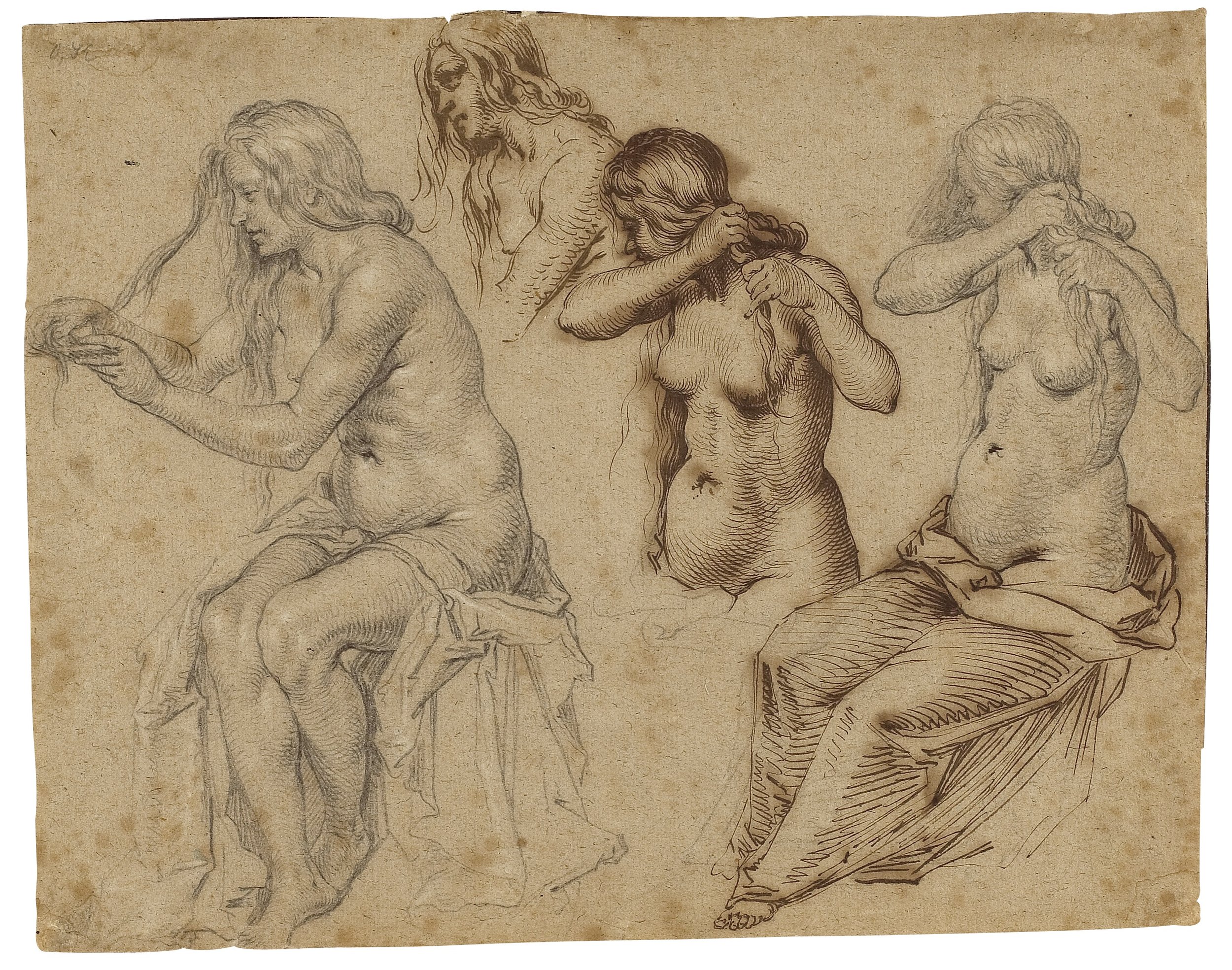
Jacques de Gheyn II (1565–1629), Four studies of a nude woman combing her hair, 1602–1603, Royal Museums of Fine Arts of Belgium, Brussels, inv. no.: 4060/1346
Jane Simpkiss, curator at Compton Verney, Warwickshire, has chosen our drawing of the month.
Four studies of a nude woman combing her hair, 1602–1603
Black chalk, pen and iron gall ink, partly over a first sketch in black chalk, heightened with white chalk on beige-grey coarse-grained paper, 259/263 × 330/335 mm (irregular edges), Royal Museums of Fine Arts of Belgium, Brussels, Inv. 4060/1346
Time seems to fall away when I look at Jacques de Gheyn II’s (1565–1629) studies of a nude woman combing her hair. It is currently on display in Compton Verney’s latest exhibition Bruegel to Rembrandt: Drawing Life, Sketching Wonder, one of over 65 drawings on loan from the Royal Museum of Fine Arts in Brussels, most of which are in the UK for the first time ever. Whilst these drawings offer visitors a glimpse into the creativity of artists working in the 16th- and 17th-century Netherlands, De Gheyn’s sheet has a universal and timeless quality. Many of us can relate to the intense focus needed when detangling or braiding our hair – this could easily be a woman from today, who has just hopped out of the shower.
Of course, the subject of De Gheyn’s study is not a woman he has stumbled upon during a quiet moment of self-care, but most likely a model who has been staged to allow him to practice sketching from life. Having imbibed the importance of direct observation from his master Hendrick Goltzius (1558–1617), De Gheyn moved away from his earlier decorative, mannerist style and began depicting more realistic figures. The woman here does not appear obviously posed but instead exudes a warmth and simplicity that seems relatable, and her limbs are not elongated or overly muscled and shaped. The model sits naked except for a sheet draped over her lap - the studies are intimate but not eroticised and whilst the artist captures his subject’s quiet focus, he is not a voyeur.
De Gheyn was the first artist in the Northern Netherlands to produce studies of naturalistic nudes, of which this is one, working in this vein from the 1600s onwards. It seems highly probable that the drawings on furthest left and furthest right of this sheet were drawn from life, whilst the two innermost drawings are copies after them respectively, something suggested by the spacing of the drawings on the page.
De Gheyn likely drew the sketch on the furthest left first, then the bust copy, followed by the sketch to the furthest right, finally squeezing in the drawing second from the right. The cross hatching, particularly on the belly and legs, highlights De Gheyn’s familiarity and skill with the techniques of engraving, where cross hatching was often used. De Gheyn experiments with rendering the model’s curves with different materials, starting with softer strokes of black chalk (with white for highlights) and then considering how to evoke the same volume, for both flesh and fabric, with pen and ink, in one instance combining the two in one sketch.
To date, we do not know of any paintings or engravings that these drawings relate to and, therefore, the drawing may have been made for its own sake, as a study or exercise. De Gheyn made several nude studies, some of which undoubtedly represent the same model seen here. This realistic and detailed representation of a domestic scene links back to the art of Albrecht Dürer (1471–1528) and Pieter Bruegel the Elder (c. 1527–1569) as well as prefiguring the naturalism of Rembrandt (1606–1669). Within the exhibition, we have been able to draw an interesting connection between De Gheyn’s work and later depictions by Rembrandt’s followers, including Ferdinand Bol (1616–1680), who were also captivated by intimate scenes of women – one looks in the mirror whilst adjusting an earring, the other stretches amongst a tangle of sheets in bed.
One of the recurring threads running through Bruegel to Rembrandt is the tension that exists between the real and the imagined and how draughtsmen in this period combined their experiences and sketches of the real world with their wide-ranging imagination. De Gheyn’s drawing here feels like the perfect combination of hand, mind and eye. Looking at the drawing, we can easily suspend our disbelief and imagine that rather than a study after an artificial set-up, we are, in fact, catching a rare snapshot of life over 400 years ago, which is testament to the continuity of human nature and experience.
Bruegel to Rembrandt: Drawing Life, Sketching Wonder is open at Compton Verney until 28 June.