
Reviews #27
Monday, 1 December 2025. Newsletter 27..
Michelangelo and Men
(15 October 2025 – 25 January 2026)
Teylers Museum, Haarlem
Jasmine Clark, PhD
‘Michelangelo and Men’, held at the Teylers Museum in Haarlem and curated by Terry van Druten, is an ambitious exhibition of firsts. It delves into a topic long dismissed by generations of scholars: the centrality of men in the art and life of Michelangelo Buonarroti (1475–1564). From the historic treatment of Michelangelo’s homosexuality to his revolutionary artworks that repeatedly returned to the male form, no exhibition until now has been entirely devoted to this subject.
Rather than focusing on biography alone, this intimate show offers a more nuanced exploration of the artist’s complex relationship with masculinity through drawing. It moves between Michelangelo’s engagement with the work of earlier and contemporary artists, his responses to antiquity, extensive anatomical knowledge and reliance on models, his idealised and spiritualised conception of the male body, and the relationships that shaped his life. The result is a thoughtful interrogation of the social, theoretical, and theological frameworks that forged Michelangelo’s vision of men.
The Teylers Museum proves a fitting venue for this exploration. Its remarkable group of twenty-two Michelangelo drawings, acquired by the museum from Rome in 1790, forms the heart of the display. These are joined by forty loans from over twenty institutions, which include drawings, sculptures, letters, prints, and a book. Among them, the Apollo–David (c. 1530) is a true triumph, lent by the Museo Nazionale del Bargello. It is the first time a marble sculpture by Michelangelo has been exhibited in the Netherlands, marking an extraordinary moment for Dutch audiences and viewers outside of Italy.
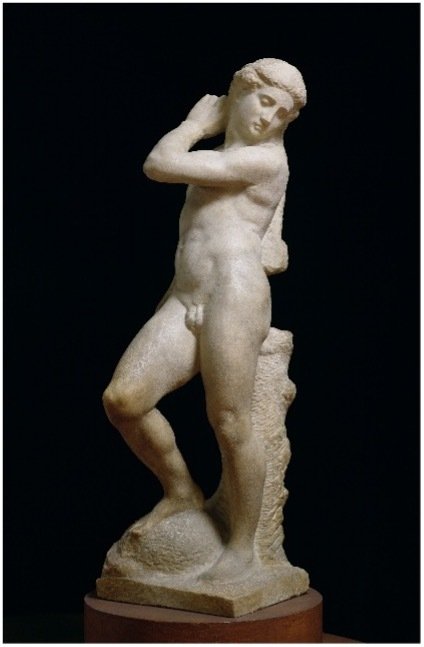
Michelangelo Buonarroti (1475–1564), Apollo-David, c.1530, marble, Museo Nazionale del Bargello, Florence
Stemming from the mind of Dutch architect Afaina de Jong, the exhibition’s design refreshingly departs from the usual sobriety of shows on Old Master drawings. Contemporary mint-green walls and sculptural, oval apertures cut into the gallery partitions create striking visual sightlines, prompting unexpected juxtapositions. Even the typography of the wall text titles is playfully formed from contorted bodies. From the very outset these choices invite visitors to look at Michelangelo afresh.
Six thematic categories structure the exhibition: ‘Larger than Life’, ‘Influential Bodies’, ‘Building the Body’, ‘Male and Female’, ‘The Divine Body’, and ‘Friendship and Love’. The opening section traces the foundations for Michelangelo’s ideal male body, beginning with A Male Nude (after Masaccio) (c. 1492–1496) which sold at Christie’s for a record-breaking $23.16 million in 2022. Driven by an almost forensic curiosity, Michelangelo scrutinised antique sculpture, contemporary artworks, living models, and crucially dissected human bodies to understand anatomy from within. The drawings assembled here make that process abundantly clear; a red chalk nude from the Royal Collection, marked with proportional annotations, expresses the symbiosis of accuracy and exaggeration that truly made Michelangelo’s figures “larger than life”.
Equally compelling in ‘Influential Bodies’ are the black chalk workshop studies for the Battle of Cascina (1504) from the Teylers, displayed beside the copy of the Bathers (c. 1542) by Bastiano da Sangallo (1481–1551) from Holkam Hall. Here, the male body becomes a theatre of movement where soldiers brace, twist, and strain in rapid, muscular inventions, the drawings an exploratory archive of their limbs and torsos. Nearby engravings by Marcantonio Raimondi (c. 1480–1530) and Agostino Veneziano (c. 1490–1540) attest to the cartoon’s early fame within and beyond Florence, a city eager to see itself reflected in monumental, heroic nudity.
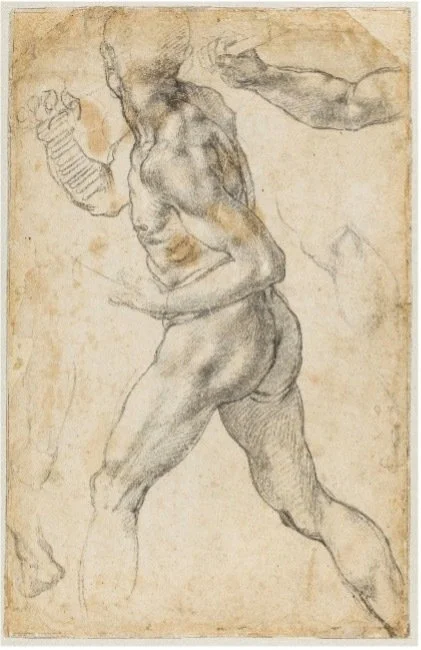
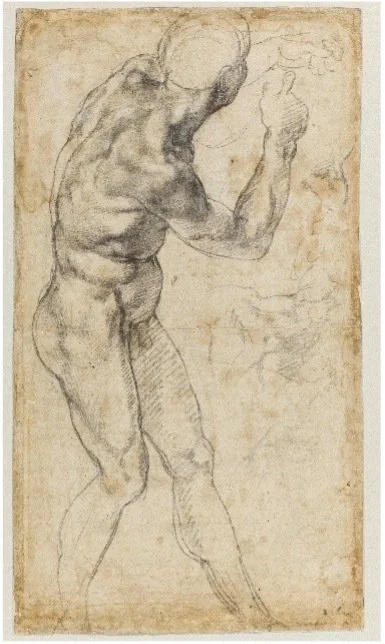
Michelangelo Buonarroti (1475–1564), Studies of a Male Nude for the Battle of Cascina, 1504, black chalk, white heightening on paper, Teylers Museum.
Shortly after the Cascina commission, Michelangelo most famously painted the Sistine Chapel in Rome, where his newly created Adam embodied divine perfection in human form. Visitors gain further insight into Michelangelo’s use of live models for such commissions in ‘Building the Body’. Many surviving sheets are fragmentary, yet their incompletion is informative. Models were held in position by ropes or supports as complex poses and gestures were clarified independently. What emerges from sheets like the Teylers’ Studies for Haman (c. 1511), the British Museum’s Study for Adam (c. 1511), and the Uffizi’s Studies for Night (1524) is Michelangelo’s sustained observation of the body, and his vigorous modelling to reveal contour.
Michelangelo also played with gendered bodies, a theme examined next in ‘Male and Female’. His women often possess masculine or androgynous characteristics, a deliberate decision that endowed biblical and mythological figures with heightened grandeur or mystery, as well as reflecting the realities of using male models. The celebrated Studies for the Libyan Sibyl for the Sistine Ceiling (c. 1511) from The Metropolitan Museum of Art – shown for the first time in the Netherlands – captures this dynamic in soft black chalk. Seen beside the Teylers’ Study for Hebe (c. 1518) by Raphael (1483–1520), the formidable presence of Michelangelo’s women becomes unmistakeable, particularly in Cornelis Bos’s (1506/10–1555) engraving of Leda and the Swan (1544–1545), after Michelangelo, and a small nineteenth-century plaster copy of Night from the Maastricht Institute of Arts.
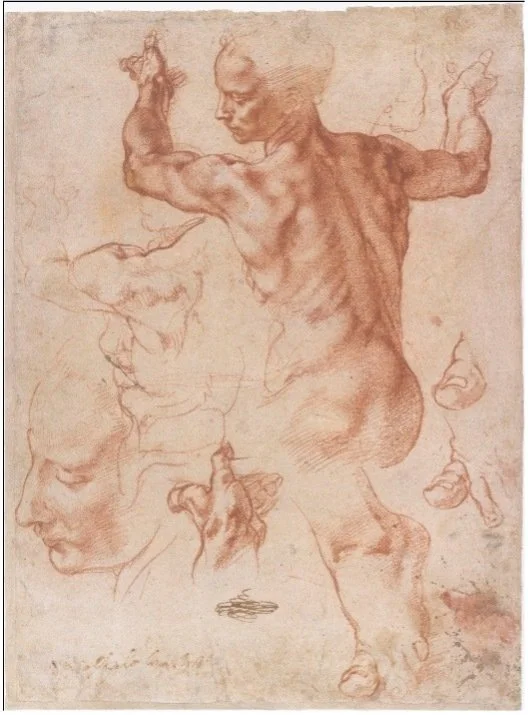
Michelangelo Buonarroti (1475–1564), Studies for the Libyan Sibyl for the Sistine Ceiling, c. 1511, red chalk, white chalk on paper, The Metropolitan Museum of Art, New York.
In ‘The Divine Body’, a small wooden Study for a Crucifixion (c. 1562–1563) from Casa Buonarroti, attributed to Michelangelo, expands upon the artist’s fascination with the spiritual potential of the male form. For Michelangelo, discovery was inseparable from creation; the form already lived within the material, waiting to be revealed. His depictions of Christ shown in this section diverge from his other ideal bodies, as gentler, more vulnerable, expressions of a profound personal devotion.
The exhibition culminates in a separate room on ‘Friendship and Love’, a sensitive exploration of Michelangelo’s closest attachments. Letters, poems, and drawings reveal the emotional intensity of his relationships, especially with younger men like the Florentine noble Andrea Quaratesi. Daniele da Volterra’s (1509–1566) informal Portrait of Michelangelo (1547– c. 1553) from the Teylers presents the artist not as a colossal figure of legend, but as a sitter seen through the eyes of a friend. In this final room, the display of the Apollo–David sculpture at a lowered height with soft lighting transforms it into an object of quiet longing. It concludes with The Dream [il Sogno] (c. 1533) from the Courtauld, the most elaborately worked sheet Michelangelo ever produced, saturated with Neoplatonic reflections on desire, beauty, and morality.
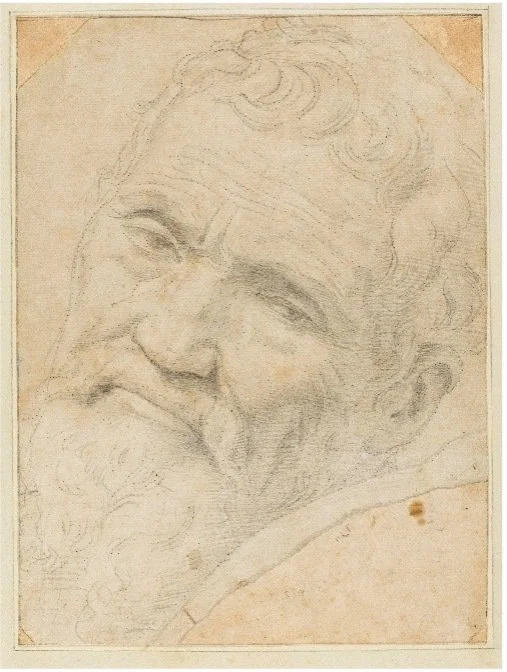
Daniele da Volterra (1509–1566), Portrait of Michelangelo, 1547–c. 1553, metalpoint and black chalk, white heightening, on pricked paper, Collection Teylers Museum.
Commemorating the 550th anniversary of Michelangelo’s birth, the exhibition offers a singular opportunity to encounter an unprecedented assembly of his works in the Netherlands. It speaks to specialists and general audiences alike. While contemporary voices respond to Michelangelo’s work on the audio guide, the accompanying catalogue essays – by Michael Rocke, Raymond Carlson, Eric Boot, Marieke van den Doel, Jennifer Sliwka, Paul Joannides, Terry van Druten, and guest curators Klazina Botke and Martin Gayford – extend the exhibition’s scholarship to confront the contradictions of sexuality, faith, tolerance, and artistic aspiration in sixteenth-century Florence. Through its innovative design and fresh curatorial approach, the exhibition ultimately delivers an exciting reappraisal of Michelangelo and his men.
The exhibition Michelangelo and Men continues at Teylers Museum until January 25.