
Demystifying Drawings #27
Monday, 1 December 2025. Newsletter 27.
Collector Portraits: Giorgio Vasari
Daniel Lowe, contributing editor
ariette mounts, Lanier stamps, Gainsborough numbering, inscriptions by ‘the reliable Venetian hand’, snipped-off top corners: studying the collecting and display history of drawings can be one of the most rewarding yet most daunting aspects of their study.
This occasional mini-series dedicated to drawings collectors will question how the practice of amassing works on paper has enriched and challenged the study of this field. What is the ‘allure’ of collecting objects that were once largely considered merely practical tools rather than works in their own right? How have seminal collectors (and their collections) informed the way we view and study drawings today?
Many collectors would make an excellent (re)introduction to such a broad topic, but Giorgio Vasari (1511-1574) and his so-called Libro de’ disegni seemed particularly suitable to the task. The collecting activity of this much-admired and sometimes maligned Tuscan polymath was the focus of an exhibition held at the Louvre and the Nationalmuseum (Stockholm) in 2022, as well as earlier studies by Hellmut Wohl (1986), Licia Ragghianti Collobi (1974), and Otto Kurz (1937), amongst others.
Although Vasari was a highly productive painter and architect, his collection of artist biographies, the Vite de’ più eccellenti pittori, scultori, e architettori (Lives of the Most Excellent Painters, Sculptors, and Architects) has been his most consequential theoretical and art-historical work, informing every aspect of his activity – including his collecting habits.
Initially published in 1550, then re-issued in a heavily revised and expanded format in 1568, the Vite presents the arts of painting, sculpture, and architecture as derived from a singular artistic faculty, which Vasari called disegno:
As there arises a certain notion and judgment which forms in the mind that which, when expressed with the hands, is called disegno, one many conclude that this disegno is nothing other than a visible expression and declaration of one’s mind, or of that which others have imagined in their minds.
- Vasari, Vite, G I.43 (translation by C. Fryklund in Paris-Stockholm 2022, p. 25; with modifications by the author)
Referring to an artist’s capacity of abstraction and inventiveness, the concept of disegno was a founding principle of Vasari’s intellectual activity. Viewed as the most direct and intimate testament of disegno, drawings were pivotal in helping Vasari illustrate the development and improvement of this faculty from the thirteenth century to his lifetime.
The artist avidly and widely collected sheets and had them mounted into his Libro de’ disegni, a bound volume expressly made to mirror the development of the Vite. It is known that Vasari sourced many drawings directly from artists and their descendants, such as a small corpus of thirteenth- and fourteenth-century sheets from Vittorio Ghiberti, the great-grandson of Lorenzo Ghiberti. As Vasari makes no mention of the Libro in the 1550 edition of the Vite, it is likely that a portion of his drawings collection was initially bound into the Libro sometime after this date.
From Vasari’s frequent references to the Libro in the second edition of the Vite, we know his collection contained drawings thought to be by Cimabue, Giotto, Luca Della Robbia, Andrea Mantegna, Domenico Ghirlandaio, Fra Bartolomeo, Leonardo, and many more cardinal figures of Italian art from the Duecento to the Cinquecento. After Vasari’s death in 1574, the Libro passed to his heirs, who quickly surrendered the book to Grand Duke Ferdinando I of Tuscany. From this point, all mentions of the Libro cease, leading to the speculation that the collection was unbound and dispersed shortly after the donation.
Various attempts have been made to reconstruct Vasari’s lost drawings collection, not without difficulty. Since Pierre-Jean Mariette’s first reconstruction of the Libro in 1730, it was thought that various sheets could be associated with Vasari by the presence of a characteristic support (Figs. 1-2). These so-called ‘Vasari mounts’, which feature pen-and-wash architectural designs with typically Florentine embellishments (masks, herms, vases), are now thought to have belonged not to their namesake, but to the Florentine nobleman Niccolò Gaddi (1537-1591). Gaddi was likely well-acquainted with Vasari’s drawings collection and may have taken direct inspiration from it: the nobleman possessed at least one drawing formerly in the Libro – Giulio Romano’s Fall of Icarus, now at the Louvre (inv. 3499).

Fig. 1. Page from the collection of Niccolò Gaddi (so-called ‘Vasari Page’). Drawings by Raffaellino del Garbo, Sandro Botticelli, and Filippino Lippi, mount by the ‘Chief Framer’ (anonymous Florentine artist, 16th century). 56.7 x 45.7 cm. National Gallery of Art, Washington, inv. 1991.190.1

Fig. 2. Verso of Figure 1
The erroneous association of the ‘Vasari mounts’ was initially theorised by Arthur Ewart Popham and Philip Pouncey in 1950, who noted the Gaddi family impresa – a phoenix or falcon with the motto ‘TANT CHE GIE VIVRAI’ [‘as long as I’ll live’] – on presumed Libro drawings at the British Museum (inv. 1860,0616.49) and the Louvre (inv. 3573). Research conducted for the 2022 Paris-Stockholm exhibition massively expanded this theory, extending it to nearly all of the mounted sheets traditionally associated with Vasari, not just those that bear the Gaddi impresa.
Today only very few sheets can be confidently deemed to have formed part of the Libro. These consist of drawings that can be successfully cross-referenced with mentions in the Vite or other historical documents (no more than twenty), those that bear mount designs certainly ascribable to Vasari or his circle (about nine, including Fig. 3), or those that can be associated to extant drawings used to make the woodcut portraits which preface each artist biography in the second edition of the Vite.
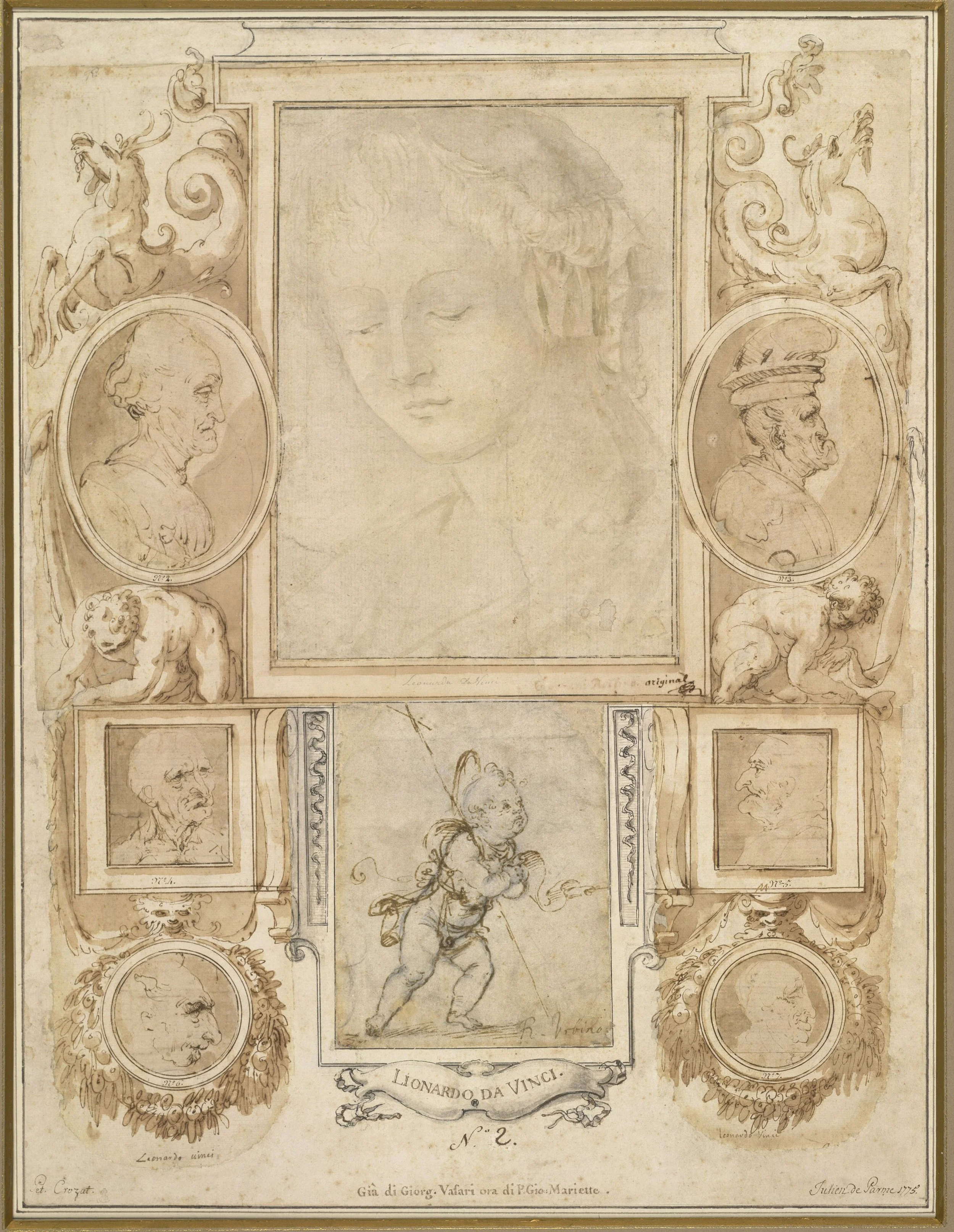
Fig. 3. Page from the Libro of Giorgio Vasari. Drawings by Leonardo da Vinci (Head studies, copies after), and Francesco Granacci (Saint John the Baptist) mount made for Giorgio Vasari by Jacopo Zucchi, with later modifications by Pierre-Jean Mariette. 49.3 x 37.3 cm. Albertina, Vienna, inv. 14179
Even after the radical (and absolutely necessary) reduction in confirmed Vasari drawings after 2022, the seminal nature of his collection has largely endured. Though the artist’s use of his sheets to prove his theory of the constant ‘betterment’ of art has largely fallen out of fashion today, his ideas concerning disegno still have great currency in the common conscience of collectors and enthusiasts. Whether attentively gazing at a Michelangelo drawing at an exhibition or questioning the attribution of a Dutch landscape in a print room, the implicit thirst of many drawings devotees to be better acquainted with the artist’s mind (their disegno) through drawings persists to this day. Conversely, those wishing to pursue different approaches to drawings (anthropological, social, technical) constantly grapple with Vasarian assumptions and impositions. Though it may have been dismembered more than four-hundred years ago, the spectre of Vasari’s Libro is still very much intact: we carry and contend with it wherever we go.