Fondation Custodia, Paris
17 October 2026 – 17 January 2027
Trois Crayons Magazine, November 2026
Previewed by Laurence Lhinares, curator and research associate at the Fondation Custodia, Paris
At the Fondation Custodia in Paris, a new exhibition explores nineteenth-century French artists’ drawings collections, revealing friendship, admiration and artistic exchange. For this month’s Preview, the exhibition curator, Laurence Lhinares, joins the editor to discuss the history of artists as collectors, artistic kinship, and unexpected associations.
TN: From Giorgio Vasari and Jonathan Richardson to the traditional album amicorum, artist-collectors occupy a significant place in the history of drawings collecting. In nineteenth-century France, however, personal exchanges between artists surged dramatically. How and why did artists’ collecting practices evolve during this uniquely fertile period?
LL: In the nineteenth century, collecting took on a new dimension against a particularly favourable backdrop, marked by a boom in artistic production and the art market. The creation of the Musée du Luxembourg, dedicated to contemporary art, the popularity of visits to artists’ studios and galleries, and the central role of the Paris Salon all contributed to this craze. In the middle of the century, the opening of the Hôtel Drouot, which succeeded the auction houses on the Place de la Bourse and the Rue des Jeûneurs, encouraged a proliferation of sales and the growing prominence of modern art. Modern drawing benefited from this effervescence: more frequently offered as a gift, exchanged or sold than a painting or sculpture, it found its way into artists’ portfolios or onto the walls of their studios or homes. Artists fully understood a drawing’s value and assembled collections that reflected their personal taste and their friendships with fellow artists.
TN: Could you walk us through the layout and structure of the exhibition? Around which narrative or social threads – from the Villa Medici in Rome to the studios of Paris – has the display been curated?
LL: The exhibition opens with souvenirs of friendship and collaboration preserved by painters, sculptors, printmakers, architects and musicians. We then explore bonds of loyalty through sheets kept by artists who belonged to the same circle of friends or pursued similar artistic paths. A specific section is devoted to the two great artists of the century, Ingres and Delacroix. The exhibition concludes with a presentation of a number of artists who assembled significant collections of drawings by their contemporaries, including Léon Bonnat and Edgar Degas. We present an intimate history of drawing in nineteenth-century France, rich in anecdotes, personal stories, enthusiasm, admiration and friendship.
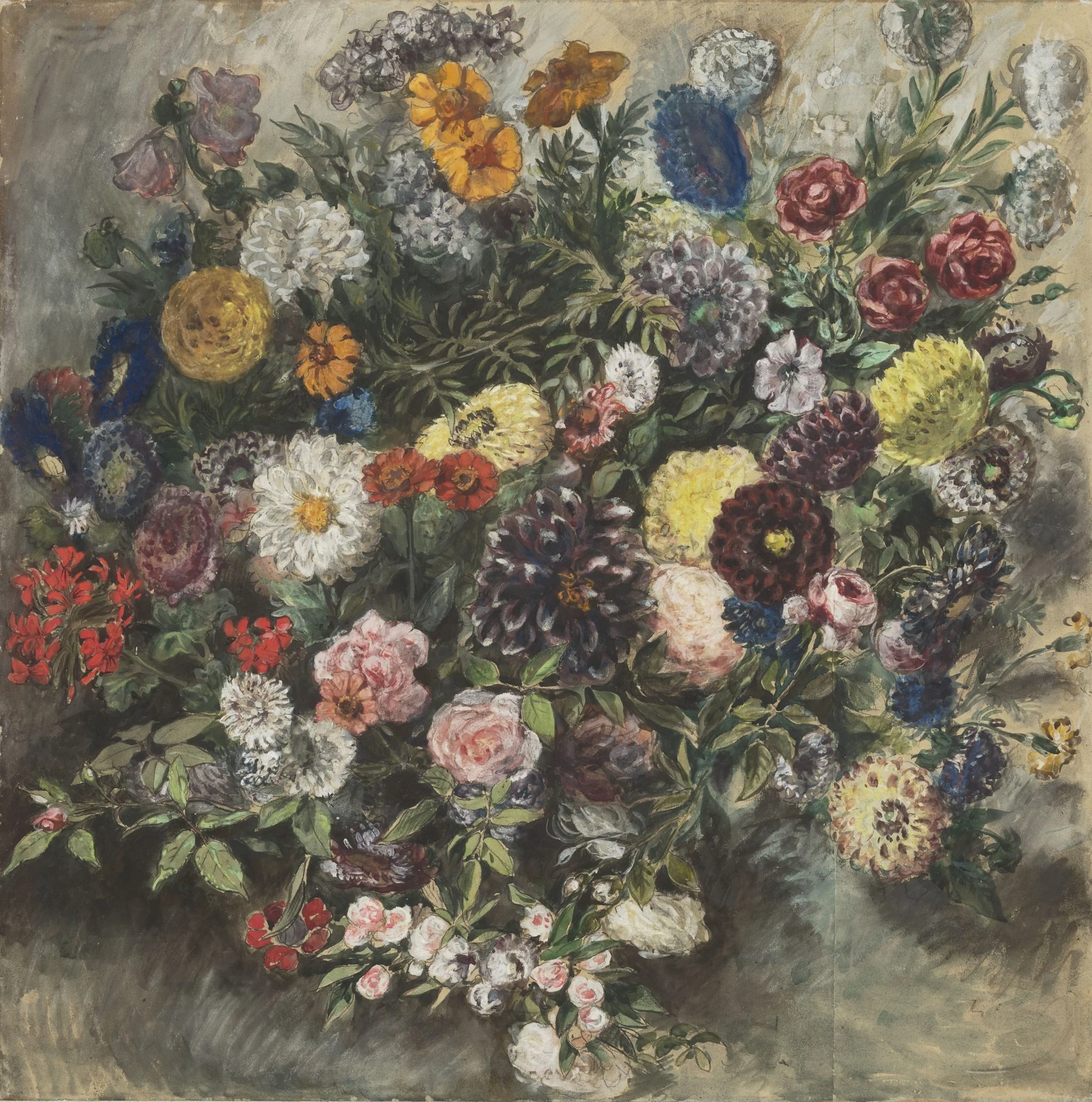
Eugène Delacroix (1798–1863), A Bouquet of Flowers, c. 1849–1850, Musée du Louvre, Paris, inv. RF 31 719 © GrandPalaisRmn (musée du Louvre) / Michel Urtado. Formerly owned by Paul Cézanne (1839–1906)
TN: The exhibition reunites nearly 100 works from the Frits Lugt Collection at the Fondation Custodia, as well as loans from major international institutions, regional museums and private collections. How did you arrive at your selection, and how do these loans allow you to reconstruct collection ensembles that have remained dispersed for over a century?
LL: In order to showcase these souvenirs and significant collections, we have been able to benefit from the exceptional participation of the Musée du Louvre and the Musée d’Orsay, as well as the generosity of French museums, the Metropolitan Museum of Art in New York and private collections.
Donations and bequests made by the artists, often to their hometowns, led us to approach the museums that now house their works and collections: those of David d’Angers and Turpin de Crissé at the Musée des Beaux-Arts in Angers, of Jean Gigoux in Besançon, and of Léon Cogniet in Orléans. The Louvre, the Musée d’Orsay and the Metropolitan Museum of Art in New York, thanks to the richness and diversity of their collections, have also enabled us to present or supplement certain groups of works. It is worth emphasising the decisive contribution made by regional museums, which give us the opportunity to showcase beautiful sheets that are rarely on display.
Thus, four spectacular drawings by Géricault from the collection of his pupil Pierre-François Lehoux, now divided between the Louvre, Rouen and Lille, are reunited in the “Loyalties” section. The portraits of Lancelot Théodore Turpin de Crissé and his wife, on loan from the Metropolitan Museum, are displayed alongside works from his collection, which is today mainly preserved in Angers. Loans from the Musée de Poitiers and the Musée d’Orsay have made it possible to reunite two exceptional sheets by Daumier and Doré from the Giacomelli collection, which was dispersed at his sale in 1905.
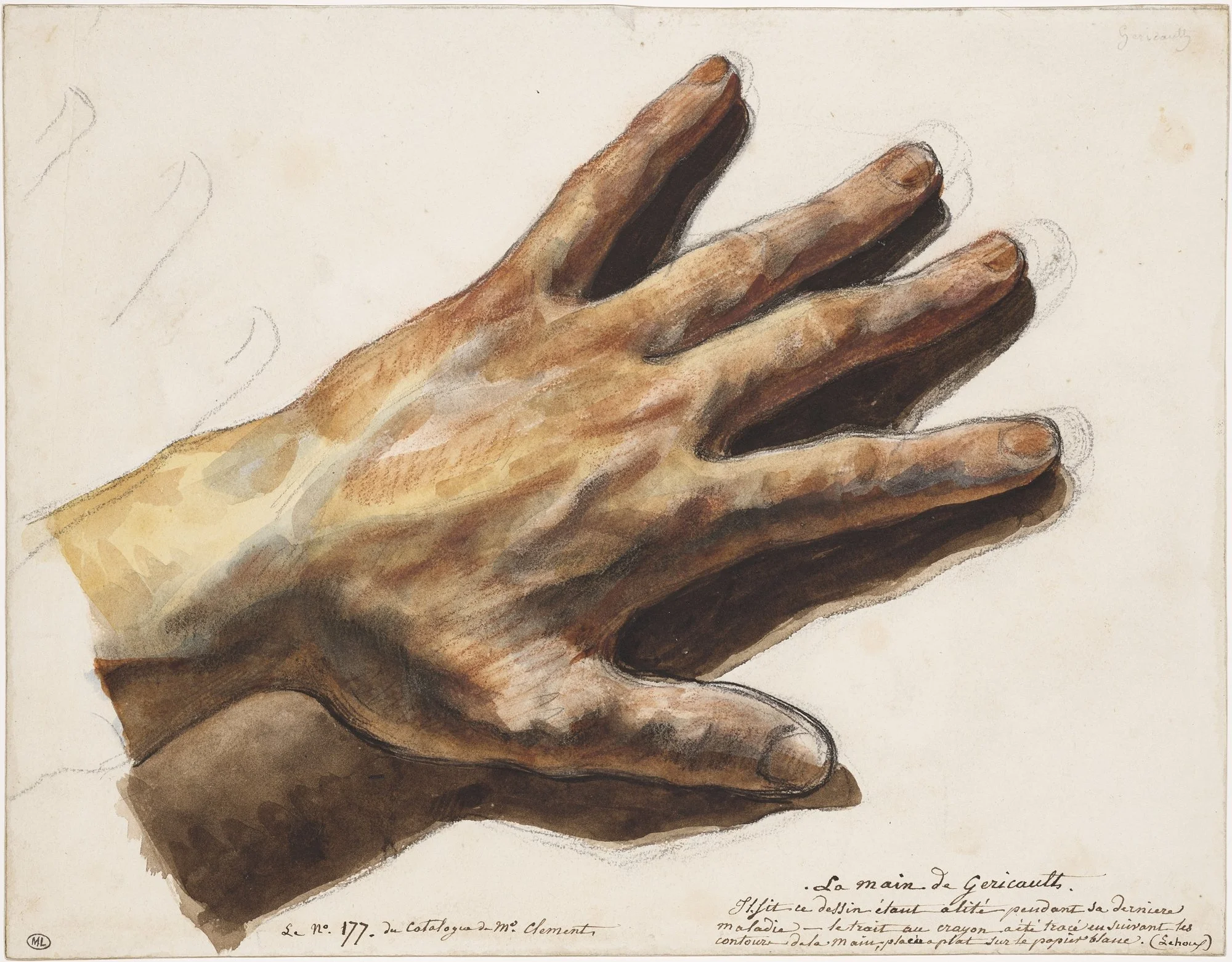
Théodore Géricault (1791–1824), The Artist’s Left Hand, c. 1823-1824, Musée du Louvre, Paris, inv. RF 1397 © GrandPalaisRmn (musée du Louvre) / Sylvie Chan-Liat. Formerly owned by Pierre-François Lehoux (1803–1889)
TN: Jean-Auguste-Dominique Ingres and Eugène Delacroix form the core of the show. Why were their works so widely collected by their peers, and what do these sheets reveal about the fascination surrounding both figures?
LL: Ingres, a leading figure among his friends and acquaintances, gave away numerous drawings which became tokens of friendship and esteem. The fact that his colleagues preserved these drawings reveals the significance of the artistic circle he had built around himself, which helped to promote his work as a draughtsman. The portrait of Auguste Boucher-Desnoyers, which remained in the model’s family until its rediscovery in 1993, illustrates this personal dimension. Executed in 1825, a landmark year for both artists, it bears witness to the mutual esteem that bound them together.
Eugène Delacroix, for his part, was widely collected by his peers. Generous towards those close to him, he gave or bequeathed several of his own works, as well as a few pieces by fellow artists that he had chosen to keep for himself. Through the names of Auguste, Charlet, Riesener, Bonington, Huet and George Sand, Delacroix’s entire circle of friends comes to life once more. His posthumous sale attracted the entirety of the Paris art world. Many of his contemporaries were keen to acquire a souvenir of the master. This fascination extended beyond his own generation. Paul Cézanne, who kept no works by his contemporaries, hung the master’s marvellous Bouquet of Flowers in his bedroom.
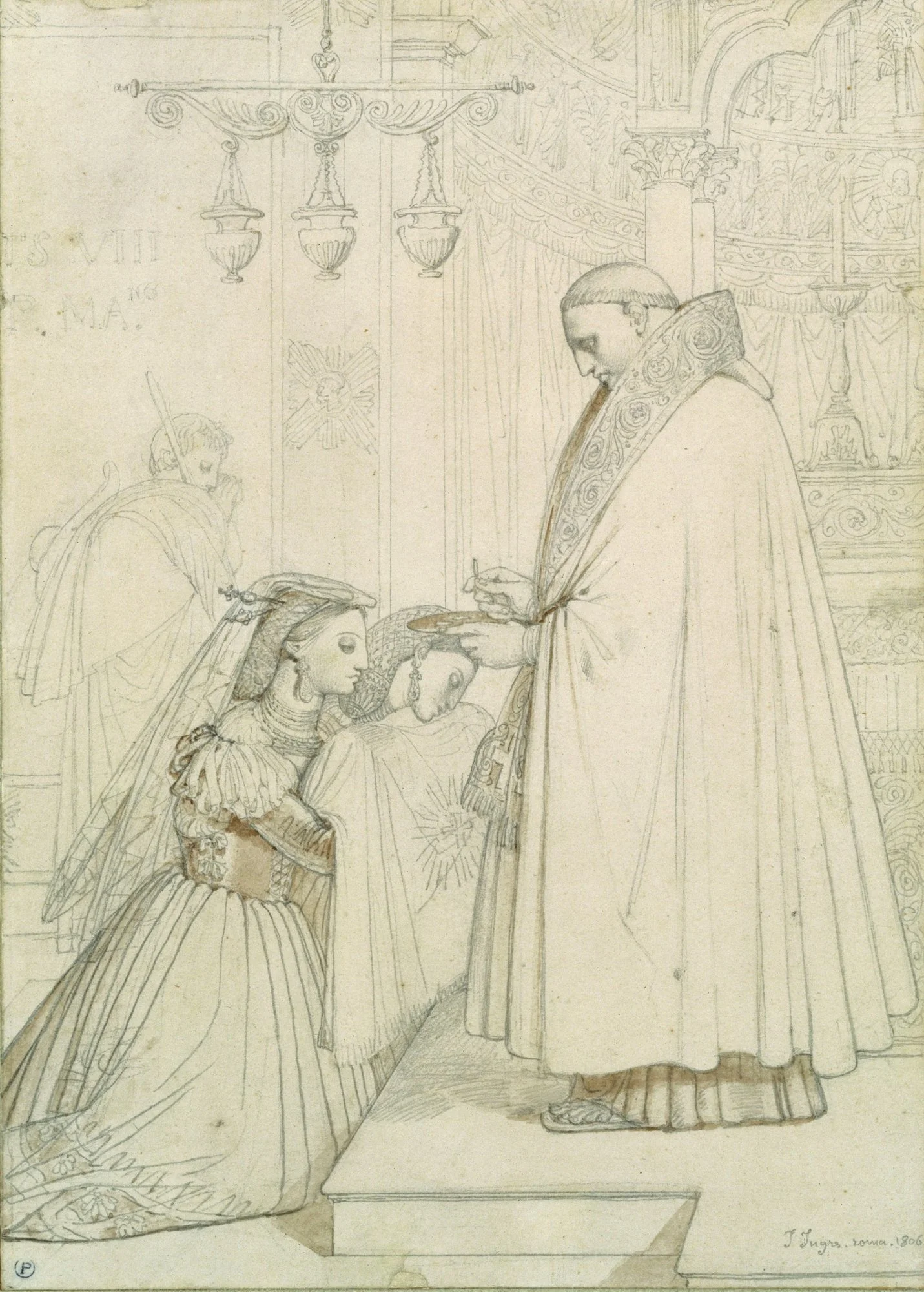
Jean Auguste Dominique Ingres (1780–1867), A Communion in Rome, 1806, Prat Collection, Paris. Formerly owned by Anne-Louis Girodet-Trioson (1767–1824)
TN: Many of these sheets were gifted or exchanged as tokens of admiration and friendship. Did the research process reveal any unexpected alliances and are there any stories of artistic friendship that you were particularly keen to highlight?
LL: Artists generally kept works by contemporaries who belonged to their circle and with whom they were on friendly terms. For example, the Barbizon artists kept only works by those close to them. It is therefore hardly surprising that no drawings by Ingres are to be found in Narcisse Diaz’s collection, as a journalist pointed out regarding the painter’s personal collection at the time of his posthumous sale.
We wished to highlight certain artistic friendships. That of Léon Cogniet, who reserved a place of honour for his friends and those he admired in his drawing room and in his portfolios, notably for Michallon, his “friend for life”. We also wished to devote space to a more unexpected circle of friends: that which surrounded le beau Mélingue, a painter and sculptor best known as a successful actor. Together with his wife, the actress Théodorine Mélingue, he entertained numerous Romantic artists in their salon-museum on Rue Levert in Belleville. Paul Gavarni, Henry Monnier, Diaz and Raffet were also among the couple’s most loyal friends.
TN: If you had to choose one drawing from the exhibition that best embodies this sense of intimacy and artistic loyalty among nineteenth-century peers, which sheet would it be and why?
LL: The double effigy of the brothers Paul and Hippolyte Flandrin. These portraits, each drawn by the other and dedicated to their friend, the composer Ambroise Thomas, celebrate a friendship forged at the Villa Medici. The two brothers pay mutual tribute to each other’s talent as draughtsmen, presenting the sheet to the musician before his departure from Rome. This drawing captures the fraternal and artistic bond that united these three artists. We have chosen it for the cover of the catalogue.
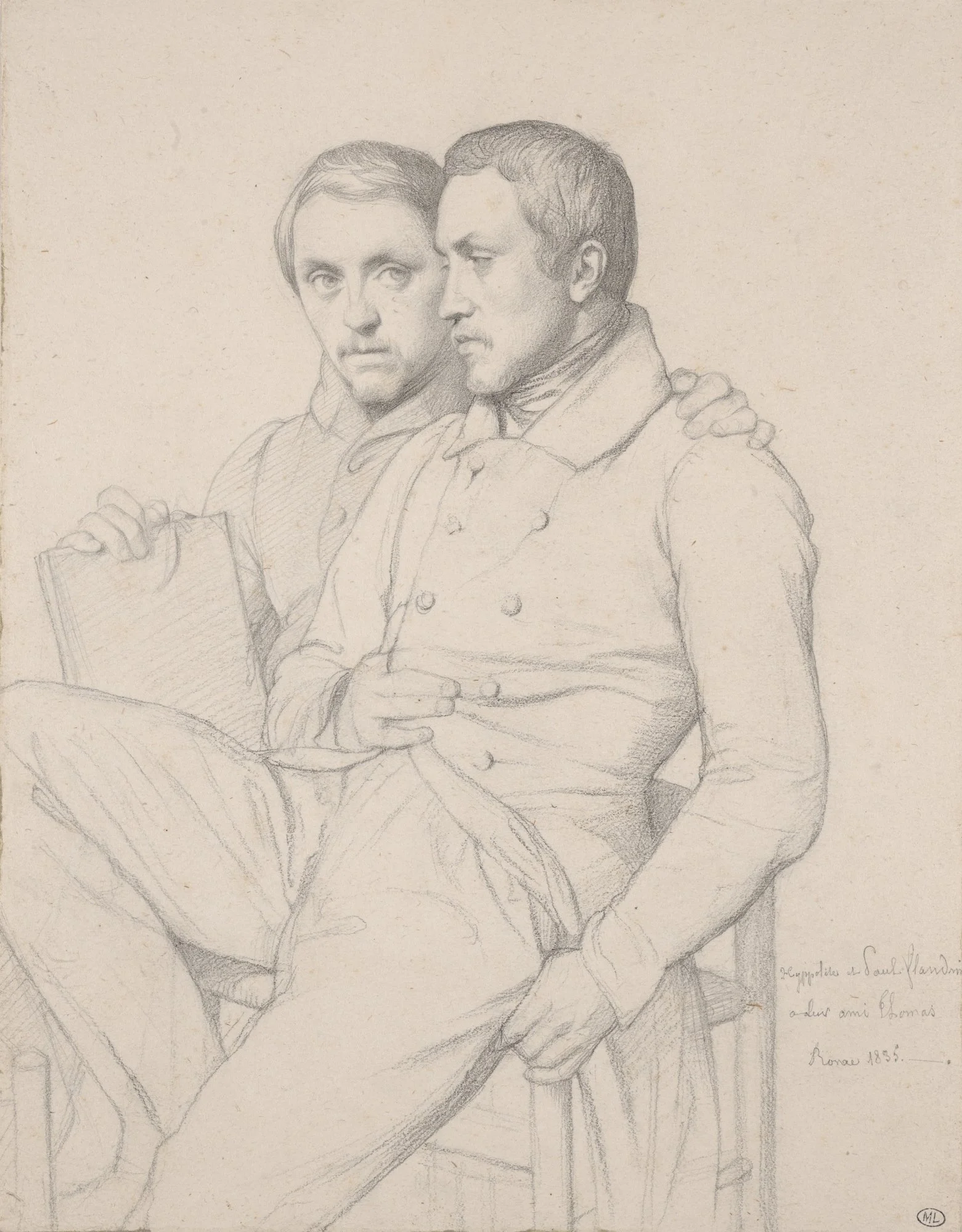
Hippolyte Flandrin (1809–1864) and Paul Flandrin (1811-1902), Double Self-Portrait, 1835, Musée du Louvre, département des Arts graphiques, Paris, inv. RF 4021 © GrandPalaisRmn (musée du Louvre) / Michel Urtado. Formerly owned by Ambroise Thomas (1811–1896)
Mes Chers Amis is on view at the Fondation Custodia from 17 October 2026 – 17 January 2027. The exhibition catalogue is available now.