Trois Crayons Magazine, November 2026
Francesco Grisolia, Associate Professor at the University of Rome ‘Tor Vergata’ and Principal Investigator of the Padre Resta Project

Carlo Maratti (1625–1713), Padre Sebastiano Resta Consulting One of his Albums of Drawings, 1689, Devonshire Collection, Chatsworth, inv. 584. © Devonshire Collection, Chatsworth
Padre Sebastiano Resta did not own a collection in the usual sense of the word, yet the drawings that passed through his hands, many of them still recognisable by his inscriptions and their mounts, are now scattered through print rooms across the world. On the last day of March 1689, as Resta was consulting one of his albums, Carlo Maratti drew him in red chalk, and the sheet was promptly added to that very volume, with an inscription that records the occasion and describes it as ‘furto e dono dell’autore’ (‘the artist’s theft and gift’). For half a century this Milanese Oratorian priest based in the Roman church of Santa Maria in Vallicella gathered, studied, annotated and arranged thousands of drawings. Posterity proved less generous. In 1786 Girolamo Tiraboschi, who suspected that commerce lay behind his attributions, judged ‘this good priest’ all too ready to assign to Correggio ‘works that no one else attributes to him’, and in his pioneering essay of 1936–37 A. E. Popham could still introduce him, not without sympathy, as ‘that singular, but not unattractive, charlatan, as his detractors would call him’.
His father Filippo, a Milanese painter and collector, steered him towards the arts: after studying philosophy and law, Resta spent time in the workshop of Ercole Procaccini the Younger, though he never became a painter. Around 1661 he settled in Rome, becoming a full member of the Congregation in 1668. From his rooms at the Chiesa Nuova he travelled in search of drawings and information, and built up a dense web of relationships with artists, scholars, collectors and dealers that reached across Italy and beyond: Maratti, Giuseppe Ghezzi and Giuseppe Passeri; Giovan Pietro Bellori and Carlo Cesare Malvasia; Queen Christina of Sweden; the seventh Marqués del Carpio, Spanish ambassador in Rome and later Viceroy of Naples, whose drawings he arranged in volumes; correspondents such as Giuseppe Magnavacca in Bologna, Filippo Baldinucci and Francesco Maria Niccolò Gabburri in Florence, and Agostino Scilla in Messina; and a number of Englishmen, among them John Talman, Charles Jervas and Henry Newton.
Resta bought, exchanged and received drawings in order to mount them in albums destined for others, and the proceeds went to the charities of the Oratory. He assembled more than thirty albums holding no fewer than 5,000 drawings, and both figures rise if one counts the volumes he arranged on behalf of other collectors, such as those of the Marqués del Carpio. Each was a book with a given theme or topic. Titles such as Parnaso de’ pittori, Senatori in gabinetto or L’arte in tre stati proclaim the ambition to narrate the history of Italian art through drawings. Other volumes were monographic, among them the Libro d’arabeschi, devoted to ornament and sent to Palermo in 1689. Among the masters, Correggio came first – an admiration that Resta brought with him from Milan. Throughout his life he hunted for Correggio’s drawings and paintings and for information about his life; he devoted several volumes to him, including Correggio in Roma (part of which survives in the British Museum).
Beyond the many ways Resta sought to narrate and depict the history of Italian art through drawings, what sets these books apart is the page itself. Resta pasted his drawings onto album leaves, at times surrounding them with a gold fillet, and at others with ruled borders drawn in pen. The empty spaces on the page were often filled with writing: attributions, provenances, biographical notes, digressions and family trees of schools, with frequent corrections to Vasari, Baglione and the other writers whose books he annotated with equal density.
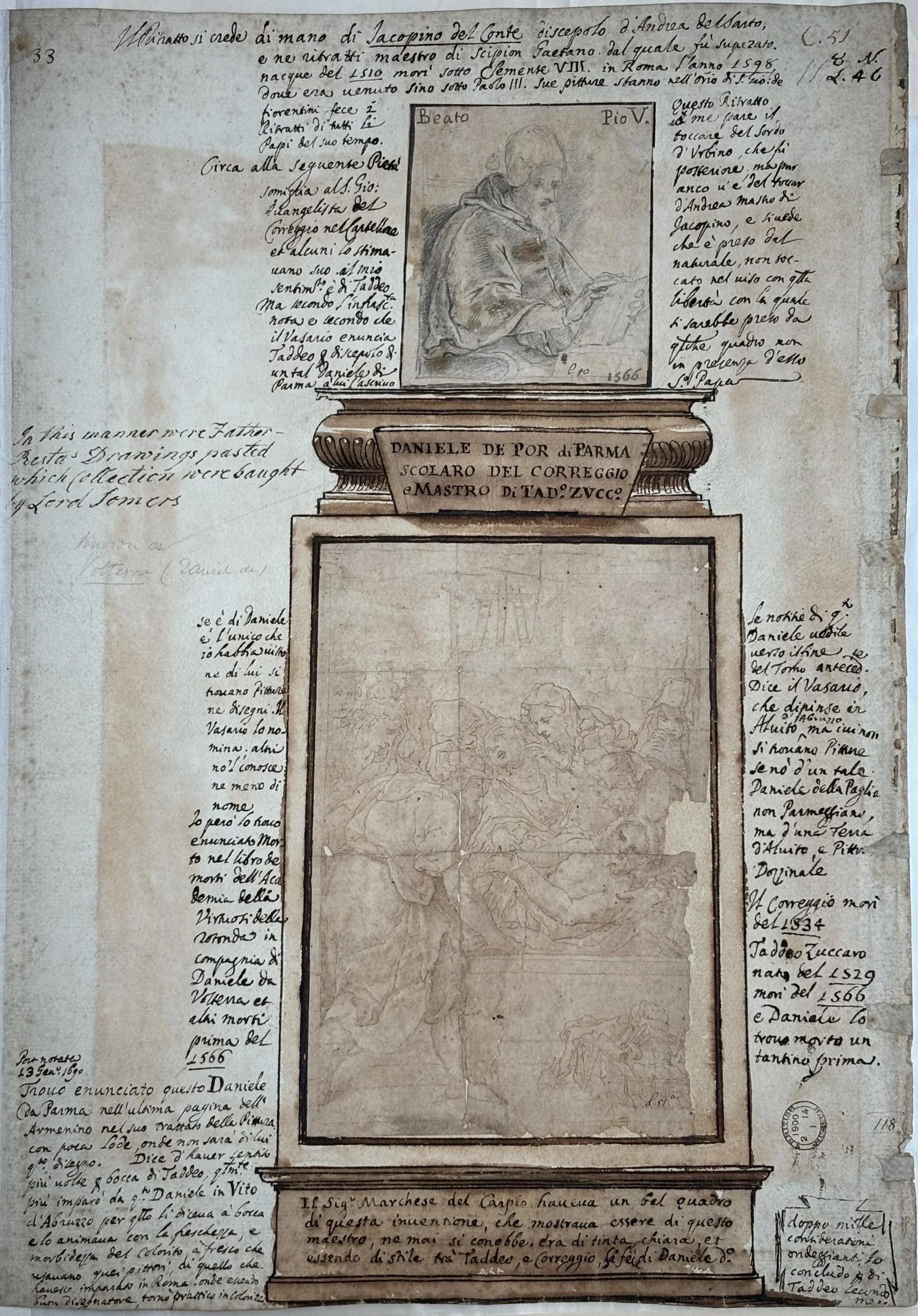
Page from Resta’s album Secolo pratico, with his mount and inscriptions, holding two drawings: above, Anonymous (formerly attributed to Jacopino del Conte), Portrait of Pope Pius V; below, copy after Taddeo Zuccaro, Entombment; album leaf 490 × 340 mm. British Museum, London, inv. 1900,0214.1. © The Trustees of the British Museum
A page from the Secolo pratico, now in the British Museum, is one of the best-known examples, chosen by Popham himself to show Resta’s handwriting and his method of mounting drawings. Within an architectural setting designed for the purpose sit two sheets of different sizes and by different hands: above, a Portrait of Pope Pius V, which Resta attributed to Jacopino del Conte; below, an Entombment that he assigned to Taddeo Zuccaro only ‘after a thousand wavering considerations’, noted at different times in the cartouche and on the plinth and ranging from Daniele da Parma to Correggio. Resta’s attributions could be wildly optimistic, above all where Correggio was concerned; yet the same eye could be remarkably acute: in a rapid pen sketch, now in the famous album known as the Galleria portatile in the Biblioteca Ambrosiana in Milan, he recognised the ‘embryo’ of Raphael’s Disputa.
Well before eighteenth-century collectors like Jonathan Richardson and Pierre-Jean Mariette, Resta sought out and studied periods and schools that the collectors and critics of his day neglected or dismissed: medieval art and the painters of the fifteenth century, the Lombard, Venetian and Neapolitan schools, artists from north of the Alps, decorative drawing, and the Mannerists, to whom he devoted his most extensive known album, the Secolo pratico, with no fewer than 344 drawings, at a time when Bellori’s circle held the Maniera in low esteem. In the Galleria portatile a Bust of Christ then believed to be by Piero della Francesca, and now given to the school of Perugino, heads Resta’s life of Piero and a family tree of his school: such genealogical trees of artists and styles were a crucial tool for him, and one that Baldinucci also adopted in those same years.

School of Pietro Perugino (attributed by Resta to Piero della Francesca), Bust of Christ, with Resta’s life of Piero della Francesca and a family tree of his school; page from the album Galleria portatile, Biblioteca Ambrosiana, Milan, F 261 inf. n. 10, p. 5. © Veneranda Biblioteca Ambrosiana
Between 1698 and the early years of the new century, Resta sent some nineteen volumes to Marchetti, who died in 1704 without having settled his debt. Most of the Marchetti volumes went north. In 1710, Talman described them as the work of ‘a person so well known in Rome and all over Italy for his skill in drawings’, designed ‘to shew the rise and fall of painting in diverse periods of time’. Through Talman they passed from the bishop’s heirs to Lord Somers, and Henry Newton later bought further albums from Resta himself. Burdened by debt, Resta died in poverty at the Chiesa Nuova in 1714.
In England the albums had a short life, but they left traces that collectors and dealers can still read today. Richardson, who arranged the Somers collection, had each drawing marked with a lower-case letter for its album and a number for its place within it (Lugt 2981): ‘b 36’, for instance, is no. 36 of the Saggio dei secoli, and the order is sometimes reversed, as in the ‘59 n’ on a Sibyl by Taddeo Zuccaro in the British Museum. He also had Resta’s notes copied before the London auction of 1717, and that transcript, now Lansdowne MS 802 in the British Library, turns such a mark into a provenance and often into Resta’s own comment, which in many cases is otherwise lost: under no. 36 of book B one reads that the sheet ‘was noted in Bellori’s studio as by Raphael’; under no. 59 of book N one finds the biography of Pellegrino da Modena, to whom the Sibyl was then attributed. On the mount of Polidoro’s Triumphal Arch for the Emperor Charles V in the Victoria and Albert Museum the inscription repeats, almost word for word, the entry recorded under no. 202 of book K. Popham warned, however, that the writing on some later mounts and on the backs of these sheets is Richardson’s copy, not Resta’s hand. That hand, unmistakable once seen, survives on the intact albums and pages and on sheets that travelled by other routes, and often records where a drawing had come from.
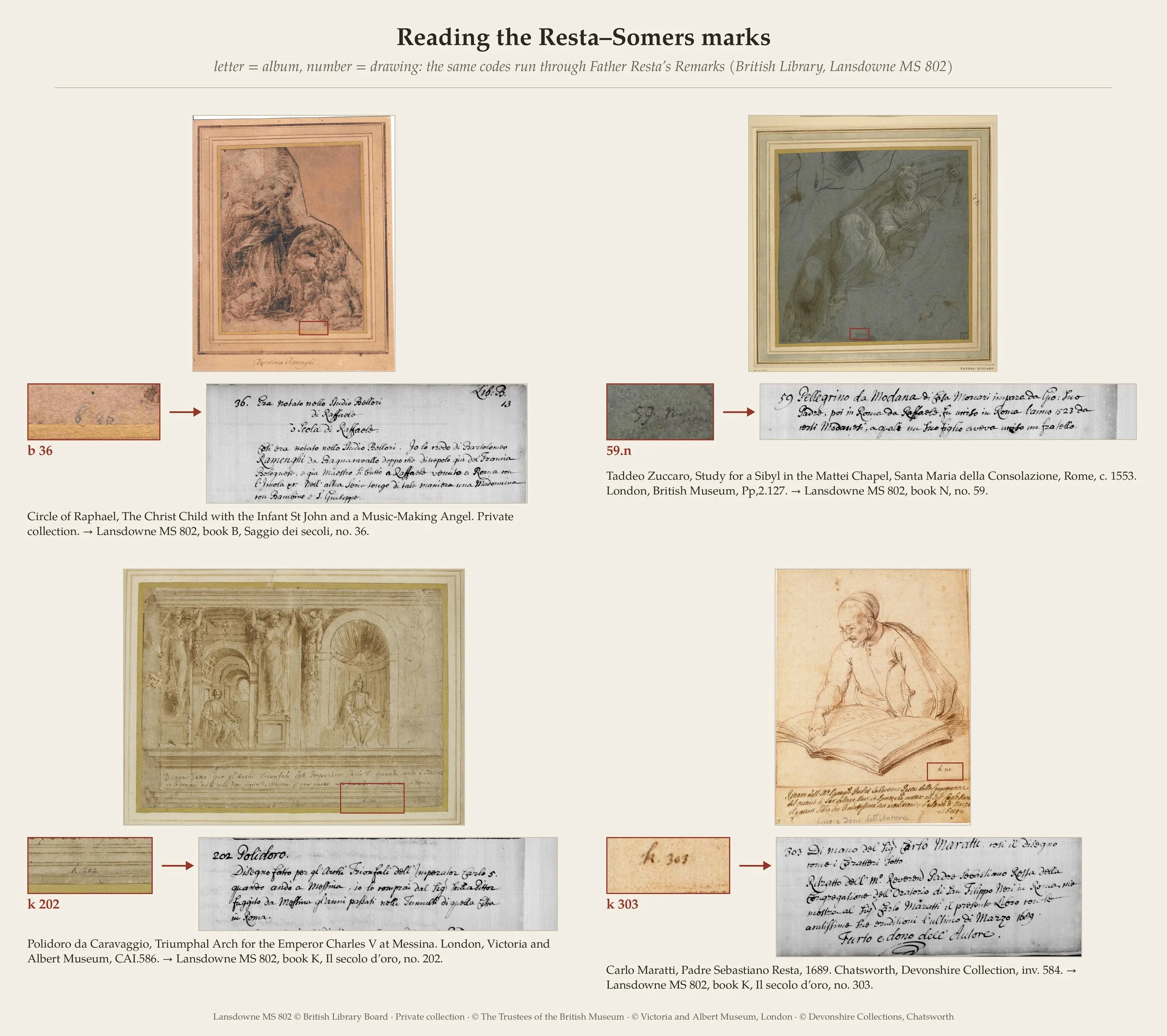
Resta–Somers marks and the corresponding entries in Lansdowne MS 802 (British Library, London): b 36, circle of Raphael, Christ Child, private collection; 59.n, Taddeo Zuccaro, Sibyl, London, British Museum, Pp,2.127; k 202, Polidoro da Caravaggio, Triumphal Arch for the Emperor Charles V at Messina, Victoria and Albert Museum, London, inv. CAI.586; k 303, Carlo Maratti, Portrait of Padre Resta, Devonshire Collection, Chatsworth, inv. 584
Of this legacy, scholarship has so far grasped only part of it. The point is not merely that Richardson, while his Two Discourses (1719) were taking shape, drew from the Somers albums a chronology of painters. Resta’s albums offered a new model: a collection that aspires to completeness, ordered by school and by period, in which every sheet carries its own commentary beside it and the whole tells a history of art. Born in the rooms of the Chiesa Nuova in the late seventeenth century, this is the same model that the great collectors of the eighteenth century would make their own, from Richardson himself to Mariette in Paris and Francesco Algarotti in Dresden, with their ambitions of completeness and their geographical and historical criteria. The rehabilitation of Resta and of this legacy, begun by Popham and carried forward by Giulio Bora, Simonetta Prosperi Valenti Rodinò, Jeremy Wood, Genevieve Warwick and others, has recently been taken up by two research programmes: the Padre Resta Project, led by the present writer at the University of Rome Tor Vergata; and the University of Mainz project led by Elisabeth Oy-Marra.
Anyone today, who comes across one of those sheets, with its letter and its number, can still trace it back to the page from which it was removed and hear the voice of the man who assembled it. Most of those albums have not survived intact, but the history of art that Resta wrote in them can still be read, and rebuilt, one entry at a time.
Grisolia’s publications on Padre Resta include: Le postille di padre Resta alle Vite del Baglione, co-edited with B. Agosti and M. R. Pizzoni, Milan, Officina Libraria, 2016; Padre Sebastiano Resta (1635–1714): milanese, oratoriano, collezionista di disegni nel Seicento a Roma, co-edited with A. Bianco and S. Prosperi Valenti Rodinò, Rome, Edizioni Oratoriane, 2017; Trattenimenti pittorici. I disegni del Codice Resta degli Uffizi, Rome, UniversItalia, 2018; Padre Sebastiano Resta collezionista di disegni. Gli album Resta–Marchetti–Somers, forthcoming.