Dealer Portraits: James Byam Shaw (1903–1992)
Tom Nevile, Editor
Trois Crayons Magazine, August 2026
The archetype of the scholar-dealer, few figures better epitomise the English gentlemanly connoisseur of the mid-twentieth century than James “Jim” Byam Shaw (1903–1992). Straddling the worlds of commerce and scholarship, Byam Shaw served as director of the venerable gallery Colnaghi from 1937 to 1968. He was, however, equally distinguished as a scholar, publishing his first article in The Burlington Magazine in 1927 and reaching a climax with the publication of his catalogue of the drawings at his alma mater, Christ Church, Oxford, in 1976.

Lafayette, James Byam Shaw © National Portrait Gallery, London
With artist parents, a Westminster and Oxford education, and family connections to Colnaghi, Byam Shaw’s rise in the drawings world was perhaps as predictable as the inverse was true of his rival, the Hamburg-born former stockbroker Hans Calmann (see Calmann’s ‘Dealer Portrait’). His interest in works on paper was further encouraged by the print scholar Campbell Dodgson, the uncle of his first wife, Eveline Margaret Grose Dodgson. With a job at Colnaghi pre-agreed in his twenties, Byam Shaw was afforded the rare luxury of seven years in which to educate himself in the print rooms of Europe. Such a schooling was foundational to his expertise and, although not typical, similar exposure was afforded to some of his contemporaries and rivals in the field, namely Richard Day and John Baskett.
After a two-year spell working at the British Museum and teaching at the newly established Courtauld Institute, Byam Shaw finally joined Colnaghi in 1935. One of his first major assignments came in that same year, when he was sent to Vienna to value the prints and drawings collection of the Albertina. He knew the collection and staff well from his time in Europe and a contentious proposal to sell the museum’s entire collection of prints and drawings to the Museum of Fine Arts in Boston was under serious consideration at the time. This disaster for Austria was ultimately averted by a single City Council vote, allowing Byam Shaw to return to London with the Albertina's treasures – and his friendships – intact.
Prints and drawings formed a major component of Colnaghi’s business, and these were kept in solander boxes on the fourth floor at 14 Old Bond Street, Byam Shaw’s domain. Although his manner was patrician – as Francis Russell has noted, his affected pronunciation of names such as Guardi (pronounced ‘Gaardi’) and Bison (pronounced ‘Bis-own’) could surprise the uninitiated – an open-door policy encouraged both young and old to frequent the fourth floor, whether or not they bought anything. He was a teacher by nature, and perhaps because he had no children of his own, he was extremely generous to the young and to his friends. Profit was seemingly of lesser importance than nurturing enthusiasm, although this was in the full knowledge that many of the day’s students would become the morrow’s museum directors. He believed that these relationships were not only important to the health of the field but mutually beneficial and he promoted links between the museum world and the art trade.
Among his closest friends were Arthur Ewart Popham and Sir Karl T. Parker, the keepers of the prints and drawings departments at the British Museum and the Ashmolean, respectively. Nourished on regular lunches, followed by games of billiards at the Athenaeum, these friendships were enduring and symbiotic. Any drawing which Byam Shaw thought should be added to one or other of the collections was passed on with minimal or no profit. He was equally generous with his rare mistakes: when the Courtauld professor Michael Hirst found an overlooked Correggio drawing in a box of bargains and showed it to Byam Shaw, the latter simply congratulated him. Whether from absent-mindedness or gentlemanly reluctance, he was also notably slow at remembering to send invoices to his museum clients.
Though his own collection demonstrated wide-ranging artistic interests, and his expertise extended across all the principal European schools, he was internationally recognised as a specialist in Italian art, and in eighteenth-century Venice in particular. He produced landmark studies on Francesco Guardi (1951) and Domenico Tiepolo (1962). These were followed by catalogues of the Frits Lugt (1983) and Robert Lehman (1987) collections. He also returned to Christ Church as Assistant Curator of Pictures, producing a record of the college’s paintings (1967) and his two-volume magnum opus on its drawings (1976) which demonstrated the breadth of his knowledge in pithy and concise prose.
These scholarly credentials gave him the reputation as the soundest judge of a drawing’s quality and attribution. In time, he became aware that his bids were often followed by those with less knowledge or confidence in their own judgement, who saw his bidding as confirmation of an attribution. Known for his pragmatic bidding style, this allowed others with deeper pockets to exceed his bids with confidence and pip him in the saleroom. As a result, he famously did not bid directly on Pieter Bruegel the Elder’s The Calumny of Apelles, which was unrecognised by the auctioneers Sotheby’s but tentatively coveted by Byam Shaw’s rival, Calmann. Calmann became increasingly unnerved when he saw Byam Shaw motionless during the bidding, with the result that the drawing was knocked down for a relatively low price to an unknown bidder at the back of the room. The unknown bidder was, in fact, one of the porters from Colnaghi. With characteristic graciousness, instead of letting Calmann find out for himself what had happened, Byam Shaw went up to him at the end of sale and said that it was he who had bought it on behalf of the British Museum.
With an extensive “black book” of contacts, one of Byam Shaw’s most loyal clients was Count Antoine Seilern, whose old-fashioned attitude towards the trade meant that he would only deal directly through Byam Shaw. Seilern’s collection, which included perhaps the most remarkable of all acquisitions made through Byam Shaw: Michelangelo's The Dream (Il Sogno), was eventually bequeathed to the Courtauld Institute of Art. After the war, visitors from across the Atlantic arrived with increasing frequency, and Byam Shaw contributed to the development of several major institutional collections. Regular visitors included Jacob Bean, Curator of Drawings at the Metropolitan Museum of Art, and Felice Stampfle, Curator of Drawings at the Pierpont Morgan Library, as well as the banker Robert Lehman, whose transformational bequest of 750 drawings to the Metropolitan Museum included many acquisitions sourced through Byam Shaw.
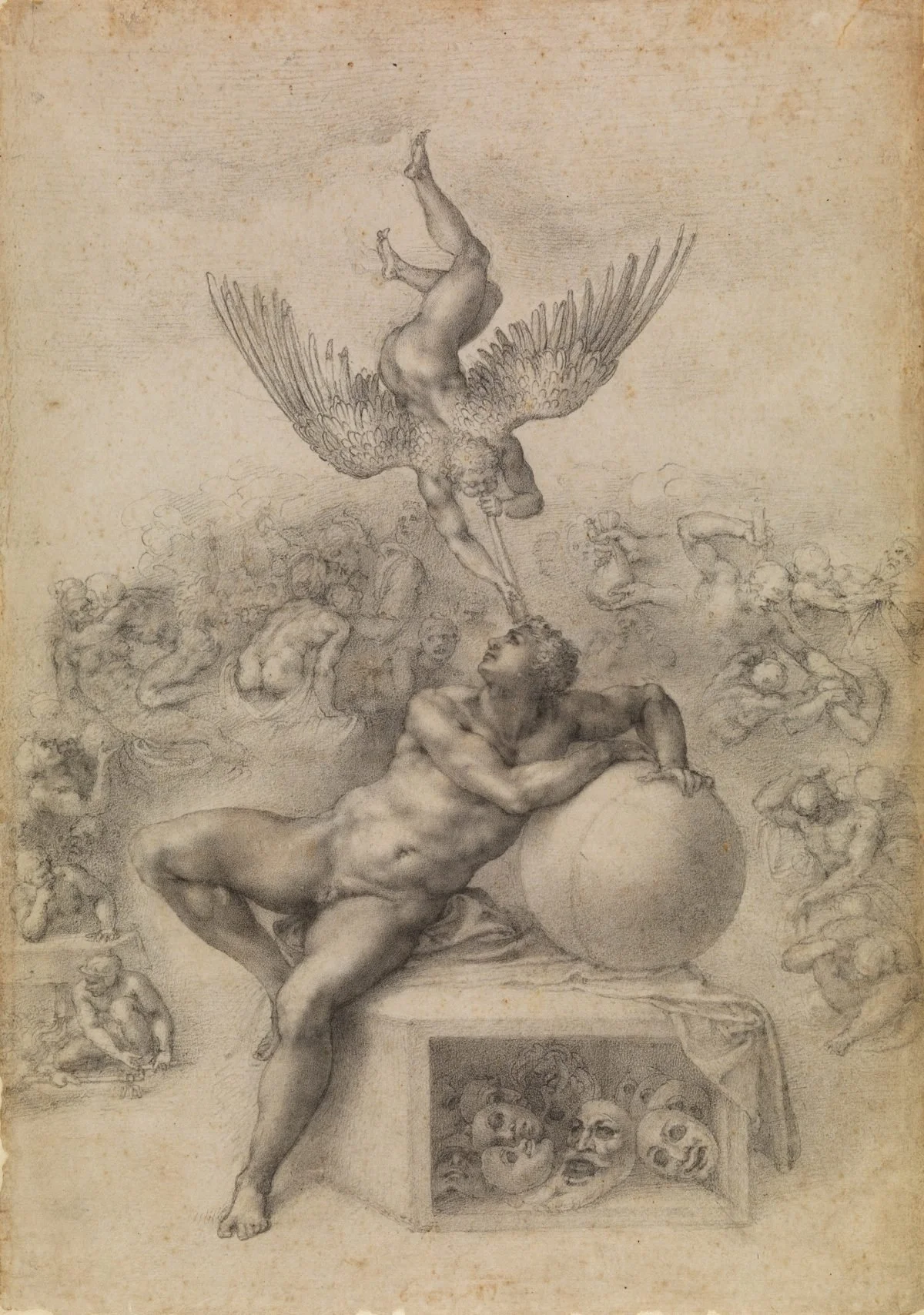
Michelangelo, The Dream (Il Sogno), c. 1533. Courtauld Gallery, London, Princes Gate Bequest, inv. D.1978.PG.252
Through his gentlemanly manner and his impeccable erudition, James Byam Shaw cemented himself as one of the most important dealers of the twentieth century. Beyond his foundational role in moulding the holdings of some of the world’s foremost public collections, he shaped the ideal of what an Old Master drawings dealer should be. Byam Shaw incarnated and codified a tradition of dealing that championed research and courtesy as a business strategy, where the dealer’s name was a near-assured sign of quality. His approach, which bridged academia and the market, is preserved by many purveyors of fine Old Master drawings to this day.