Paul Lacroix (1827–1869)
Trois Crayons Magazine, February 2026
Can we fool you? The term “fake” may be slightly sensationalist when it comes to old drawings. Copying originals and prints has formed a key part of an artist’s education since the Renaissance and with the passing of time the distinction between the two can be innocently mistaken.
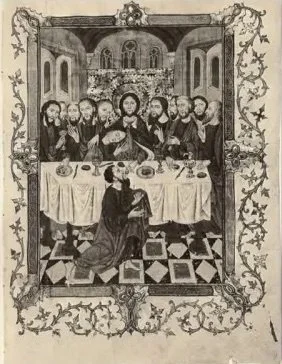
Medieval or not, that is the question. One of these works, depicting the Last Supper, is based on the other and reversed, but which is it?

-
The original is the right/lower image.
Left/Upper Image: an illuminated manuscript leaf by The Spanish Forger from Antiphonary MS M.786a, The Morgan Library & Museum, New York
Right/Lower Image: an illustration from Paul Lacroix, Vie militaire et religieuse au moyen âge et à l'époque de la Renaissance, Paris, Librairie de Firmin-Didot et Cie, 1877, p. 224, fig. 175
Although the left/upper drawing purports to be a medieval work – a page from an illuminated manuscript – and several centuries older than the lower image, it is actually a late nineteenth or early twentieth-century forgery by the so-called ‘Spanish Forger’. To deceive audiences, the artist used medieval sheets of parchment or vellum for his elegant courtly compositions, capitalising on an idealised chivalric conception of the Middle Ages and a vogue for medieval miniatures. He is believed to have worked in Paris at the turn of the twentieth century, and takes his misleading name from the misattribution of one of his paintings to a fifteenth-century Spanish artist. Although his deceit was unmasked by Belle da Costa Green, director of the Morgan Library, in 1930, the artist’s true identity remains a mystery.In this example, and in many others, the Forger appropriated ideas from chromolithographic editions published in Paris. Here, he reversed and elaborated an image of the Last Supper from Paul Lacroix’s Vie militaire (1877). The book was published by the Parisian firm Firmin Didot, and it has been suggested that the Forger was in the employ of the publishing house. To further the impression of age, the Forger altered and restored his own work.
Amongst the Forger’s giveaway signs was the prominent décolletage given to his courtly ladies, implausible in a medieval painting. Furthermore, the vibrant palette of blues, pinks, reds, and green (unfortunately not reproduced here), gave away the deceit. Technical analysis revealed that many of the colours used were not synthesised until the nineteenth century.