The recent sales of two remarkable drawings – a study of a foot by Michelangelo and a lion by Rembrandt, which realised $27.20 million and $17.86 million respectively – made headlines around the world this month, bringing drawings into the global spotlight. Beyond the auction room, March promises another wealth of public opportunities to engage with drawings, with several major exhibitions opening across Europe and the United States, and two major art fairs returning to Maastricht and Paris.
In Rome, the Istituto Centrale per la Grafica has recently inaugurated an exhibition devoted to Maarten van Heemskerck’s Roman drawings, organised in collaboration with the ICG, the Bibliotheca Hertziana – Max Planck Institute for Art History, and the Kupferstichkabinett of the Staatliche Museen zu Berlin. In France, the Musée Condé presents a selection of seventeenth-century Italian drawings from 7 March at the Château de Chantilly, marking the first public outing for this exceptional group, while the same day the Musée de Valence opens an exhibition pairing two leading figures of eighteenth-century French art, Hubert Robert and Jean-Honoré Fragonard. In the UK, Compton Verney launches a survey of Dutch and Flemish drawings of the sixteenth and seventeenth centuries on 14 March, followed on 27 March by the Royal Academy of Arts’ landmark exhibition dedicated to the painter Michaelina Wautier, the first presentation of her work in the country. Rounding off the month, the Metropolitan Museum of Art in New York opens its much-anticipated retrospective of Raphael on 29 March. Meanwhile, the art market will also turn its attention to drawings, with the 39th edition of TEFAF Maastricht returning to the MECC from 14 March, and the 34th edition of the Salon du Dessin returning to the Palais Brongniart on 25 March. Further details of these exhibitions and related events can be found in the News section below.
In this month’s magazine, French exhibitions take centre stage as the focus of three special features, but first, a submission to the Trois Crayons Museum Forum from the Devonshire Collections at Chatsworth. News headlines, gallery listings, announcements, events and an overview of recent institutional acquisitions follow. Sarah Catala, curator of Hubert Robert & Fragonard. A Feeling for Nature at the Musée de Valence, shares a personal highlight from the exhibition as our Drawing of the Month. A Demystifying Drawings interview with Ulysse Jardat on the seventeenth-century Italian drawings at the Musée Condé is followed by Nicolas Bousser’s review of Rosso and Primaticcio: Renaissance at Fontainebleau at the Beaux-Arts de Paris. After the month’s exhibition listings and the Real or Fake quiz, the issue concludes with a trio of audio, video and literary recommendations.
For next month’s edition, please direct any recommendations, news stories, feedback or event listings to tom@troiscrayons.art.
IN GALLERY, ART FAIR AND AUCTION NEWS
3–15 March: A Paradise Regained: Neo-Romanticism in Britain presented by John Swarbrooke Fine Art at 11 Fitzroy Square (London). By appointment.
4–26 March: Neo-Romanticism: Origins and Evolution at Brooke-Walder Gallery (London).
12 March–11 April: Edna Clarke Hall (1879–1979). The Poem Paintings at Abbott and Holder (London).
14–19 March: TEFAF Maastricht 2026 at MECC Maastricht (Maastricht). VIP days: 12–13 March.
16–18 March: A Brush with Metal: A Selling Exhibition of Oil Portraits presented by The Limner Company at Wartski (London). By appointment.
19–27 March: Dessins anciens et du XIXème siècle at Nicolas Schwed (Paris).
19 March–3 April: Dessin au Quartier Drouot at various venues (Paris).
19 March–TBC: Dessins et aquarelles du XIXe siècle at Galerie La Nouvelle Athènes (Paris).
21–30 March: De Polidoro à Baciccio, Dessins et tableaux du XVle au XVIIle siècle presented by Galerie Duponchel at Galerie Michel Descours (Paris).
23 March–4 April: Léonard Sarluis – Singulier Symboliste presented by Artwins & Mathieu Néouze at Galerie Ambroise Duchemin (Paris).
24–30 March: Pop-up Selling Exhibition of 19th and 20th Century Works on Paper presented by Ubbens art and Bert Nordin Fine Art at Passage Verdeau 28 (Paris).
24–30 March: A Fine Line from Figuration to Abstraction presented by Perspective Fine Art at Benjamin Peronnet Fine Art (Paris).
25–30 March: Salon du Dessin at Palais Brongniart (Paris).
25 March: Chefs-d'oeuvre de la collection Veil-Picard at Christie’s, 14:30 (Paris).
25 March: Dessins Anciens et du XIXe siècle incluant une sélection de terres cuites at Christie’s, 15:30 (Paris).
25 March: Dessins Anciens et du XIXe siècle at Artcurial, 17:00 (Paris).
24–31 March: Artist Portraits and Other Works presented by Pierre Brost Galerie at Galerie Tarantino (Paris).
26–29 March: Paris Print Fair at Réfectoire du Couvent des Cordeliers (Paris).
26–29 March: Drawing Now Paris at Carreau du Temple (Paris).
Until 5 April: All Aspects of Love at Emanuel von Baeyer, 18 Cecil Court (London).
IN LECTURE AND EVENT NEWS
7 March–Talk: Introduction to Love and Landscape at Gainsborough’s House (Sudbury). Speaker: Amy Lim. 15:30. £15.
7 March–Panel: Women in the Art World. In Conversation with a Curator, a Conservator, an Artist and an Academic at ArtSpace5-7 (Cambridge). Speakers: Annette Wickham, Rosie Macdonald, Wei Yuan, Dr. Anna Dempster. 16:00. £22.38; £11.55 for students.
10 March–Lecture: The Renaissance as Historical Laboratory: The Case of the Sack of Rome of 1527 at The Courtauld, Vernon Square (London). Speaker: Professor Guido Rebecchini. 18:00. Free with registration.
11 March–Talk: Seurat and the Sea at Institut français du Royaume-Uni (London). Speaker: Karen Serres. 19:00. £12.
13 March–Conference: Research Notes: Views of their Own: Rediscovering and Re-presenting the Work of Women Artists at The Manton Centre for British Art, The Courtauld (London). Speakers: Paris A. Spies-Gans, Susan Owens, Hannah Lyons. 10:30–17:00. £10-20
16 March–Lecture: Gothic Aryan: Viollet-le-Duc and the Museums of the Trocadéro at Bard Graduate Center. Risham Majeed (New York). 18:00. $0–15. Organised by The Drawing Foundation.
23–30 March–Museum visits: The Drawing Week at various venues. (Paris). Free. Reservation required.
24 March–Symposium: Rembrandt Symposium: New Directions in Rembrandt Research at Rijksmuseum (Amsterdam). 09:00. €100.
25–26 March–Symposium: The materiality of drawing. Supports, materials, tools, uses and conservation of drawing at the Palais Brongniart, Petit auditorium, 1st floor, Salon du Dessin (Paris). 14:30. Free entry with a ticket to the Salon du Dessin. Reservation recommended.
Federico Zuccaro (1539/40–1609), Soldiers by a column. Nicolas Schwed, Paris. Dessins anciens et du XIXème siècle on view from 19–27 March.
IN LITERARY, MUSEUM AND ACADEMIC NEWS
New publication: Museo Nacional del Prado. Disegni italiani: Napoli tra i secoli XVII e XVIII, Viviana Farina. Published by Editori Paparo Libri. €68.
New publication: Dessins du Seicento: L’Italie du XVIIe siècle autour des collections du musée Condé, Ulysse Jardat et al. Published by Faton. €22.
New publication: Raphael: Sublime Poetry, Carmen C. Bambach. Published 10 March by Metropolitan Museum of Art. £60.
New publication: La collection Bruyas du musée Fabre, Michel Hilaire, Pierre Stépanoff. Published 12 March with Edition Sans Egal. €58.
New publication: Hubert Robert & Fragonard. Le Sentiment de la nature, Sarah Catala et al. Published 12 March by Lienart éditions. €39.
New publication: Gaspar van Wittel (1652/53-1736). Il Catalogo raisonné dei Disegni, Carolina Trupiano Kowalczyk. Published 15 March by Dario Cimorelli Editore. €90.
Call for papers: La taille et le trait. Dialogues entre dessin et estampe (XVe-XVIIIe siècle) at the Bibliothèque nationale de France, Paris. Application deadline: 3 April. Conference dates: 18-19 November.
Call for papers: Ninth Annual Ricciardi Prize from Master Drawings. The award is given for the best new and unpublished article on a drawing topic (of any period) by a scholar under the age of 40. Prize: $5000. Application deadline: 15 November.
Call for contributions: Drawing as an epistemic tool in art history at the University of Fribourg, 2025-2029. The project organisers “invite researchers and institutions to identify and report any archival collections—public or private, academic or associative—that may help to inform and enrich this investigation on an international scale. A key requirement is that these collections include graphic records of any kind, regardless of their form or medium : collages, tracings, sketches, diagrams, doodles, and so forth.”
Summer course: Collecting Prints and Drawings from the 16th to the 20th Century in Florence: Techniques, Papers, and Conservation, organised by the Fondazione Roberto Longhi at the Villa Il Tasso (Florence). €3,000. Application deadline: 28 May 2026. Course dates: 22 June – 23 July 2026.
Catalogue update: Edgar Degas online catalogue raisonné, edited by Michel Schulman, has recently uploaded over 1,500 new drawings to their website.
IN ACQUISITION NEWS
Workshop of Andrea del Sarto (1486–1530), The Deposition. Acquired by the Getty Museum, Los Angeles. Gift of Kate Ganz and Daniel Belin.
Jacques Androuet du Cerceau (1511–1586), Etude de cheminée pour le château de Verneuil. Acquired by the Musée des Beaux Arts d’Orléans, Orléans. Gift of Peter Soriano and Christophe Defrance in homage to Dominique Cordellier.
Studio of Peter Paul Rubens (1577–1640), Study for the Mystic Marriage of St Catherine. Acquired by the Museum de Reede, Antwerp, from Galerie Lowet de Wotrenge, Antwerp.
Karel Dujardin (1626–1678), Le chèvre. Acquired by Petit Palais, Paris, from Galerie Motte Masselink, Paris.
Anna Waser (1678–1714), Self-portrait as the Goddess Flora. Acquired by The Toledo Museum of Art, Toledo.
Barbara Regina Dietzsch (1706–1783), A Red, White, and Yellow Parrot Tulip, a Butterfly, and a Beetle. Acquired by Herbert F. Johnson Museum of Art, Cornell University.
Giovanni Battista Piranesi (1720–1778), Study of four figures. Acquired by the Fondation Custodia, Paris, from Christie’s, New York (sale: 5 February 2026) (via Facebook).
Henri de Triqueti (1803–1874) auction at Ader, Paris, Triqueti Intime (sale: 9 February 2026). Nine lots pre-empted by the Beaux-Arts de Paris, the Musée des Arts Décoratifs, the INHA, the Musée Girodet in Montargis and the archives municipales, the Musée des Beaux-Arts in Orléans and the Bibliothèque Méjane in Aix-en-Provence (via La Gazette Drouot).
Credit: Devonshire Collections, Chatsworth
Museum Partner Spotlight:
Devonshire Collections, Chatsworth
This month we are pleased to introduce a work from the Devonshire Collections, Chatsworth: a mythological scene by an unknown artist of the eighteenth century.
Curator’s comments: This newly discovered drawing is puzzling both regarding its attribution and its subject. For the former, it has been suggested French, Genoese and Flemish. The technique of chalk and coloured wash (with no pen) is distinctive, so it may invite a name. The subject is also confusing; in the middle with shield and helmet, we might see Athena (but Bellona has also been suggested). It is difficult to distinguish what the man next to her is offering to the figure on the throne. The Arts/Muses are on the left, and presumably Hercules and Fame driving out Envy.
To register as a museum partner, please email info@troiscrayonsforum.org.
Here attributed to Jean Honoré Fragonard (1732–1806)
The Oval Fountain in the Gardens of the Villa d'Este, Tivoli, 1760
Red chalk and graphite on laid paper, 327 x 451 mm, The National Gallery of Art, Washington, Inv. 1990.129.1. Gift of Mr. and Mrs. Neil Phillips and Mr. and Mrs. Ivan Phillips, in Honor of the 50th Anniversary of the National Gallery of Art
Here attributed to Jean Honoré Fragonard (1732–1806), The Oval Fountain in the Gardens of the Villa d'Este, Tivoli. The National Gallery of Art, Washington, inv. 1990.129.1, Gift of Mr. and Mrs. Neil Phillips and Mr. and Mrs. Ivan Phillips, in Honor of the 50th Anniversary of the National Gallery of Art
Sarah Catala, curator of Hubert Robert & Fragonard. A Feeling for Nature at the Musée de Valence, has kindly chosen our drawing of the month.
The remarkable proximity of Fragonard and Hubert Robert’s drawing styles during their years in Rome, around 1760, long fostered confusion in the attribution of certain drawings. Thus, a sheet preserved at the National Gallery of Art, Washington, has for more than forty years been described as a copy executed by Robert in Italy, around 1760–1761, in imitation of Fragonard and after a painting that the latter is said to have produced in France… after 1761. This analysis, however, cannot withstand consideration of the exchanges that united the two artists, grounded in emulation rather than imitation, nor the material examination of the works, still less their chronology.
The Washington drawing must be given to Fragonard. It bears his signature technique: the sheet folded at its centre, the composition first sketched in graphite, followed by the free sweep of red chalk that overlays and animates the composition. To these material indicators may be added the graduated structuring of the composition, the poetry of light, and above all the emergence of the feminine at the heart of nature. The exhibition Hubert Robert & Fragonard. A Feeling for Nature, which will open at the Musée de Valence in France from 7 March to 21 June 2026, will reunite for the first time the drawing and the corresponding painting. What I set down here in a few lines, and what each visitor may look at for perhaps two minutes, is the result of a long process. I had to dare to think against the authorities that I admired.
I studied the red chalk and graphite on several occasions in Washington, scrutinising each line of the drawing, reading every page of the file, and enquiring into the belief of the donor, who was convinced he possessed a Fragonard. One decisive detail guided me: the preparatory graphite underdrawing, visible beneath the red chalk. Robert never employed this method. I returned to examine Fragonard’s major red chalk drawings in Besançon: all reveal this carbon-based preparation. I sought the assistance of colleagues to obtain infrared images capable of confirming its presence. To clarify my intuitions, I first set out my initial conclusions in the catalogue of the Fragonard exhibition at Galerie Coatalem in 2022. The responses were largely enthusiastic, with the exception of one sceptical voice, which prompted me to pursue the matter further.
I then wrote an article intended for Master Drawings, which I submitted to Perrin Stein, Eunice Williams and Meg Grasselli for careful review. I am deeply grateful for their encouragement, as their comments opened up new lines of thought. Lastly, as a researcher trained within the university tradition, I wished to present an expanded version of my research at a conference, the proceedings of which will be published shortly (Landscape drawing in the making: materiality–practice–experience, 1500–1800). All this took place in 2024, when the Valence exhibition project was already under way.
Three months ago, for budgetary reasons, few loans had to be reconsidered, and the museum’s management turned its attention to the American works. I succeeded in convincing the team that the Washington drawing alone embodies the collective effort required for the advancement of knowledge: that of scholars, curators and conservators. It also testifies to the ability of a modestly sized French museum to champion research and to present exceptional artworks to its public. In Valence, the museum’s visitors’ book repeatedly expresses disappointment at no longer seeing on permanent display the red chalk drawings by Robert that have made the institution’s reputation. For this exhibition, we shall present some of those celebrated sheets alongside Fragonard’s finest red chalk drawings (with graphite underdrawing!). For the museum, this represents a responsibility; for me, a great honour, mixed with joy.
Hubert Robert & Fragonard. A Feeling for Nature at the Musée de Valence is open from 7 March 2026 – 21 June 2026.
The Seventeenth-Century Italian Drawings of the Musée Condé
Ulysse Jardat, curator at the Musée Condé
in conversation with the Editor, Tom Nevile
Bernardino Barbatelli, called Il Poccetti (1548–1612), The Seven Founders of the Servite Order Retiring to the Villa Camarzio. Private collection
From 7 March, for the first time in the Musée Condé’s history, the museum’s collection of Seicento (seventeenth century) Italian drawings will be exhibited to the public. Alongside loans from institutional and private collections, the museums’ lesser seen drawings are set to receive their moment in the sun.
Ulysse Jardat joins the editor to discuss the history of the collection, the goals of the exhibition and the drawing he’d most like to take home with him.
Jusepe de Ribera, called Spagnoletto (1591–1652), A Martyrdom Scene © GrandPalaisRMN-Domaine de Chantilly - Sylvie Chan-Liat
Could you outline the scale and scope of the Musée Condé’s holdings of Seicento Italian drawings and explain how they came to enter the museum’s collection?
The Musée Condé’s collection of seventeenth-century Italian drawings remains relatively limited when compared to the extraordinary richness of its Italian painting collection, where the Baroque period holds a prominent place, with artists such as Guercino, Domenichino, Guido Reni, Salvator Rosa, and Mattia Preti. This contrast is, in fact, one of the paradoxes of the collections assembled by Henri d’Orléans, Duke of Aumale: while the painting gallery offers a particularly dense panorama of the Seicento, the graphic arts strongly favour the Renaissance.
This imbalance is largely explained by the origin of the collection. Most of the Italian drawings come from the collection acquired in 1861 from Frédéric Reiset (collector and later Louvre curator, a discerning eye!), whose tastes were strongly oriented toward the masters of the fifteenth and sixteenth centuries. Reiset primarily sought sheets attributed to the great names of the Renaissance, which were relatively abundant on the market at the time.
The Seicento was thus represented by a limited group—originally about ten identified drawings—supplemented over time, through reattributions and occasional acquisitions by the Duke of Aumale, by other sheets now recognized as belonging to the seventeenth century. This history explains the very selective nature of the corpus: each drawing appears as an isolated piece, yet often of high quality, reflecting a logic of choice rather than a systematic plan.
The exhibition therefore proposes, for the first time, to consider this collection in its historical and stylistic coherence, placing it within a broader network thanks to loans that restore the artistic contexts to which these works belong.
What curatorial story does the exhibition seek to tell? Around which narrative, thematic, or didactic threads has the display been structured?
The exhibition unfolds over five ground-floor rooms of increasing scale, structured according to a chrono-thematic principle that allows visitors to follow the transformations of Italian drawing from the late Mannerism to the affirmation of the Baroque.
Rather than a strictly monographic overview, the layout highlights several artistic centres and stylistic currents: the naturalistic revolution initiated by the Carracci, the tensions between classicism and expressiveness in central Italy, Rome’s role as a centre of exchange and diffusion, and the artistic circulations between Naples and the Iberian Peninsula.
The comparisons made possible by the loans help to reconstruct dispersed groups, clarify stylistic or technical contexts, and shed light on influence networks. The exhibition thus adopts both a didactic and a sensitive approach: it invites visitors to explore the shifting cartography of seventeenth-century Italian art, a century marked by artists’ travels, school rivalries, and a diversity of graphic languages, from Barocci, Moncalvo, and Guercino to Poccetti and Stefano della Bella.
Federico Barocci (1535–1612), Study for The Perugia Deposition © GrandPalaisRMN-Domaine de Chantilly - René-Gabriel Ojeda
The show includes over fifty drawings, typically with one representative work per artist, chosen from the museum’s collection and from private collections. How did you arrive at your selection, and how do these loans serve to enhance the collection’s holdings?
The selection was built according to a deliberately focused principle, drawing on the Musée Condé’s core holdings and the specific characteristics of each work—artist, technique, and, above all, period of activity. It allows for the presentation of precise stylistic moments, such as Giovanni Benedetto Castiglione after his stays in Rome, or Bernardino Poccetti between Pistoia and Florence during the last ten years of his activity.
The loans place the Musée Condé’s drawings within particularly active networks of exchange in seventeenth-century Florence and Rome, notably in landscape painting and major decorative projects.
Several works concretely illustrate these circulations. The frieze project held at the Fondation Custodia, attributed to Giovanni Francesco Grimaldi, sheds light on collaborations between landscape painters and quadraturists (illusionistic ceiling painters) in the palace decorations of Rome. It directly dialogues with marine and ship studies preserved at Chantilly, particularly those by Filippo Napoletano, revealing the circulation of common motifs between Rome and Tuscany in the early decades of the Seicento.
These comparisons allow us to reconstruct not only workshop practices but also collaborative logics that often escape a strictly monographic reading. Loans thus play a decisive role: they do not merely fill material gaps in the collection but renew its interpretation.
Compared with other areas of the collection – such as the paintings of the Renaissance or the Ancien Régime – Seicento drawings have received relatively little attention at Chantilly. Did the research process yield any surprises, or lead to discoveries that are being presented to the public for the first time?
Yes, the systematic re-examination of the corpus led to several significant reattributions and reclassifications, revealing the true scope of the seventeenth-century holdings, long underestimated. Several sheets previously attributed to other schools or more famous masters have been returned to Seicento artists, notably a sensitive study by Alessandro Tiarini (once thought by Reiset to be by Correggio or Schedoni) and a rare landscape by Dughet, formerly attributed to the Carracci school.
These new attributions, often based on precise stylistic comparisons and material study of the sheets, now allow a better understanding of the chronological coherence of the collection. Several drawings are thus presented in a renewed reading, often for the first time to the public, such as works by Baglione, Ribera, or Domenichino. The same applies to most loans from the Louvre or private collections, with works by the Carracci, Baglione or Arpino which had never before been publicly exhibited.
Agostino Carracci (1557–1602), Three Studies of Women in Draperies © GrandPalaisRMN-Domaine de Chantilly - Sylvie Chan-Liat
A recent conservation campaign uncovered historic mounts, inscriptions, and watermarks that helped refine both provenance and attribution. What were the most significant discoveries to emerge from this process?
The conservation campaign revealed for instance preparatory stylus lines or corrections that were difficult to discern on works never before cleaned, making the stages of the graphic elaboration more directly visible. It also uncovered marks from major European collections, such as those of Count John Spencer, revealing the circulation of baroque Italian drawings and prints early in the eighteenth century.
Moreover, the identification of watermarks allowed for more precise dating and a better understanding of production contexts. For example, one of the most monumental sheets in the collection—a head of Christ previously attributed to the circle of Sebastiano del Piombo—was reattributed to Giuseppe Cesari, called Cavaliere d'Arpino. The watermark dates from after 1550, a chronological discrepancy that was decisive in rejecting an early sixteenth-century attribution and placing the sheet in the context of early seventeenth-century Rome.
More broadly, the study of old mounts helped reconstruct certain historical groupings made by collectors, providing valuable insight into the reception of Italian drawings in the eighteenth and nineteenth centuries: for instance, the Barocci sheet revealed an interesting light green English mount from the eighteenth century.
If you had to choose one drawing from the exhibition to take home with you, what would it be and why?
I would choose the preparatory drawing by Bernardino Poccetti for a fresco cycle in Pistoia, which I had the chance to identify in a private collection.
Beyond the personal connection of its rediscovery, this sheet seems particularly emblematic of the exhibition’s project: it occupies a pivotal moment between the late decorative culture of Florentine Mannerism and the new narrative demands of early Seicento. It displays both the linear precision inherited from the sixteenth century and a more direct attention to the rhythm of figures and the visual effectiveness characteristic of large wall cycles.
It is also a drawing that reminds us how these works, often created for now-transformed or fragmentary sites, can be among the most vivid witnesses of vanished or, in this case, even forgotten decorations. In return, it helped reattribute the Chantilly drawing, also preparatory for Poccetti’s Pistoia cycle, rather than the better-known, later Florence cycle.
Seicento in Carta. 17th-Century Italy, in the Musée Condé’s Graphic Collections is open at the Musée Condé, Château de Chantilly, from 7 March 2026 – 14 June 2026.
Rosso and Primaticcio: Renaissance at Fontainebleau
21 October 2025 – 1 February 2026
Beaux-Arts de Paris, Cabinet des dessins Jean Bonna, Paris
Reviewed by Nicolas Bousser, Coupe-File Art. Published in collaboration with Coupe-File Art
Circle of Francesco Primaticcio (1504–1570), Ancient battle scene inspired by Trajan's Column with Roman soldiers forming a tortoise formation. Beaux-Arts de Paris, Paris, Gift of Monroe Warshaw in honour of Dominique Cordellier
Fontainebleau: a subject that continues to offer ample material for art historians. Since the exhibition The School of Fontainebleau held at the Grand Palais from 17 October 1972 to 15 January 1973, presentations, acquisitions, and discoveries have followed in procession, culminating in the most recent exhibition devoted to the early years of the building project, Rosso and Primaticcio: Renaissance at Fontainebleau open at the Cabinet des dessins Jean Bonna at the École des Beaux-Arts in Paris from 21 October 2025 to 1 February 2026. The curators of this interesting presentation, Hélène Gasnault and Giulia Longo, have drawn from the institution's collection of drawings and engravings – highly significant in terms of production from Fontainebleau. Given the size of this group, the curators have chosen to limit the presentation to the years 1530–1560 for the drawings and 1542–1547 for the engravings. The presentation is accompanied by a catalogue in the Carnet d’étude series of the Cabinet Jean Bonna, which draws heavily on the work of leading voices in Fontainebleau studies like Dominique Cordellier and Sylvie Béguin.
The exhibition naturally revisited several key locations, whose positions were indicated by a large map of the castle attached to the picture rail. This has notably led to a lengthy and ongoing exploration of Rosso Fiorentino's work in the François I Gallery up until his suicide in 1540. The exhibition opened with one of the master's finest surviving drawings, Pandora Releasing the Plagues from Her Box, evidence of an abandoned project or a lost decorative scheme. The Golden Gate and its frescoes by Primaticcio were also examined in detail, as was the now heavily remodelled bedroom of the Duchess d’Étampes, and of course, the ballroom. But the curators also highlighted vanished decorative schemes that continue to fascinate the scholarly community. First, there is the ‘apartment des bains’, decorated between 1540 and 1550, which was located beneath the François I Gallery, and of course, the Gallery of Ulysses, destroyed in 1739. Primaticcio's vault in this gallery, nearly 155 meters long and 6 meters wide, was long celebrated; it remains an immense loss to this day. Also evoked, through a drawing from Primaticcio's circle, was the Pavilion of Pomona, a small open-air structure also now destroyed.
Giovanni Battista di Jacopo, called Rosso Fiorentino (1494–1540), Pandora Releasing the Plagues from Her Box. Beaux-Arts de Paris, Paris
The second half of the presentation focused on the engravers active on the site in the mid-sixteenth century (the École des Beaux-Arts de Paris holds one of the world's most important collections of their work). The catalogue presents them in a series of biographies. First are the most prolific artists: the well-known Léon Davent and his mysterious Garden of Pomona after Primaticcio, and Antonio Fantuzzi, both very active on the site in the early 1540s. Then come Domenico Fiorentino, Juste de Juste, Jean Mignon, the still unidentified Master I♀V, and Master N.D., the only artist on the site to have practiced chiaroscuro woodcutting. The exhibition also explores the contemporary and ancient sources of the masters active at Fontainebleau and their critical reception in the following years, notably by focusing on the Anet project and the figure of Charles Carmoy. It is worth noting that some previously unseen works were on display, such as a drawing by Primaticcio's circle inspired by one of the bas-reliefs on Trajan's Column, donated in 2025 by Monroe Warshaw in honour of Dominique Cordellier.
The recent publication by Arthena of Vladimir Nestorov's thesis, Painting in Paris at the Dawn of the Grand Siècle (1590-1620), extends the exhibition's theme by examining later phases of the Fontainebleau construction project, focusing in particular on the team working on the Pavillon des Poêles in the 1590s, including Ruggiero de Ruggieri, Toussaint Dubreuil, and later Ambroise Dubois. The ‘Second School of Fontainebleau’ (a term which is now obsolete) also deserves to be highlighted.
Pieter Bruegel the Elder (c. 1527/39–1569), Prudence, 1559. Royal Museums of Fine Arts of Belgium, Brussels, inv. no.: 4060 / 490 / photo: J. Geleyns – Art Photography
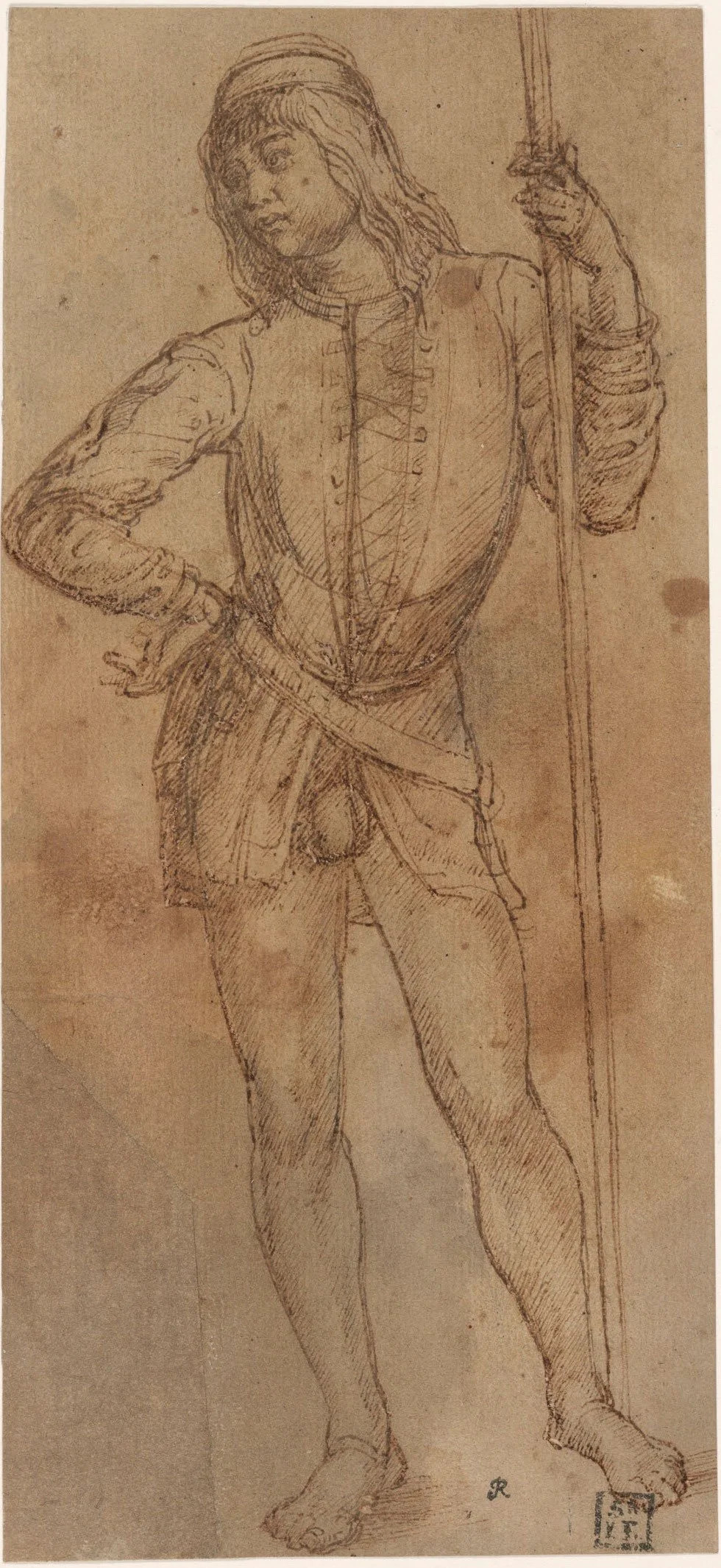
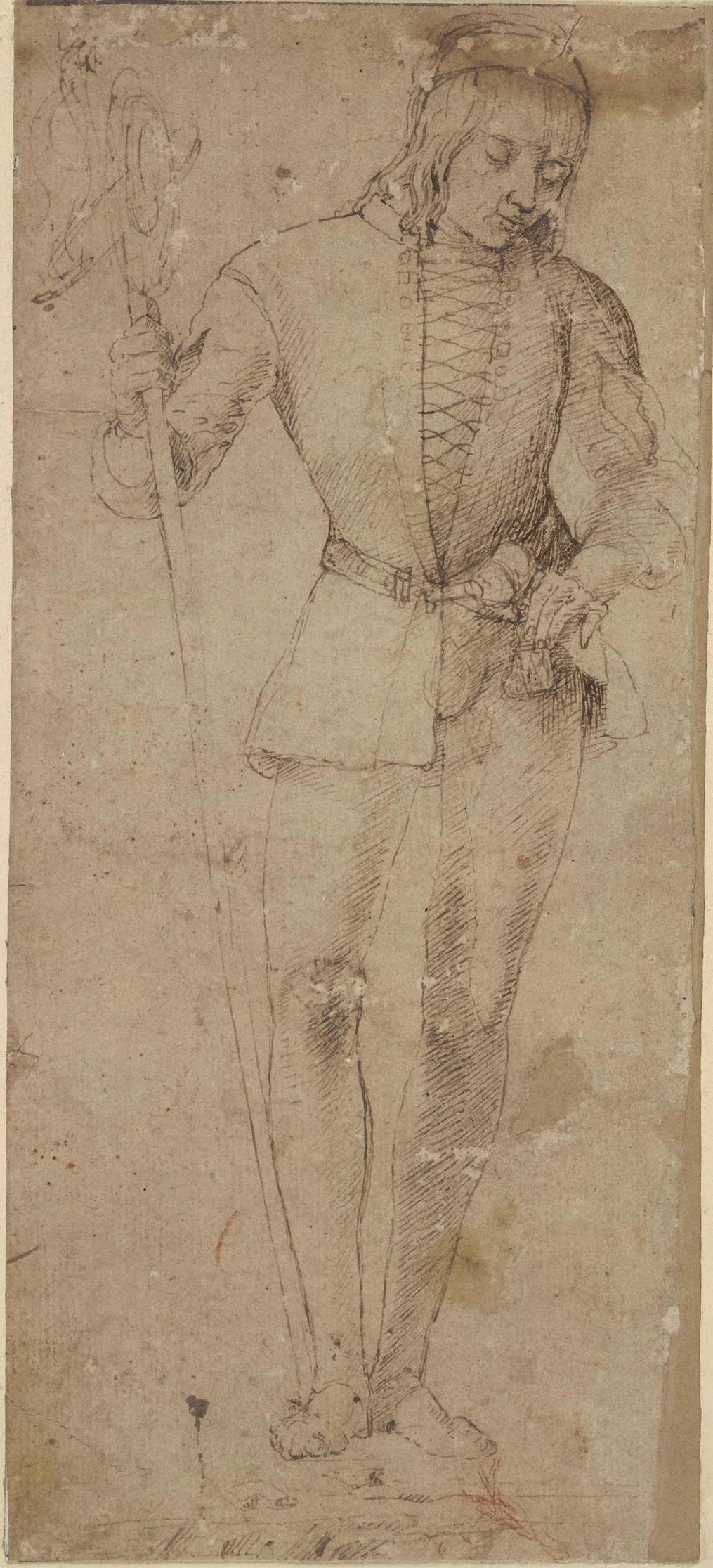
It is somewhat ironic that the authorship of this month’s ‘fake’ drawing is more secure than that of the ‘original’. While one of the drawings can be securely dated to the Renaissance, the other is a 20th century forgery, drawn both on and with Renaissance materials, but which is which?
-
The original is the right/lower image.
Upper Image: Eric Hebborn (1934–1996), Standing Youth Holding a Staff, 20th-century forgery in the manner of Francesco del Cossa, Morgan Library and Museum, New York, inv. no.: 1967.8
Lower Image: Attributed to Francesco del Cossa (1435/6–1477/8), A Young Man Standing to Front, Looking Down, holding a staff, British Museum, London, inv. no.: 1946,0713.212
The lower drawing is in held in the British Museum in London and is attributed to the fifteenth-century Ferrarese artist Francesco del Cossa, although it has historically been linked to other Quattrocento artists like Niccolò Alunno, Vincenzo Foppa and Ercole de' Roberti. The upper drawing is held in the Morgan Library & Museum in New York was originally attributed to del Cossa due to a favourable stylistic and compositional comparison between the two drawings, however it eventually proved to be fake and proved instrumental in unveiling the forgeries of its true maker, Eric Hebborn, in the late 1970s.
While studying a third drawing believed to by del Cossa and a fourth drawing by his contemporary Sperandio Savelli at the National Gallery of Art in Washington,the curator of drawings, Konrad Oberhuber, observed certain stylistic overlaps, a precise correspondence in the paper type and the deliberate simulation of age. He conferred with Felice Stampfle, curator at the Morgan Library & Museum in New York, to share his concerns and compare the two ‘del Cossas’. It had already been noted that two collectors' marks on the Morgan drawing were likely later imitations, and with Oberhuber’s latest revelation, Stampfle too began to doubt the authenticity of all three drawings.
It transpired that the three drawings had been acquired from the reputable London dealer Colnaghi around a decade earlier. When asked, Colnaghi named their own source as Eric Hebborn which confirmed certain suspicions of his fraudulent dealings. The game was up for Hebborn and on 10 March 1978, Colnaghi published a statement in the Times of London. Refunds were issued to those who had acquired Hebborn’s drawings, but he himself was not named in the announcement for fear of libel charges as the materials used by the artist were technically ‘of the period’ and connoisseurship alone was unlikely to be decisive in court.
Could one of art’s greatest mysteries at last be solved? Who was the luminous girl with a pearl earring in Vermeer's iconic painting? Professor Suzannah Lipscomb is joined by Andrew Graham-Dixon who believes he's finally identified her.
For francophone readers, Adriane Grünberg and Marie Peronnet’s podcast series Affaires de familles visited the de Bayser family in their latest episode. Key figures in the world of Old Master drawings, the four brothers, Augustin, Louis, Matthieu and Patrick recounted, among other adventures, the day when they discovered a treasure.
Back in May 2020, Getty drawings curator Stephanie Schrader spoke with Jim Cuno, president of the J. Paul Getty Trust, about the upside-down world of An Enchanted Cellar with Animals, made by Cornelis Saftleven around 1655 to 1670. The recording was recently uploaded to the Getty Museum’s Youtube channel with further information and a link to the discussed artwork.
Almost a century after Baron Edmond de Rothschild’s enormous collection of drawings was donated to the Louvre, historians are still considering his impact. In Town and Country, James Mcauley reflects on de Rothschild’s progress from a schoolboy collector to a compiler of the exceptional, from Dürer to Raphael.