Sir Anthony van Dyck (1599–1641)
Trois Crayons Magazine, June 2026
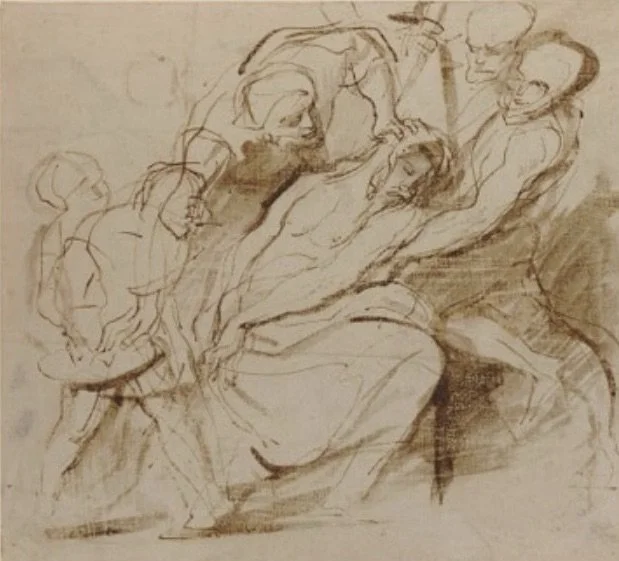
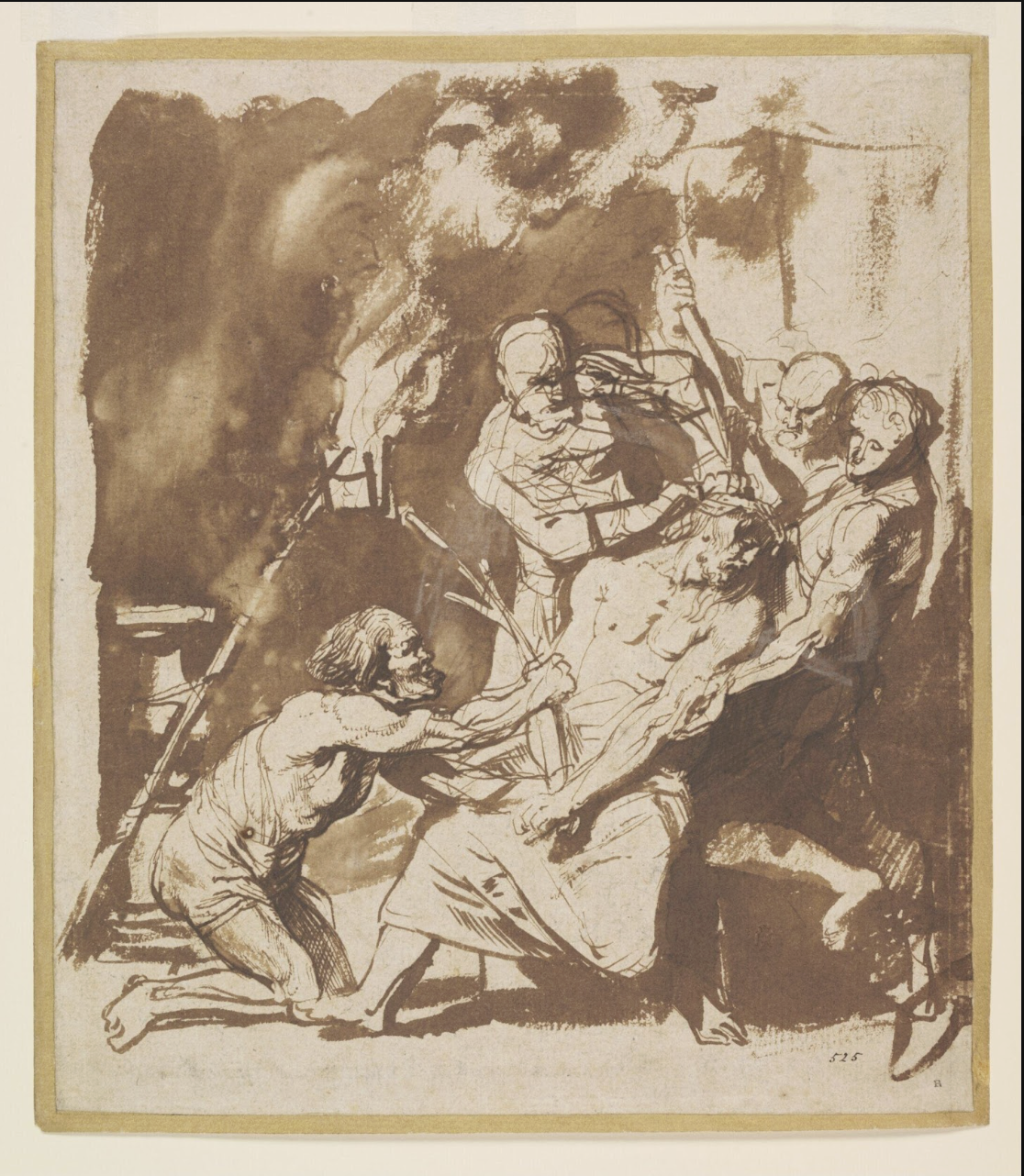
These two drawings were originally thought to be studies for two closely related paintings by Sir Anthony van Dyck: one in the Kaiser Friedrich Museum, Berlin, which was destroyed during the Second World War; the other, a slightly smaller version of the composition, is in the Museo del Prado, Madrid. While one of the drawings dates to c. 1618–20, the other is a twentieth-century forgery.
-
The original is the lower (right) image.
Upper (Left) Image: Eric Hebborn (1934–1996) in the manner of Sir Anthony van Dyck, Christ Crowned with Thorns, the British Museum, London, inv. 1970,0411.21
Lower (Right) Image: Anthony van Dyck (1599–1641), Christ Crowned with Thorns, Victoria & Albert Museum, London, inv. DYCE.525
Drawn “in the style of” Anthony van Dyck, the upper drawing is a twentieth-century creation by the renowned forger Eric Hebborn. Although seemingly executed in van Dyck’s free manner, the drawing was in fact carefully constructed to be plausibly interpreted as a “lost” preparatory study related to van Dyck’s painting in Madrid and the lost version formerly in Berlin. The Hebborn drawing shows notable differences from the van Dyck at the V&A, ensuring that it would not be perceived as a direct copy but rather as another preparatory step in the same creative process.
Tactically, Hebborn allowed others to establish the hypothetical connection between his drawing and van Dyck’s paintings, and the sheet was consequently acquired by the British Museum from Colnaghi’s in 1970 as a work by van Dyck. Suspicions that the drawing was a forgery first arose in 1978 and were confirmed when Hebborn wrote to the museum in 1990 claiming it as his own work. It was subsequently reattributed and transferred to the museum’s “fake box” in January 1991.