Louis Carrogis, called Carmontelle (1717–1806) The Beautiful Milkmaid of Villers Cotterets
Trois Crayons Magazine, June 2026
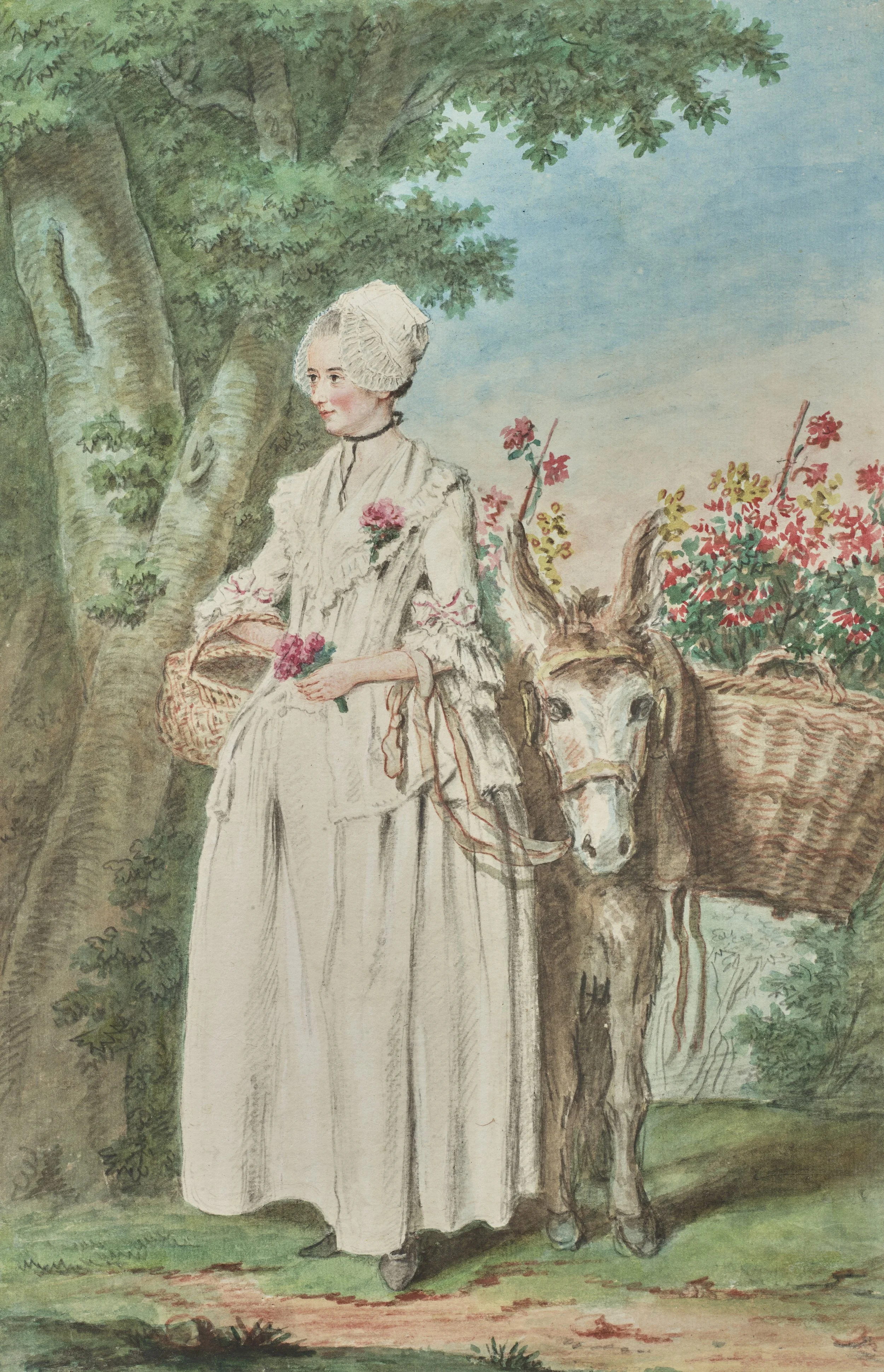
Louis Carrogis, called Carmontelle (1717–1806), The Beautiful Milkmaid of Villers Cotterets. Private collection, France
Charlotte Roosen, Assistant Curator of the exhibition Michaelina Wautier, Painter at the Kunsthistorisches Museum, Vienna, has kindly chosen our drawing of the month.
The Beautiful Milkmaid of Villers Cotterets
Black and red chalk, watercolour, 318 x 203 mm, Private collection, France
On 22 June 2026, the Musée de Picardie in Amiens will open an exhibition entitled French Drawings from French Private Collections. It will feature 170 French drawings from French private collections executed between 1589, the first year of the reign of King Henry IV, and 1789. This is the third exhibition of drawings from French private collections that I have curated. The first two took place in Caen and Rennes respectively and were devoted to Italian Renaissance and Baroque drawings. There, Catherine Goguel and Patrick Ramade were my co-curators. In Amiens, Patrick and I were joined by Pierre Stepanoff, the director of the Amiens museum and a specialist in French art.
Whereas for the Italian exhibitions we had to scour collections to assemble the groups, for the French show our principal challenge was to sift through the abundance of material we encountered. Of course, we found outstanding drawings by Claude, Poussin, Le Brun, Fragonard, Robert and all the good names that one could expect. Yet, for me, one drawing stands out from the eighteenth-century works. It embodies, perhaps better than any other drawing, the Douceur de vivre à la française. It is the beautiful milkmaid by Carmontelle. When we began conceiving the exhibition in Amiens six years ago, that drawing was at the top of my list as I have known it since 1995, when I sold it at Christie’s. I have always greatly admired it, and I knew it had returned to France in 2015. The owner kindly lent it to our show.
The drawing depicts “the beautiful milkmaid of Villers Cotterets”, as the artist himself described her on the mount. The beautiful young girl is rosy-cheeked, dressed in white, and wears a white bonnet. She holds a bouquet of violets while her donkey is carrying a large bundle of flowers. The gentle animal stands beside her looking directly at the artist. The girl carries a wicker basket probably containing the cream she is delivering to the Duc d’Orléans. Carmontelle added on the mount that “the good Duke of Orléans liked very much this charming country girl who prepared fresh cream for the prince and offered him the most beautiful flowers of each season”.
Born Louis Carrogis, Carmontelle was the son of a humble Parisian cobbler. He began a career in the army, but he showed more talent for carving turkeys and amusing the officers with his caricatures and portraits than for fighting. It was these skills that brought him into the entourage of the Duc d’Orléans, a cousin of King Louis XV and one of the richest men in France – said by some to be even richer that his cousin. The duke, nicknamed “the good fat duke”, was a real bon vivant, hence the etiquette at the court of the Orléans was more relaxed than at Versailles, especially at the family’s summer castle at Villers-Cotterêt, north of Paris near Amiens. Carmontelle, initially hired to educate the duke’s sons, quickly took over the court’s entertainments. He organised parties, wrote plays, designed gardens and even invented a precursor of cinema to amuse the Orléans family during the long winter evenings. One of Carmontelle’s occupations was to portray each visitor to the court. He sketched their profile and costume and, according to Baron Grimm, would draw a full portrait in two hours. He produced close to a thousand of these portraits.
But that quiet world was soon to disappear. The duke died in 1785; his son, Louis-Philippe d’Orléans, was guillotined in 1793 and the family lost its fortune and dispersed. Subsequently, Carmontelle moved to Paris and in his old age frequented the remnants of the Orléans court that had not emigrated. Madame de Genlis, a former mistress of Louis-Philippe d’Orléans, described him “as happy as he deserved to be his character was gentle, his manners were pure”. He had kept his watercolour portraits, probably browsing through them from time to time to remember the good old days. When he died aged 89 at his home, 22 rue Vivienne, the portraits were bought by his old friend, the Chevalier de Lédans. Only a few years later, they were acquired by John Duff and taken to his castle in Banff, at the northern tip of Scotland, seemingly never to be returned to France.
In a reversal of fortune typical of the Orléans family, the son of the guillotined duke became King Louis Philippe I in 1830. As the French love revolutions, he too was exiled to England only eighteen years later. From then on, his son, the Duc d’Aumale‘s life obsession became to collect art and recreate the vanished world of Orléans. Bringing the Carmontelle drawings back to France was at the top of his list, and he managed to purchase most of the group in 1877. Unbeknownst to him, the Duff family had retained their favourite drawings, including The Beautiful Milkmaid of Villers Cotterets. Duff’s descendants auctioned them in 1995 and the milkmaid, after a twenty year sojourn in London with John Winter, finally returned to France, two hundred years after the death of the artist.
Carmontelle’s beautiful milkmaid is now number 119 in the show of French drawings at the Musée de Picardie, on view until 26 September, along with 169 other drawings, most of which have never been exhibited or published. The catalogue, published by Sans Egal, will be available a few days before the opening of the exhibition through the usual channels.
Poussin, Watteau, Fragonard, David: French Drawings from French Private Collections is open at the Musée de Picardie, Amiens, until 27 September.