As June gives way to July, the drawings world once again turns its attention to London. With major drawings sales at Sotheby’s and Christie’s, Treasure House Fair, the multi-venue collegial event Classic Art London, independent gallery shows and a symposium on Early Netherlandish drawings at the Warburg Institute, there is no shortage of opportunities to engage with works on paper in the capital.
In this issue, we turn our attention to the events taking place in London and beyond. We begin with news headlines, gallery listings, announcements, lectures and events, and an overview of recent institutional acquisitions. For our Drawing of the Month, Nicolas Schwed, co-curator of Poussin, Watteau, Fragonard, David: French Drawings from French Private Collections at the Musée de Picardie, shares a personal highlight from the exhibition. For this month’s Demystifying Drawings feature, Emma Ricci inaugurates a new column with a profile of the influential German emigré art dealer Hans Calman, while Vittoria Cervini visits Early Netherlandish Drawings at the British Museum for the Review section. Exhibition listings are followed by the month’s Real or Fake quiz, and the issue concludes with a trio of audio, video and literary recommendations.
I would also like to express our thanks to all who have responded so enthusiastically to the launch of our watermark-inspired merchandise. Spotting our Sun in Splendour tote bag “in the wild” in London last week was a thrill. All items from the collection remain available on our website.
For next month’s edition, please direct any recommendations, news stories, feedback or event listings to tom@troiscrayons.art.







IN GALLERY, ART FAIR AND AUCTION NEWS
Bruno de Bayser, a pioneer of the drawings market in Paris and the father of a great drawings dynasty, has died at the age of 84. Carole Blumenfeld has penned tributes in La Gazette Drouot, and The Art Newspaper, as has Etienne Dumont in Bilan.
4–10 June: Exposition Inaugurale at Galerie Ambroise Duchemin (Paris). Organised by Carola Scisci Fine Art.
4 June – 10 July: Menno Balm: Drawn from Marble at Charles Ede (London).
4 June – 11 July: Max Beckmannat Hauser & Wirth (Basel).
9–20 June: Master Painters & Pioneers at Gallery Eight (London). Organised by Winsor Birch.
11–14 June: Open Gallery Weekend at Galerie Lowet de Wotrenge (Antwerp).
12–26 June: Gustave Courtois (1852-1923): Œuvres de jeunesse at Galerie La Nouvelle Athènes (Paris).
Open until 17 June: Gustav Klimt: Women at Gladstone (New York). Organised in collaboration with Richard Nagy Ltd.
18 June – 17 July: Valentin van Orley and his World: A Rediscovery in Early Netherlandish Painting at Stuart Lochhead Sculpture (London).
22 June – 3 July: Classic Art Londonat various venues (London).
22 June – 3 July: A Selling Exhibition of Women Artists at Darnley Fine Art (London).
22 June – 8 July: `Go to Nature for Everything' - Plein Air Sketches from 18th and 19th Centuries at Guy Peppiatt Fine Art (London).
22 June – 24 July: Drawing by Design: Drawings for Architecture, Ornament, Design and the Decorative Arts from the 16th to the 20th century at Stephen Ongpin Fine Art (London)
25 June – 4 July: British Women Artists 1780-1950 at Gallery 8 (London). Organised by Karen Taylor Fine Art.
23 June – 10 July: Drawings and Watercolours at The Maas Gallery (London).
23–26 June: Figure di Carta IX at Cortona Fine Art (Milan).
24–30 June: Treasure House Fair at Royal Hospital Chelsea (London).
25 June – 2 July: Northern European Drawings 1550–1850 at Day & Faber (London).
Open until 26 June: Édouard Vuillard: Selected Works on Paper at Jill Newhouse Gallery (New York). Organised in association with Christian Neffe Degandt.
Open until 27 June: In the Wake of Sargent – The de Glehn and Monod Painting Circle at Messum’s (London).
30 June: Old Masters Evening Sale at Christie’s (London). 18:30 BST.
1 July: Master Works on Paper from Five Centuries at Sotheby’s (London). 10:00 BST.
1 July: Old Masters to Modern Day Sale: Paintings, Drawings, Sculpture at Christie’s (London). 12:00 BST.
1 July: Old Master Paintings at Bonhams (London). 14:00 BST.
2 July: Old Master Paintings & Works on Paper Day Auction at Sotheby’s (London). 11:00 BST.
Open until 3 July: Robert Colquhoun & Robert MacBryde: The Celtic Soul at Brooke-Walder Fine Art (London).
Open until 1 August: Francis Picabia – Expanding Horizons at Hauser and Wirth (London)
Open until 14 August: Leon Spilliaert: Through Half–Open Doors at Patrick Derom Gallery (Brussels).
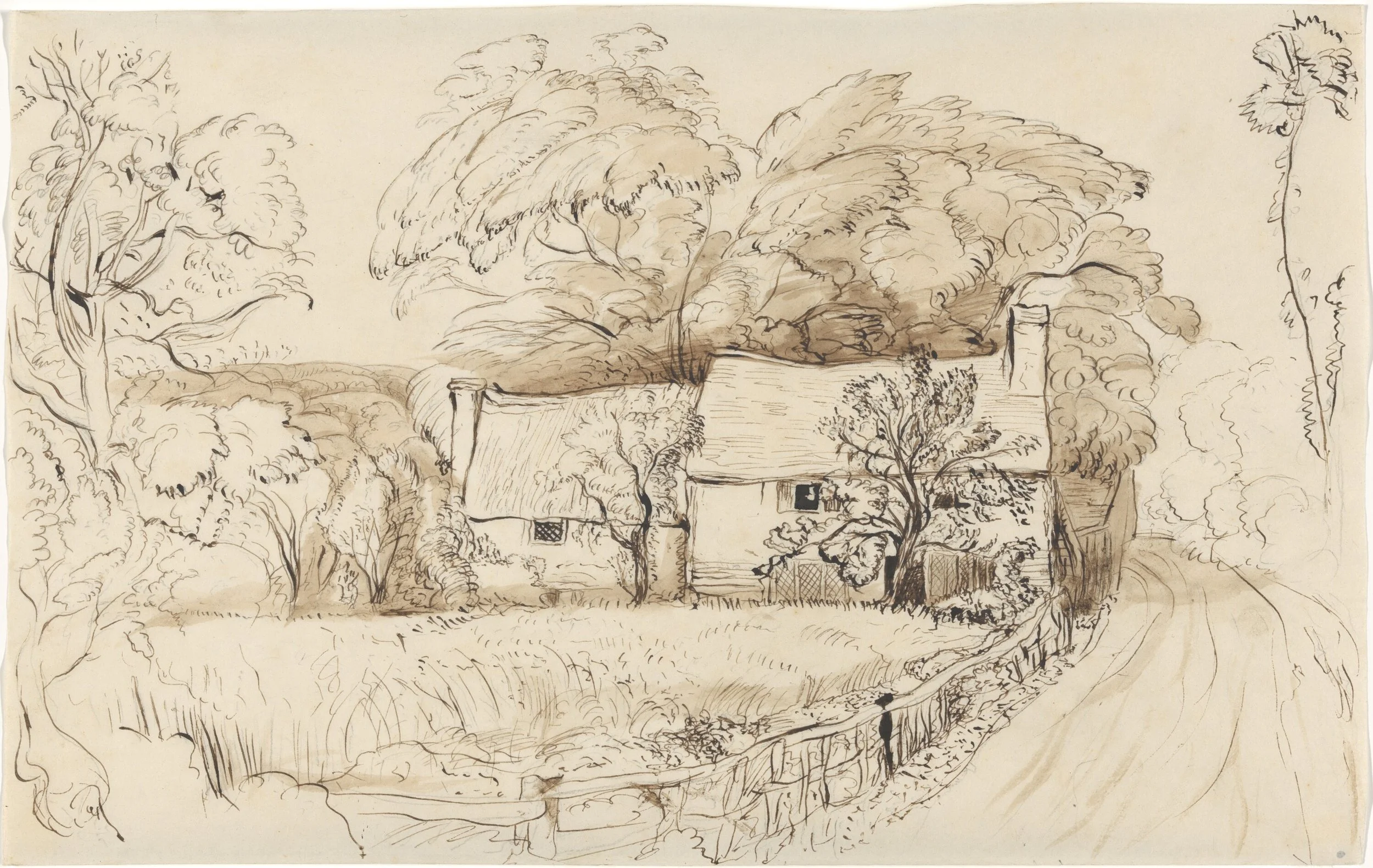
John Linnell (1792–1882), A Farmhouse at Shoreham. J. Paul Getty Museum, Los Angeles
IN LECTURE AND EVENT NEWS
9 June – Conference: Imagining Britain: Postgraduate and Early Career Research in British and Irish Art at the Courtauld Institute, Vernon Square (London). 10:00 BST. Free; registration required. Organised by Claire Ó Nualláin and Clara Shaw, supported by the CHASE Doctoral Training Partnership and the Manton Centre for British Art.
9 June – Lecture: Drawing and the Early Modern City at the Morgan Library & Museum (New York). Speaker: Katie Scott. 18:00 EDT. Free; registration required.
9–10 June – Conference: Howard Burns Seminar Series on Architectural Drawings: Architectural Drawings in the Renaissance: Anonymous Artists, Copyists, Architects at Kunsthistorisches Institut in Florenz – Max-Planck-Institut (Florence). Time: TBC. Free, subject to availability. Organised by Guido Beltramini and Bianca de Divitiis, in collaboration with the GDSU.
12 June – Symposium: On the margins? Works on paper by Dutch and Belgian amateur artists, ca. 1550-1850 at Teylers Museum (Haarlem). 09:45 CEST. €17.50. Organised by Teylers Museum and Delineavit et Sculpsit.
12 June – Conference: SALON Conference 2026: Unreliable Lives: Rethinking the Artist’s Biography in the Nineteenth Century at Singer Laren (Laren). 09:30 CEST. €40; €15 (students).
18–19 June – Conference: James McNeill Whistler in Action at Tate Britain (London). 09:00 BST. £5 (per diem).
19 June – Lecture: Frederic Church at 200 | America’s Global Artist at National Galleries of Scotland (Edinburgh and online). Speaker: Sean Sawyer. 12:45 BST. Free; registration required.
22 June – Lecture: Gwen John: A Seer of Strange Beauties at Paul Mellon Centre (London and online). Speakers: Lucy Wood, Rachel Stratton, Patrick Elliott. 17:30 BST. Free; reservation required.
22 June–3 July – Event series: Classic Art London at various venues (London).
26 June – Symposium: Early Netherlandish Drawings Symposium at the Warburg Institute (London). 10:00 BST. Free; reservation required.
Call for papers: Society for Renaissance Studies 12th Biennial Conference at the Warburg Institute and Senate House (London). Application deadline: 25 September. Event dates: 30 June – 3 July 2027.
Call for papers: Disegnare per la Scultura: 1400–1970 at Scuola Normale Superiore (Pisa). Application deadline: 31 August. Event dates: 14–15 May 2027.
IN LITERARY, MUSEUM AND ACADEMIC NEWS
Museum merger: The Metropolitan Museum of Art and the Ronald S. Lauder Neue Galerie New York have announced plans for a landmark merger.
New publication: The reception of Annibale Carracci’s drawings in Britain: a study of the sources, collectors, market and taste by Elania Pieragostini. Edizione Efesto. €30.
New publication: Gustav Klimt: Die Zeichnungen. The digital catalogue raisonné of Gustav Klimt's drawings has been published by the Albertina. Online. Free.
New publication: Odilon Redon: Otherworldly Visions by Danielle Canter. J. Paul Getty Museum. Published 30 June. $24.95.
New publication: The summer issue of Master Drawings (Vol. 64, No. 2) is out now and honours former Editor of the journal, Jane Turner.
Course opportunity: Drawings in Theory and Practice: Connoisseurship - Collecting - Curatorial - Practice at various venues (Vienna). Application deadline: 8 June. Course dates: 27–31 July. Organised by the Albertina and the Institute of Art History at the University of Vienna with generous support from the Wolfgang Ratjen Foundation.
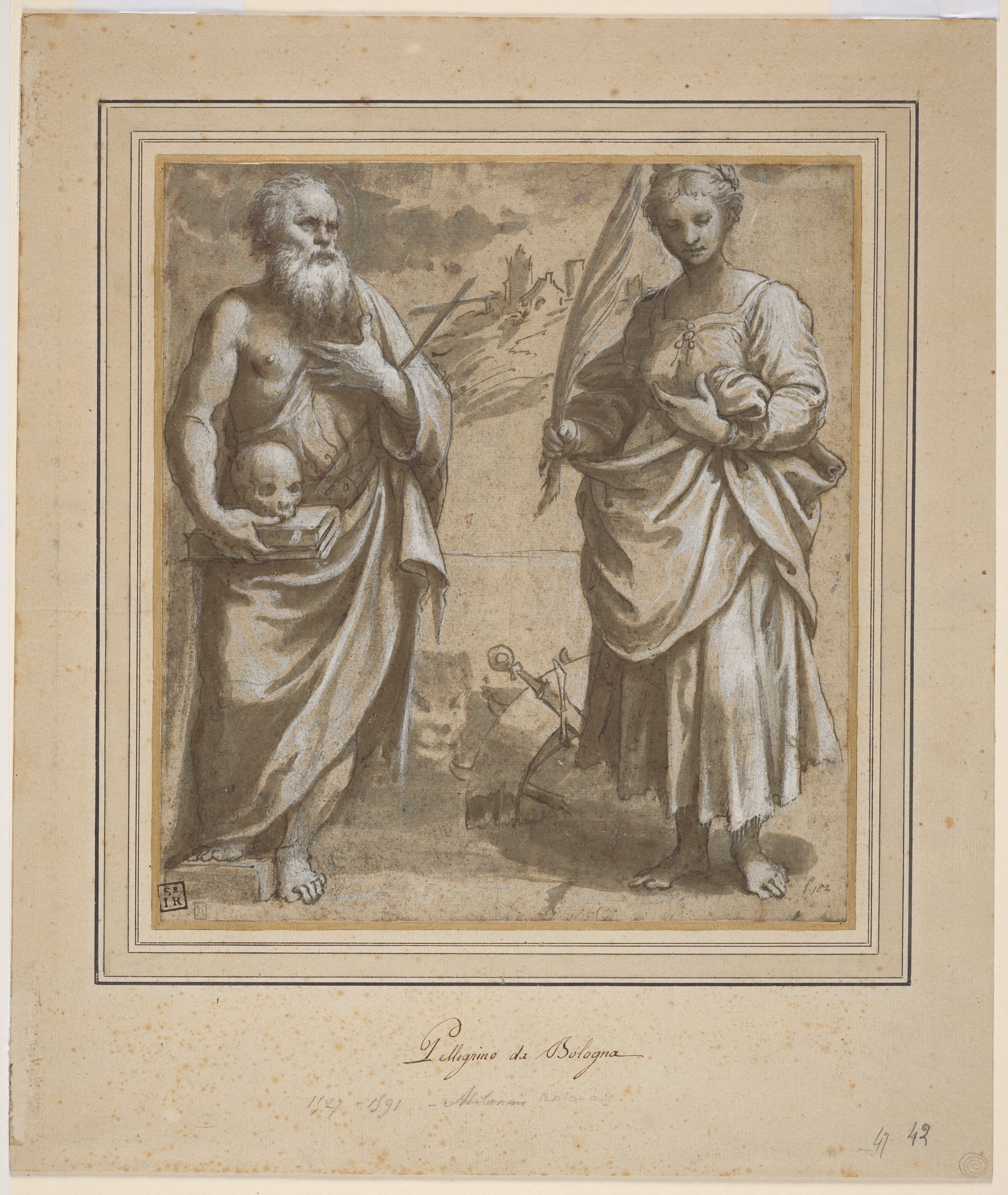
Girolamo da Treviso the Younger (1497–1544), Saint Jerome and Saint Catherine of Alexandria Standing in a Landscape. Cleveland Museum of Art, Cleveland.
IN ACQUISITION NEWS
Girolamo da Treviso the Younger (1497–1544), Saint Jerome and Saint Catherine of Alexandria in a Landscape. Acquired by The Cleveland Museum of Art, Cleveland, from Sotheby’s, New York (sale: 4 February 2026).
Georg Pencz (1500–1550), Portrait of Pisanello and Portrait of Pier Candido. Acquired by The Metropolitan Museum of Art, New York, from Hill-Stone, Inc., Dartmouth.
Niccolò dell'Abate (c. 1512–1571), Noli me tangere (Christ and the Magdalene). Acquired by the Nationalmuseum, Stockholm, from Sotheby’s, New York (sale: 4 February 2026).
Peter Paul Rubens (1577–1640), Three figures in classical robes, presumably apostles (recto); Handwritten letter to Cristoforo Roncalli, called il Pomarancio (verso). Acquired by the Rubenshuis, Antwerp, from Day & Faber, London.
Carlo Maratti (1625–1713), Studies of figures for the Immaculate Conception in the da Silva Chapel in Sant'Isidoro Agricola in Rome. Acquired by the Rijksmuseum, Amsterdam, from Sabrier & Paunet, Paris.
Charles de la Fosse (1636–1716), Reclining nude man. Acquired by Musée National des Chatêaux de Versailles et de Trianon, Versailles, from Rossini, Paris (sale: 20 March 2026) (via La Tribune de l’art).
Antoine Coypel (1661–1722), Apollon au milieu des Muses and Apollon et Daphné. Acquired by Musée National des Chatêaux de Versailles et de Trianon, Versailles, from Millon, Paris (sale: 26 March 2026) (via La Tribune de l’art).
Charles-Francois Daubigny (1817–1878), Sunset. Acquired by Harvard Art Museums, Cambridge, from Mireille Mosler (New York).
Max Beckmann (1884–1950), Large design drawing for Resurrection. Acquired by the Staatsgalerie Stuttgart, Stuttgart, from Mayen Beckmann.
Leonora Carrington (1917–2011), The Horse. Acquired by The Morgan Library & Museum, New York, from Nagas, New York.
The J. Paul Getty Museum, Los Angeles, has announced six recent acquisitions made in February at the Sotheby’s sale of Diane Nixon’s collection (sale: 4 February 2026). The article by Julian Brooks includes:
Baccio Bandinelli (1493–1560), The Descent from the Cross.
Domenico Campagnola (c. 1500–1564), Landscape with a Fortified Town and Rising Sun.
Annibale Carracci (1560 –1609), Study of a Tree.
John Linnell (1792–1882), A Farmhouse at Shoreham.
Edward Burne-Jones (1833–1898), Phineus and His Courtiers Turned to Stone.
Odilon Redon (1840–1916), Head of a Young Girl in Profile.
Louis Carrogis, called Carmontelle (1717–1806)
The Beautiful Milkmaid of Villers Cotterets
Black and red chalk, watercolour, 318 x 203 mm, Private collection, France
Louis Carrogis, called Carmontelle (1717–1806), The Beautiful Milkmaid of Villers Cotterets. Private collection, France
Nicolas Schwed, co-curator of Poussin, Watteau, Fragonard, David: French Drawings from French Private Collections, has kindly chosen our drawing of the month.
On 22 June 2026, the Musée de Picardie in Amiens will open an exhibition entitled French Drawings from French Private Collections. It will feature 170 French drawings from French private collections executed between 1589, the first year of the reign of King Henry IV, and 1789. This is the third exhibition of drawings from French private collections that I have curated. The first two took place in Caen and Rennes respectively and were devoted to Italian Renaissance and Baroque drawings. There, Catherine Goguel and Patrick Ramade were my co-curators. In Amiens, Patrick and I were joined by Pierre Stepanoff, the director of the Amiens museum and a specialist in French art.
Whereas for the Italian exhibitions we had to scour collections to assemble the groups, for the French show our principal challenge was to sift through the abundance of material we encountered. Of course, we found outstanding drawings by Claude, Poussin, Le Brun, Fragonard, Robert and all the good names that one could expect. Yet, for me, one drawing stands out from the eighteenth-century works. It embodies, perhaps better than any other drawing, the Douceur de vivre à la française. It is the beautiful milkmaid by Carmontelle. When we began conceiving the exhibition in Amiens six years ago, that drawing was at the top of my list as I have known it since 1995, when I sold it at Christie’s. I have always greatly admired it, and I knew it had returned to France in 2015. The owner kindly lent it to our show.
The drawing depicts “the beautiful milkmaid of Villers Cotterets”, as the artist himself described her on the mount. The beautiful young girl is rosy-cheeked, dressed in white, and wears a white bonnet. She holds a bouquet of violets while her donkey is carrying a large bundle of flowers. The gentle animal stands beside her looking directly at the artist. The girl carries a wicker basket probably containing the cream she is delivering to the Duc d’Orléans. Carmontelle added on the mount that “the good Duke of Orléans liked very much this charming country girl who prepared fresh cream for the prince and offered him the most beautiful flowers of each season”.
Born Louis Carrogis, Carmontelle was the son of a humble Parisian cobbler. He began a career in the army, but he showed more talent for carving turkeys and amusing the officers with his caricatures and portraits than for fighting. It was these skills that brought him into the entourage of the Duc d’Orléans, a cousin of King Louis XV and one of the richest men in France – said by some to be even richer that his cousin. The duke, nicknamed “the good fat duke”, was a real bon vivant, hence the etiquette at the court of the Orléans was more relaxed than at Versailles, especially at the family’s summer castle at Villers-Cotterêt, north of Paris near Amiens. Carmontelle, initially hired to educate the duke’s sons, quickly took over the court’s entertainments. He organised parties, wrote plays, designed gardens and even invented a precursor of cinema to amuse the Orléans family during the long winter evenings. One of Carmontelle’s occupations was to portray each visitor to the court. He sketched their profile and costume and, according to Baron Grimm, would draw a full portrait in two hours. He produced close to a thousand of these portraits.
But that quiet world was soon to disappear. The duke died in 1785; his son, Louis-Philippe d’Orléans, was guillotined in 1793 and the family lost its fortune and dispersed. Subsequently, Carmontelle moved to Paris and in his old age frequented the remnants of the Orléans court that had not emigrated. Madame de Genlis, a former mistress of Louis-Philippe d’Orléans, described him “as happy as he deserved to be his character was gentle, his manners were pure”. He had kept his watercolour portraits, probably browsing through them from time to time to remember the good old days. When he died aged 89 at his home, 22 rue Vivienne, the portraits were bought by his old friend, the Chevalier de Lédans. Only a few years later, they were acquired by John Duff and taken to his castle in Banff, at the northern tip of Scotland, seemingly never to be returned to France.
In a reversal of fortune typical of the Orléans family, the son of the guillotined duke became King Louis Philippe I in 1830. As the French love revolutions, he too was exiled to England only eighteen years later. From then on, his son, the Duc d’Aumale‘s life obsession became to collect art and recreate the vanished world of Orléans. Bringing the Carmontelle drawings back to France was at the top of his list, and he managed to purchase most of the group in 1877. Unbeknownst to him, the Duff family had retained their favourite drawings, including The Beautiful Milkmaid of Villers Cotterets. Duff’s descendants auctioned them in 1995 and the milkmaid, after a twenty year sojourn in London with John Winter, finally returned to France, two hundred years after the death of the artist.
Carmontelle’s beautiful milkmaid is now number 119 in the show of French drawings at the Musée de Picardie, on view until 26 September, along with 169 other drawings, most of which have never been exhibited or published. The catalogue, published by Sans Egal, will be available a few days before the opening of the exhibition through the usual channels.
Poussin, Watteau, Fragonard, David: French Drawings from French Private Collections is open at the Musée de Picardie, Amiens, until 27 September.
Dealer Portraits: Hans M. Calmann (1899–1982): The Hamburg Banker Who Became One of London’s Greatest Drawings Dealers
Emma Ricci, Stephen Ongpin Fine Art
Hans Maximilian Calmann (1899–1982) was born into Hamburg’s Jewish banking elite. After doctoral studies in political science, he joined the family business - against his better instincts - as a stockbroker, while beginning to collect ethnographic objects. In 1937, he fled Nazi Germany with his wife Gerta, four children and a Roman bronze head packed in a wooden crate. He arrived in London with no connections, no English and no money, yet he opened a single-room gallery in St James’s for £150 a year. He was not, in any obvious sense, prepared for this. What he had was an eye for quality and the confidence to act on it.
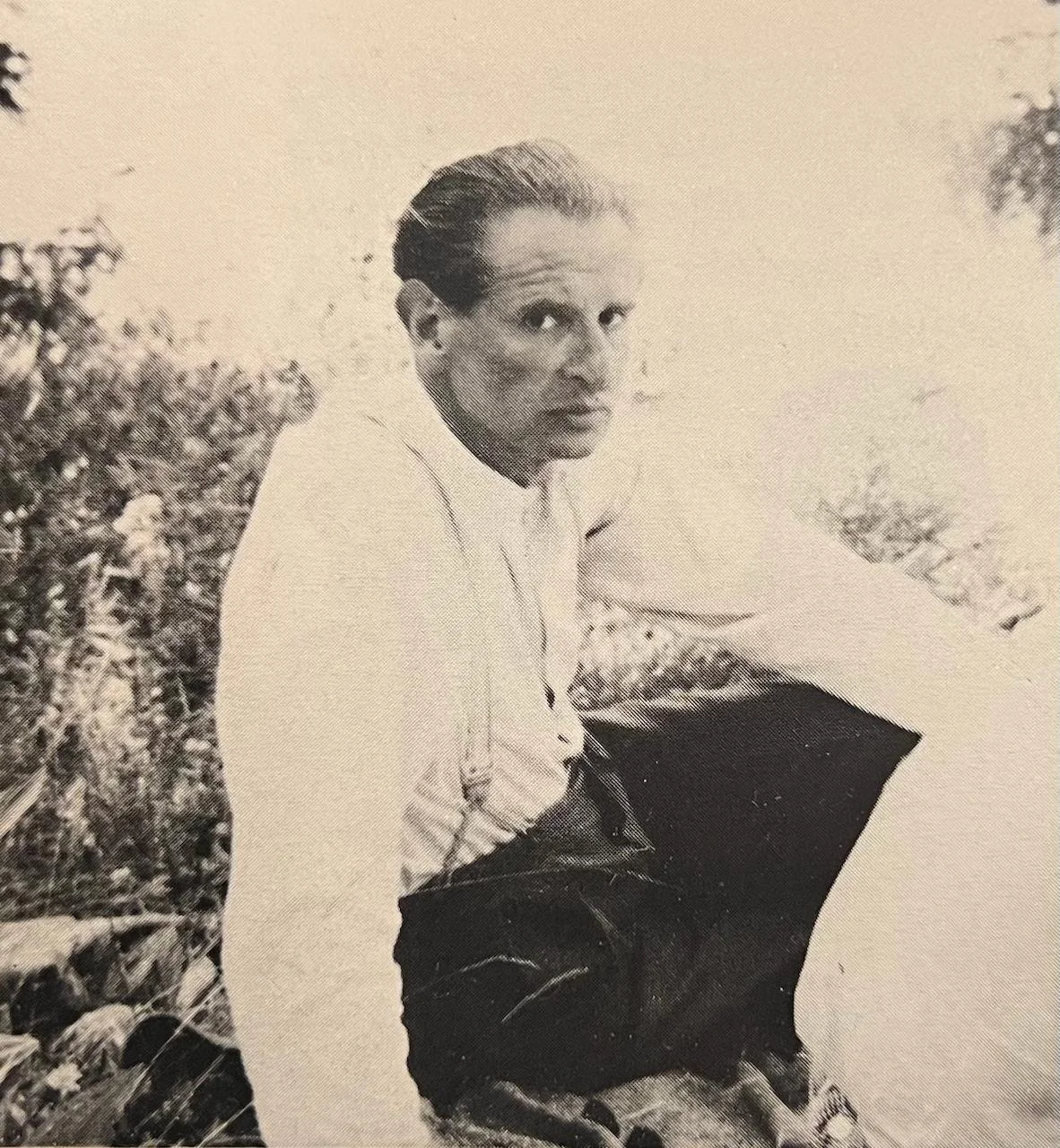
Hans Calmann, c. 1959. Calmann Family Estate
He started exploring the London scene with exhibitions covering various themes, from Balinese sculpture to British modernism. He then decided, after a few years, to focus decisively on Old Master drawings, a market he saw as wide open. The spectacular 1936 sale of the Henry Oppenheimer collection at Christie’s had already demonstrated that exceptional material could command exceptional prices. What did not yet exist, however, was a stable market for good quality, mid-market sheets, the Baroccis, Castigliones and Claudes, that would become Calmann’s daily bread. He saw that gap clearly and stepped into it.
It was a Liotard drawing that marked Calmann’s proper debut as a dealer in drawings in 1938. Preparatory for one of the artist’s final pastels depicting his daughter playing chess with an abbot, Calmann bought the drawing from Liotard’s descendants for £80. He sat with it for three months before selling it to the Basel collector Christoph Bernoulli for £150. By the 1950s, he was selling to major institutions across Europe and North America, such as the Morgan Library, the Ashmolean Museum, the Harvard / Fogg Art Museum and the British Museum. Loyal private clients included Robert Landolt, Marie-Louise Metz, Princesse de Cröy, Frits Lugt and Sir Robert Witt. By 1960 he had become, alongside Colnaghi’s, one of the two most powerful players in the field.
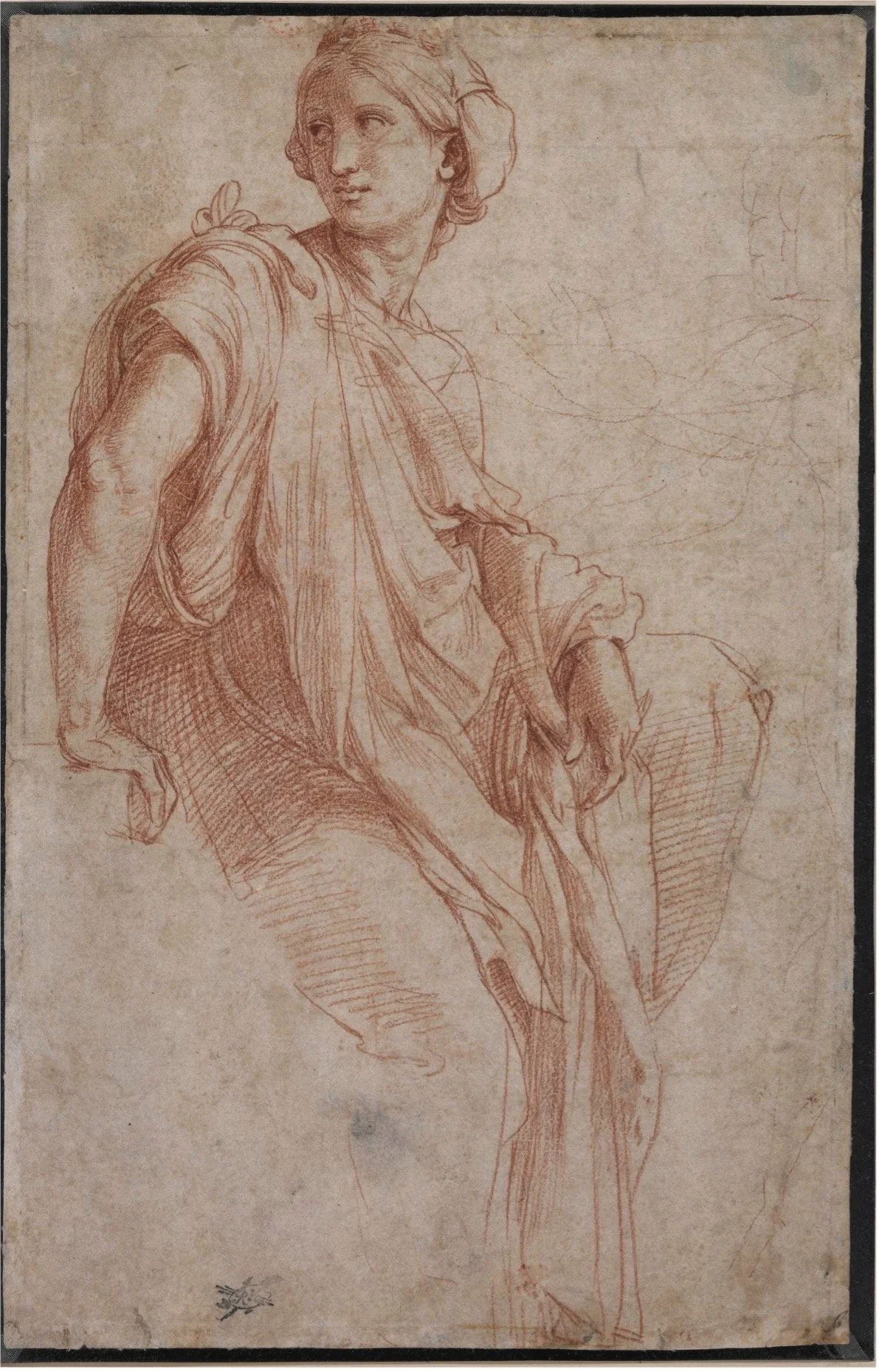
Raphael, The Phrygian Sibyl, c. 1511. British Museum, London inv. 1953,1010.1 © The Trustees of the British Museum
A major highlight of Calmann’s career occurred in 1952, when he walked into Wildenstein on Bond Street and found, buried among a lot of nondescript drawings, a superb red chalk study of a sibyl. He bought the entire group for £1,300. Immediately, he took the red chalk sheet to A. E. Popham, Keeper of Prints and Drawings at the British Museum, who identified it as a study by Raphael for the Phrygian Sibyl in the Chigi Chapel fresco at Santa Maria della Pace in Rome. The drawing had been incorrectly attributed for thirty years after an American scholarly authority had dismissed it as inauthentic. The British Museum acquired it for £2,000. Not only was it good profit, this sale was a noteworthy achievement as Calmann had bought something overlooked by Wildenstein, a “maison” which represented the art market establishment. This story also revealed one of Calmann’s methods: he could identify the quality of the drawing, but it was Popham’s attribution that could make the sale. Indeed, throughout his career, Calmann cultivated a small circle of trusted scholars, including Popham, Philip Pouncey and Frits Lugt, as the network that gave his judgment institutional credibility.
Calmann’s great rival was James Byam Shaw of Colnaghi’s. Byam Shaw was his antithesis: Oxford-educated, deeply scholarly, and marked by English gentlemanly ease. Calmann instead was famously blunt and not always easy company. His obituary in The Times noted that “by habit, Calmann was neither soft spoken nor soft thinking. He lived by his wits and his wit - English as well as German - and he loved jokes”. Despite their differences, both Byam Shaw and Calmann were powerful enough in the salesroom that their bidding could move market prices. One of their famous collisions was over Pieter Bruegel the Elder’s Calumny of Apelles, now in the British Museum, which both dealers had spotted in a Sotheby’s bundle in 1959. Calmann claimed that Byam Shaw had hired a porter to secretly bid on Colnaghi’s behalf, resulting in Calmann losing the lot despite his aggressive bidding.
Another story revealing Calmann’s attitude in the rooms occurred when the Boston collector George S. Abrams was spotted browsing some lots at Sotheby’s in the 1960s. Calmann, with much self-assurance, famously told him: “Gentlemen do not bid at auction”. This was both a joke and a power play that encapsulated his philosophy. Keeping collectors and museums out of the salesroom was the architecture of Calmann’s business model. This allowed him to remain one of the few gatekeepers of the market, controlling its demand and its supply. He was, however, known to be generous to younger dealers and helped many of the following generation to distinguish a worthy drawing from a mediocre one.
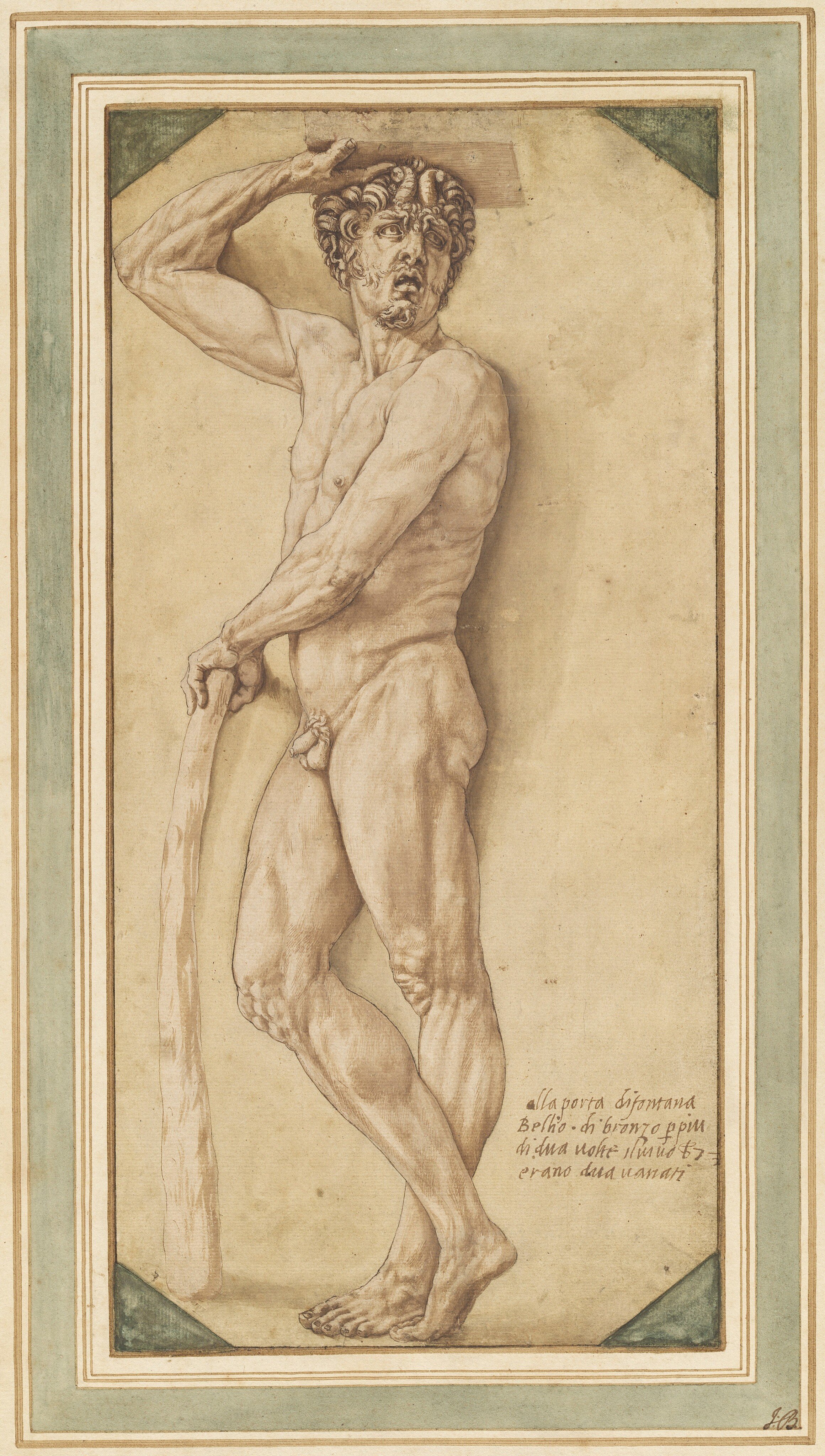
Benvenuto Cellini, A Satyr, 1544/1545. National Gallery of Art Washington, Woodner Collection Patrons’ Permanent Fund, inv. 1991.190.2
One of Calmann’s greatest discoveries happened in February 1958, when he bought a lot of three drawings at Christie’s, catalogued as “Mantegna”. One of these was a pen and brown ink study of a standing satyr with a puzzling Italian inscription at the bottom: alla porta di fontana Bellio (a la porta di Fontana Belio). Nobody could explain it. Philip Pouncey was baffled. Other scholars were too. Years passed and the drawing remained in Calmann’s drawers, until Giuliano Briganti, the Roman art historian, came into the gallery and looked at the drawing. He pointed out, amused, that Fontana Belio is simply Italian for Fontainebleau. The satyr was actually Benvenuto Cellini’s preparatory drawing for a bronze figure intended to flank the Porte Dorée at the Château de Fontainebleau. Calmann sold it to the American collector Ian Woodner via the New York dealer William H. Schab, a fellow refugee. It is now in the National Gallery of Art in Washington. Calmann had uncovered this beautiful sheet, buying it simply on the strength of draughtsmanship, without knowing the name, without understanding the inscription, without scholarly backing. The act of seeing came first. That, more than anything, was Calmann’s creed.
Early Netherlandish Drawings
The British Museum, London
16 April – 20 September 2026
Vittoria Cervini, Assistant Curator of Paintings at the Royal Collection Trust
Early Netherlandish Drawings at the British Museum, curated by Olenka Horbatsch and Charlotte Wytema, masterfully exemplifies how scholarly research and public engagement are not antonymic concepts. Free of charge, the exhibition proves the considerable advantages of investing time and resources in researching, (re)cataloguing, conserving and understanding one’s own collections – especially works traditionally viewed as being of marginal importance.
Drawings from the Low Countries produced before the age of Rubens, Rembrandt and Van Dyck are exceedingly rare compared to sheets made and collected across the Italian peninsula and German-speaking countries. The exhibition stresses that Netherlandish drawings had different functions, social and collecting histories. Perhaps, then, we should learn to see them in a different optic.
The curators have brilliantly selected 110 drawings of various subject matters and techniques out of their own vast collection of 1,200 drawings, with no external loans. The simplicity of the exhibition title, Early Netherlandish Drawings, belies the real complexity of bringing together such a diverse group of sheets. By placing the focus on the drawings themselves – how, why and for whom they were made – the exhibition encourages visitors to pause and closely engage with works by celebrated masters such as Rogier van der Weyden, Lucas van Leyden, and Hendrick Goltzius, while also discovering the often-unexpected allure of anonymous sheets and fragments.
Opening with a drawing by Maarten van Heemskerck of a semi-fantastical view of Roman ruins (cat. 112), the introduction contextualises how important a trip to Italy was for the development of an artist’s career, and how artistic and technical developments cannot be detached from cultural and material cross-contaminations. Heemskerck’s drawing gives way to the main exhibition space, which is broken up into four main portions. The first two of these are arranged according to chronological criteria whilst the latter two are broadly thematic.

Maarten van Heemskerck, Ruins with the Vulcan's forge beneath an arch, c. 1538 © The Trustees of the British Museum
The first section of the exhibition, Early Drawings (1400-1500), traces the development and changing function of Netherlandish drawings from the early fifteenth century to the dawn of the sixteenth century. Originally intended as functional objects, used and reused in busy artistic workshops, these sheets were either made to develop compositions or served as visual records of works that had already left the studio. Despite their utilitarian function, some exquisite examples are on show. The delicate handling of silverpoint in an anonymous drawing of The Arrest of Christ (cat. 1) and Rogier Van der Weyden’s celebrated Portrait of a Woman (cat. 10) clearly shows what extraordinary effect can be achieved with a notoriously unforgiving medium. Another highlight of this first display is constituted by two drawings made by different artists working in Rogier’s studio (cat. 11-12), both making copies after the Mary Magdalen from the right wing of the Braque triptych (Louvre): a fun and self-explanatory compare-and-contrast exercise that encourages close and interactive looking.

Rogier van der Weyden, Portrait of an Unknown Young Woman, c. 1435–1440 © The Trustees of the British Museum
The second section, Drawing to Design (1500-1530), could not have started with a better drawing than Jan de Beer’s St Luke painting the Virgin (cat. 41), probably made in preparation for a painted glass roundel in the chapel of the homonymous guild in the Church of our Lady in Antwerp. The drawing provides valuable insight into how artistic workshops functioned, not only through its visual representation but also through its physical evidence: small holes along the contour lines that enabled the design to be transferred across media while allowing the sheet itself to remain in the studio. The label text for this sheet (and indeed, all the labels more broadly) strikes a delightful balance between technical, visual and contextual information, which compensates for the impracticality of displaying the versos of the drawings.
This section also incorporates an interesting selection of sheets whose functions span across media, including designs for engravings, glass roundels, tapestries and paintings. Despite the focus on the drawings’ materiality and purpose, excellent draughtsmanship dominates the visual rationale of the display. Two rare red chalk drawings recently attributed to Jan Cornelisz. Vermeyen (cat. 116-117) and seven astonishing drawings by Lucas van Leyden (cat. 54-60) cannot be missed. As the British Museum is fortunate to possess the largest collection of Lucas’s drawings in the world, the display offers a rare glimpse into how brilliantly (and differently) the artist could handle different media. His extraordinary black-chalk portrait of a man wearing spectacles and holding a pen (cat. 55) raises intriguing questions: is he writing or drawing? A tantalising and complex question which can be answered only by close and attentive looking.

Lucas van Leyden, An old man drawing, c. 1512 © The Trustees of the British Museum
The final sections in the show address two broad, thematic arguments. The The Antique and the Vernacular display gathers a range of sheets of varying quality and subject matter, with superb drawings by Pieter Bruegel the Elder (cat. 126), Jan Gossart (cat. 68), and Bartholomeus Spranger (cat. 148-149), alongside a vividly coloured and meticulously executed Allegory on Life and Death by Joris and Jacob Hoefnagel (cat. 132). Yet the protagonist of this section, and perhaps of the entire exhibition, is Hendrick Goltzius. His small confident self-portrait (cat. 150) and his exquisite Ceres and Bacchus (cat. 152), with bronze-like sculptural bodies accentuated by confident strokes of brown ink, push the boundaries of the drawing medium and format to unbelievable effects.

Hendrik Goltzius, Self-portrait, c. 1589 © The Trustees of the British Museum
Landscapes concludes the show. Among fine examples by the likes of Roelant Savery (cat. 168) and Paul Bril (cat. 163), a beautifully rendered and illuminated view of Bethlehem by Jan van Scorel (cat. 66) stands out. A talented artist who travelled extensively (even being appointed Keeper of the Papal collections in Rome), his sheet provides a meaningful link with the Heemskerck drawing which opened the exhibition. Although the reviewer noted that visitors tended to spend less time in this section, its presence in the exhibition is crucial, underscoring the pivotal role that drawn landscapes played in the development of a distinctly Northern graphic tradition.
Beyond constituting a unique opportunity to see these rare drawings first-hand, the exhibition allowed for the production of a superb catalogue, the first to discuss Early Netherlandish drawings at the British Museum since Arthur Ewart Popham’s volume published in 1932. While Popham’s work remains an important source of knowledge, encompassing a much larger number of drawings than the 180 in the exhibition catalogue, different methodologies and lines of enquiry have been developed over the past century. New technical research and scientific examination have enriched and nuanced the field. New material research has challenged uncertain attributions. Each catalogue entry is thoroughly researched and well-written, with important visual and contextual references. For those who will miss the exhibition and for those keen to keep this field of research alive, the volume is a sound investment: it will undoubtedly remain a reference work for decades.
At a time when resources in the museum sector are lacking and curatorial research is often de-prioritised, this exhibition and its accompanying catalogue are useful reminders of how crucial it is to devote time to cataloguing and conservation. Only one question remains open to debate: how accessible is this exhibition? Why would general visitors with the most varied backgrounds ‘care’ about drawings? And why specifically Early Netherlandish sheets, which to be frank, as much as it pains the reviewer to admit, have rarely garnered broad interest? A personal response would be that an entirely free exhibition on a subject unfamiliar to most visitors, yet one that encourages slow looking, curiosity, and reflection on how we reconstruct the past from the scant evidence that survives, more than justifies itself. If it can make visitors care about a group of objects they had never previously considered, then it has already succeeded.
Early Netherlandish Drawings continues at the British Museum until 20 September 2026.
JUNE HIGHLIGHTS
François Lemoyne, Study of a Woman for Pandora c. 1732–1736. Private collection © D.R.
These two drawings were originally thought to be studies for two closely related paintings by Sir Anthony van Dyck: one in the Kaiser Friedrich Museum, Berlin, which was destroyed during the Second World War; the other, a slightly smaller version of the composition, is in the Museo del Prado, Madrid. While one of the drawings dates to c. 1618–20, the other is a twentieth-century forgery.
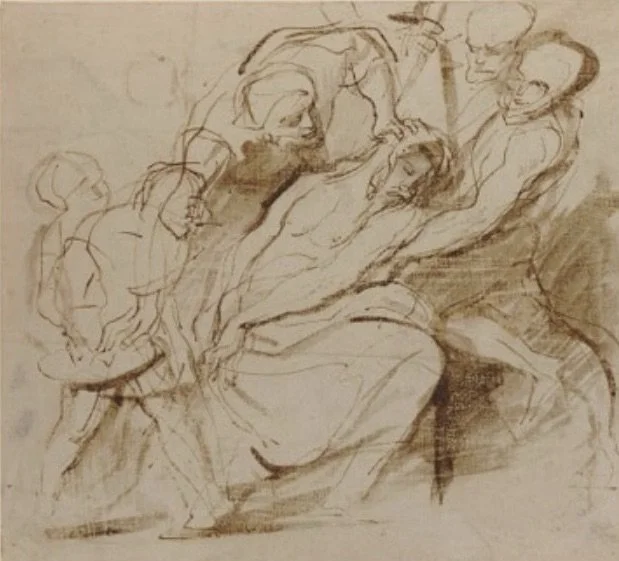
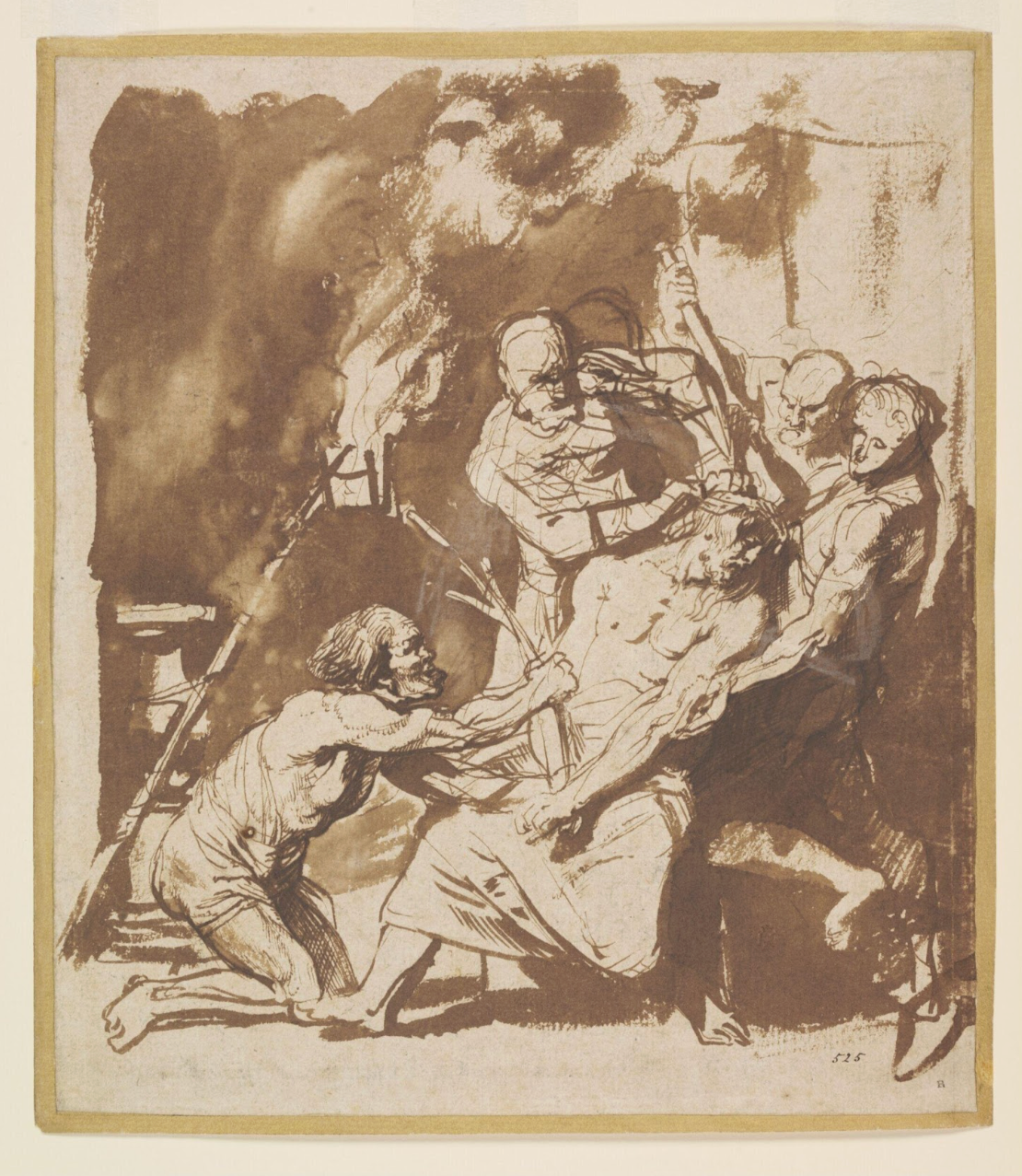
-
The original is the lower (right) image.
Upper (Left) Image: Eric Hebborn (1934–1996) in the manner of Sir Anthony van Dyck, Christ Crowned with Thorns, the British Museum, London, inv. 1970,0411.21
Lower (Right) Image: Anthony van Dyck (1599–1641), Christ Crowned with Thorns, Victoria & Albert Museum, London, inv. DYCE.525
Drawn “in the style of” Anthony van Dyck, the upper drawing is a twentieth-century creation by the renowned forger Eric Hebborn. Although seemingly executed in van Dyck’s free manner, the drawing was in fact carefully constructed to be plausibly interpreted as a “lost” preparatory study related to van Dyck’s painting in Madrid and the lost version formerly in Berlin. The Hebborn drawing shows notable differences from the van Dyck at the V&A, ensuring that it would not be perceived as a direct copy but rather as another preparatory step in the same creative process.
Tactically, Hebborn allowed others to establish the hypothetical connection between his drawing and van Dyck’s paintings, and the sheet was consequently acquired by the British Museum from Colnaghi’s in 1970 as a work by van Dyck. Suspicions that the drawing was a forgery first arose in 1978 and were confirmed when Hebborn wrote to the museum in 1990 claiming it as his own work. It was subsequently reattributed and transferred to the museum’s “fake box” in January 1991.
The confluence of connoisseurship and AI has been a hot topic in the art world for several years now, and this episode from Is It? The Art Mystery Podcast demonstrates the practical potential of the two methods. Bruce Edelstein, professor and researcher based in Florence, and Alessandra Conti from Art Recognition, discuss a portrait of Eleonora de Toledo, the wife of Duke Cosimo de Medici. But is it by the Medici court painter Bronzino, or by his pupil and follower Alessandro Allori?
For Francophone readers, two new podcasts series have emerged this month that merit mention: season 5 of L’Institut national d’histoire de l’art’s (INHA) podcast, La recherche à l’œuvre, the first episode of which features Turner Edwards; and Sur la route du Grand Tour : un voyage en Italie au 18e siècle, written by Antoine Chatelain.
What is Neoclassicism, and what does a Neoclassical drawing look like? In January 2025, Margaret Morgan Grasselli, a leading expert in the field of French drawings, gave a lecture at the The Art Institute of Chicago documenting the movement’s roots. In the lecture, Graselli references drawings from the museum's exhibition, Revolution to Restoration: French Drawingsfrom the Horvitz Collection, charting the origins and characteristics of the “new classical” style that dominated Europe, especially France, in the late-18th century.
Stephanie Schrader, curator of the Getty Museum’s ongoing exhibition Virtue and Vice: Allegory in European Drawing, explores how European artists from the sixteenth to nineteenth centuries used art as a vehicle for moral instruction using examples by Dutch and Flemish artists, Saftleven, Jordaens, Ketel, and De Gheyn. Drawing on biblical, mythological, historical, and everyday subjects, these artists created allegories that encouraged virtuous behaviour and warned against vice. Their preparatory drawings reveal the creative process behind these moralising images and the visual clues used to communicate their messages.
TROIS CRAYONS RECOMMENDS
*As an Amazon Associate we earn from qualifying purchases