Trois Crayons Magazine, November 2026
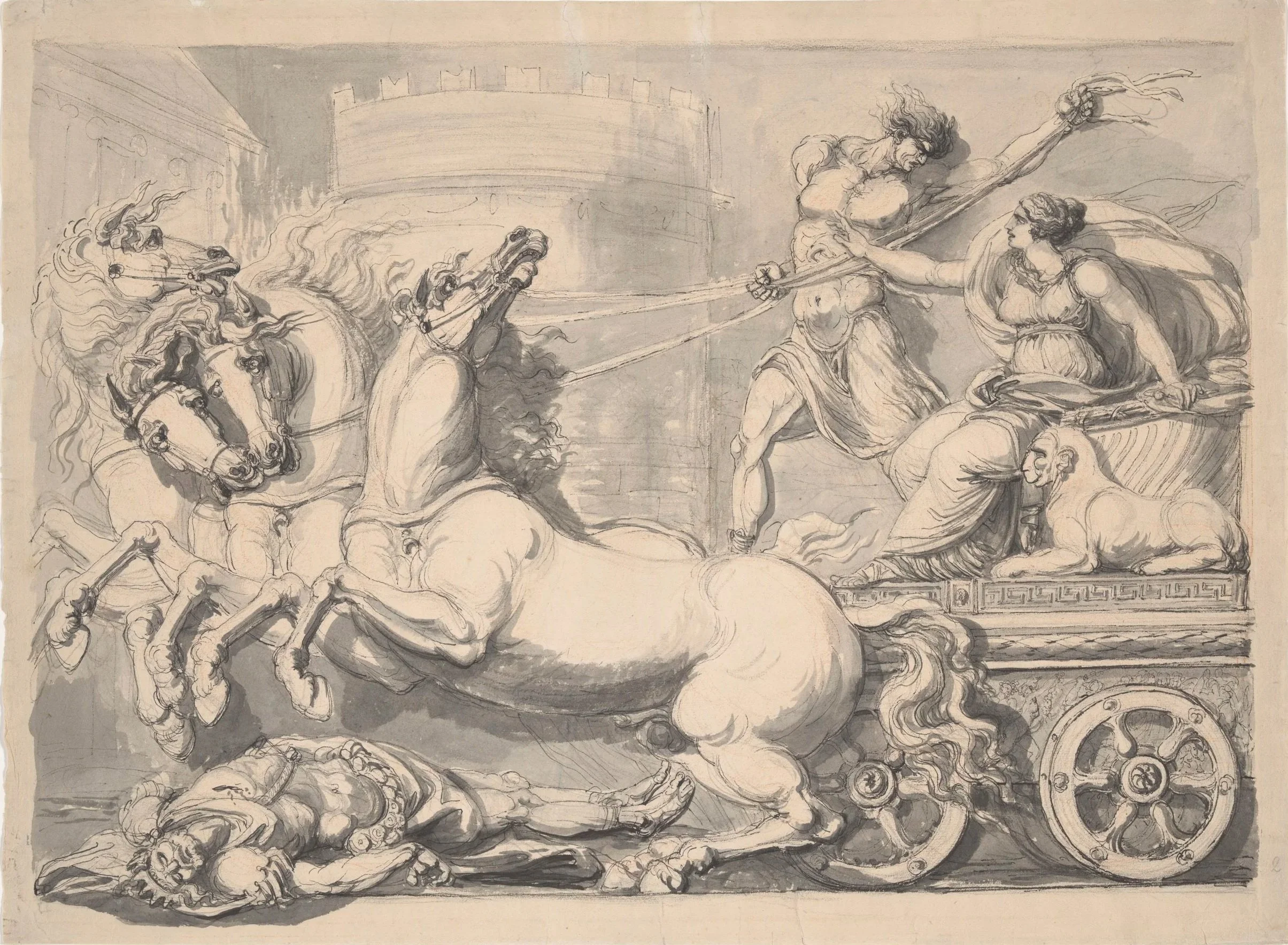
Johan Tobias Sergel (1740–1814), Tullia Directs Her Chariot over the Corpse of Her Father, c. 1770, Collection of Mr. & Mrs. Howard Lepow. Photography courtesy of The Morgan Library & Museum, Photography by Janny Chiu
John Marciari, Director of Curatorial Affairs, Charles W. Engelhard Curator and Department Head, Drawings and Prints, The Morgan Library & Museum, New York, has kindly chosen our drawing of the month
Pen and black ink and grey wash, over black and red chalk, 432 x 559 mm, Collection of Mr. & Mrs. Howard Lepow, New York
Fantasy and Reality: The Art of Johan Tobias Sergel is now on view at the Morgan Library & Museum, through 31 January 2027. Although little known today, in large part because few of his works are in collections beyond Scandinavia, Sergel is a deeply engaging artist. Born and trained in Stockholm, he spent a decade in Rome from 1767-78 where he was a pioneer in the creation of Neoclassicism. A sculptor by trade, he was also a draughtsman by whom hundreds of drawings survive, not only studies for sculpture but also a brilliant corpus of caricatures. His close associates included an amazingly international group of artists: Clodion, François-André Vincent, Henry Fuseli, Nicolai Abildgaard, Jacob Philip Hackert, Giuseppe Cades, Louis Jean Desprez, Thomas Banks, and many more. The Morgan’s exhibition thus seeks not only to reintroduce Sergel to a new audience but also to show how artistic friendships led to new developments in the great melting pot of late eighteenth-century Rome.
Tullia Directs Her Chariot over the Corpse of Her Father is one of the largest, most finished, and most spectacular of Sergel’s surviving drawings and it thus occupies a prominent place in the Morgan’s exhibition. The drawing was published in Ragnar Josephson’s magisterial Sergels Fantasi of 1956 and was even turned into a Swedish postage stamp in 1972, but it remained in private hands and, having been sold several times, was lost to recent scholars. The sheet occupies a prominent position in the Morgan’s installation, but it was “rediscovered” too late to be included in the exhibition catalogue, so it seems particularly worth drawing attention to it here.
Tullia was the daughter of the ancient Roman king Servius Tullius, but she arranged his murder so that her husband could usurp the throne. Here, in triumph, she directs her chariot to be driven over her father’s dead body. The subject had been given to French artists competing for the Prix de Rome in 1765, and the winner, Jean Bardin, arrived in Rome in 1768. Trained in Stockholm and France by Pierre Hubert L’Archevêque (who had himself studied under Edme Bouchardon), Sergel associated himself with the Académie de France upon his arrival in Rome, and it was presumably after meeting Bardin at Palazzo Mancini that Sergel created his own version of the theme.
The style that Sergel employed for his Tullia, however, is not the Bouchardonesque manner of drawing in red chalk that characterises his early works. Instead, his expressive bodies, bold forms, and extensive use of wash reflect a manner of drawing that he developed alongside his closest companion in Rome, Henry Fuseli, who arrived in 1770: one can make easy comparisons between the Tullia and the drawings in Fuseli’s Roman Album at the British Museum. In a poignant passage of his autobiography, Sergel wrote that, after a short time in Rome, he realised he had lost twelve years to training in “the abominable French manner”. He set out to learn all afresh, with antiquity and nature as his guides.
In addition to nature and antiquity, of course, Sergel had the inspiration of his fellow artists in Rome, and atop his links to French and British artists, we can also add Roman influences: The Egyptian lion on Tullia’s chariot is clearly based on one of the pair that sit at the foot of the Campidoglio ramp. Yet, when we see an artist in Rome adopt an Egyptian motif in years around 1770, we have to think of Giovanni Battista Piranesi’s then-new Egyptian interior of the Caffè degli Inglesi, loved by a few but reviled by many. Sergel, however, must have been an enthusiast, for not only do we see his Egyptian lion in the Tullia, but the Morgan exhibition also includes a caricature of Sergel in Rome by Hackert, showing our artist in a fanciful Egyptian costume.
A brilliant drawing in its own right, full of verve, the Tullia is one of many works that also document Sergel’s artistic friendships, influences, and connections, and as such, is a teaser for an exhibition that we hope will be of interest to many, even those who have never heard of Sergel himself.
Fantasy and Reality: The Art of Johan Tobias Sergel is on view at the Morgan Library & Museum, New York, from 30 October 2026 – 31 January 2027.