The Seventeenth-Century Italian Drawings of the Musée Condé
Trois Crayons Magazine, March 2026
Ulysse Jardat, curator at the Musée Condé, in conversation with Editor Tom Nevile
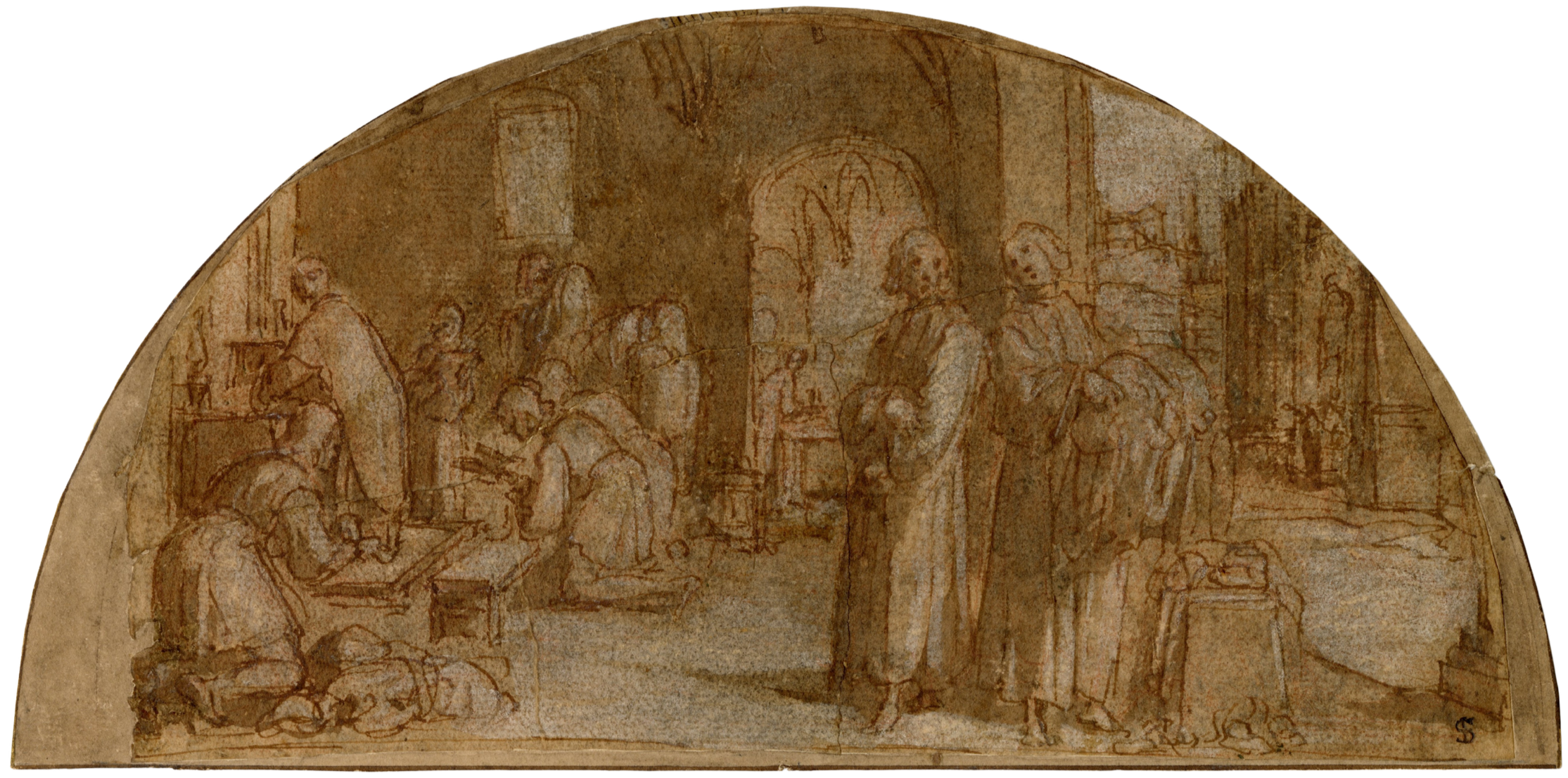
Bernardino Barbatelli, called Il Poccetti (1548–1612), The Seven Founders of the Servite Order Retiring to the Villa Camarzio. Private collection
From 7 March, for the first time in the Musée Condé’s history, the museum’s collection of Seicento (seventeenth century) Italian drawings will be exhibited to the public. Alongside loans from institutional and private collections, the museums’ lesser seen drawings are set to receive their moment in the sun.
Ulysse Jardat joins the editor to discuss the history of the collection, the goals of the exhibition and the drawing he’d most like to take home with him.
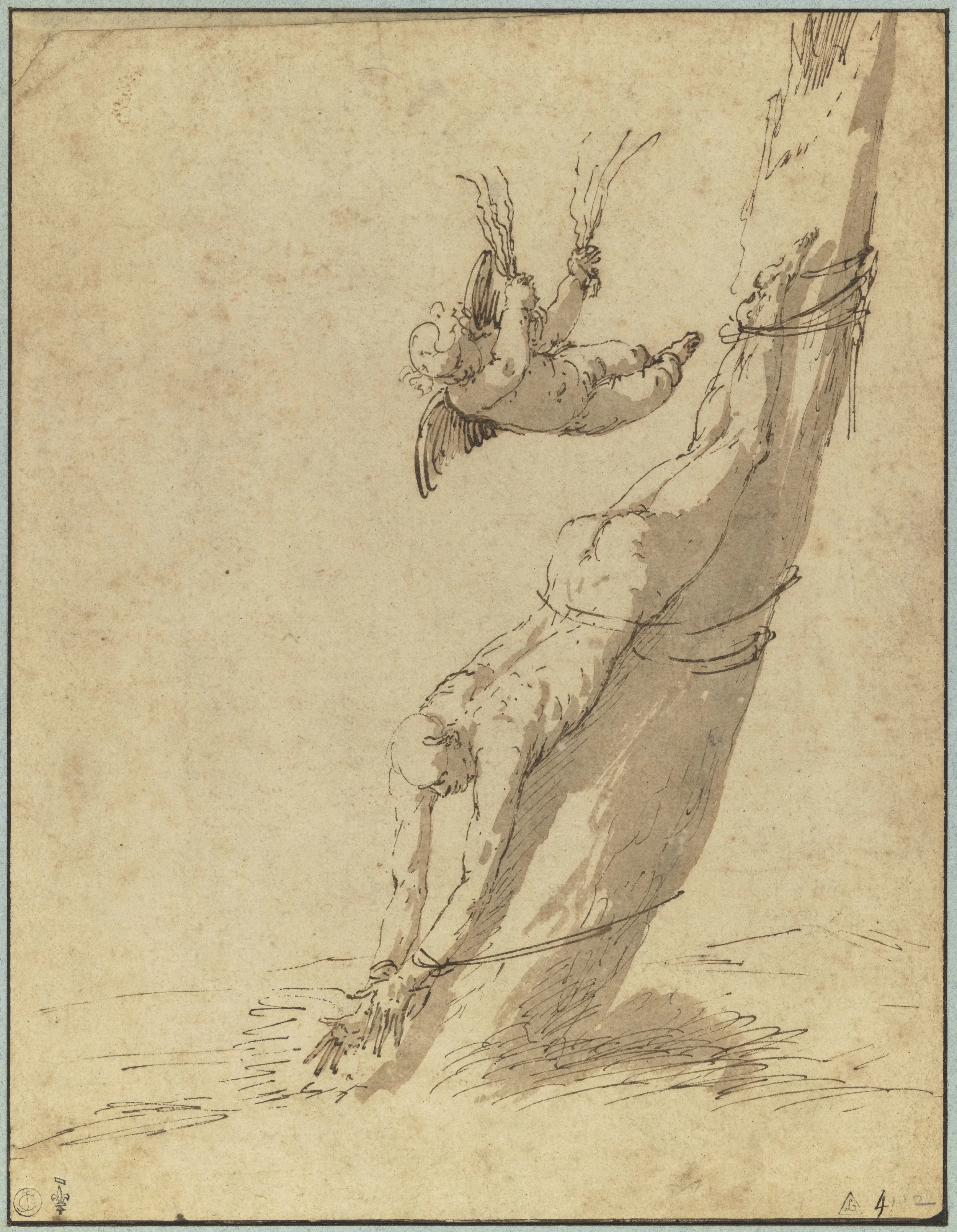
Jusepe de Ribera, called Spagnoletto (1591–1652), A Martyrdom Scene © GrandPalaisRMN-Domaine de Chantilly - Sylvie Chan-Liat
Could you outline the scale and scope of the Musée Condé’s holdings of Seicento Italian drawings and explain how they came to enter the museum’s collection?
The Musée Condé’s collection of seventeenth-century Italian drawings remains relatively limited when compared to the extraordinary richness of its Italian painting collection, where the Baroque period holds a prominent place, with artists such as Guercino, Domenichino, Guido Reni, Salvator Rosa, and Mattia Preti. This contrast is, in fact, one of the paradoxes of the collections assembled by Henri d’Orléans, Duke of Aumale: while the painting gallery offers a particularly dense panorama of the Seicento, the graphic arts strongly favour the Renaissance.
This imbalance is largely explained by the origin of the collection. Most of the Italian drawings come from the collection acquired in 1861 from Frédéric Reiset (collector and later Louvre curator, a discerning eye!), whose tastes were strongly oriented toward the masters of the fifteenth and sixteenth centuries. Reiset primarily sought sheets attributed to the great names of the Renaissance, which were relatively abundant on the market at the time.
The Seicento was thus represented by a limited group—originally about ten identified drawings—supplemented over time, through reattributions and occasional acquisitions by the Duke of Aumale, by other sheets now recognized as belonging to the seventeenth century. This history explains the very selective nature of the corpus: each drawing appears as an isolated piece, yet often of high quality, reflecting a logic of choice rather than a systematic plan.
The exhibition therefore proposes, for the first time, to consider this collection in its historical and stylistic coherence, placing it within a broader network thanks to loans that restore the artistic contexts to which these works belong.
What curatorial story does the exhibition seek to tell? Around which narrative, thematic, or didactic threads has the display been structured?
The exhibition unfolds over five ground-floor rooms of increasing scale, structured according to a chrono-thematic principle that allows visitors to follow the transformations of Italian drawing from the late Mannerism to the affirmation of the Baroque.
Rather than a strictly monographic overview, the layout highlights several artistic centres and stylistic currents: the naturalistic revolution initiated by the Carracci, the tensions between classicism and expressiveness in central Italy, Rome’s role as a centre of exchange and diffusion, and the artistic circulations between Naples and the Iberian Peninsula.
The comparisons made possible by the loans help to reconstruct dispersed groups, clarify stylistic or technical contexts, and shed light on influence networks. The exhibition thus adopts both a didactic and a sensitive approach: it invites visitors to explore the shifting cartography of seventeenth-century Italian art, a century marked by artists’ travels, school rivalries, and a diversity of graphic languages, from Barocci, Moncalvo, and Guercino to Poccetti and Stefano della Bella.
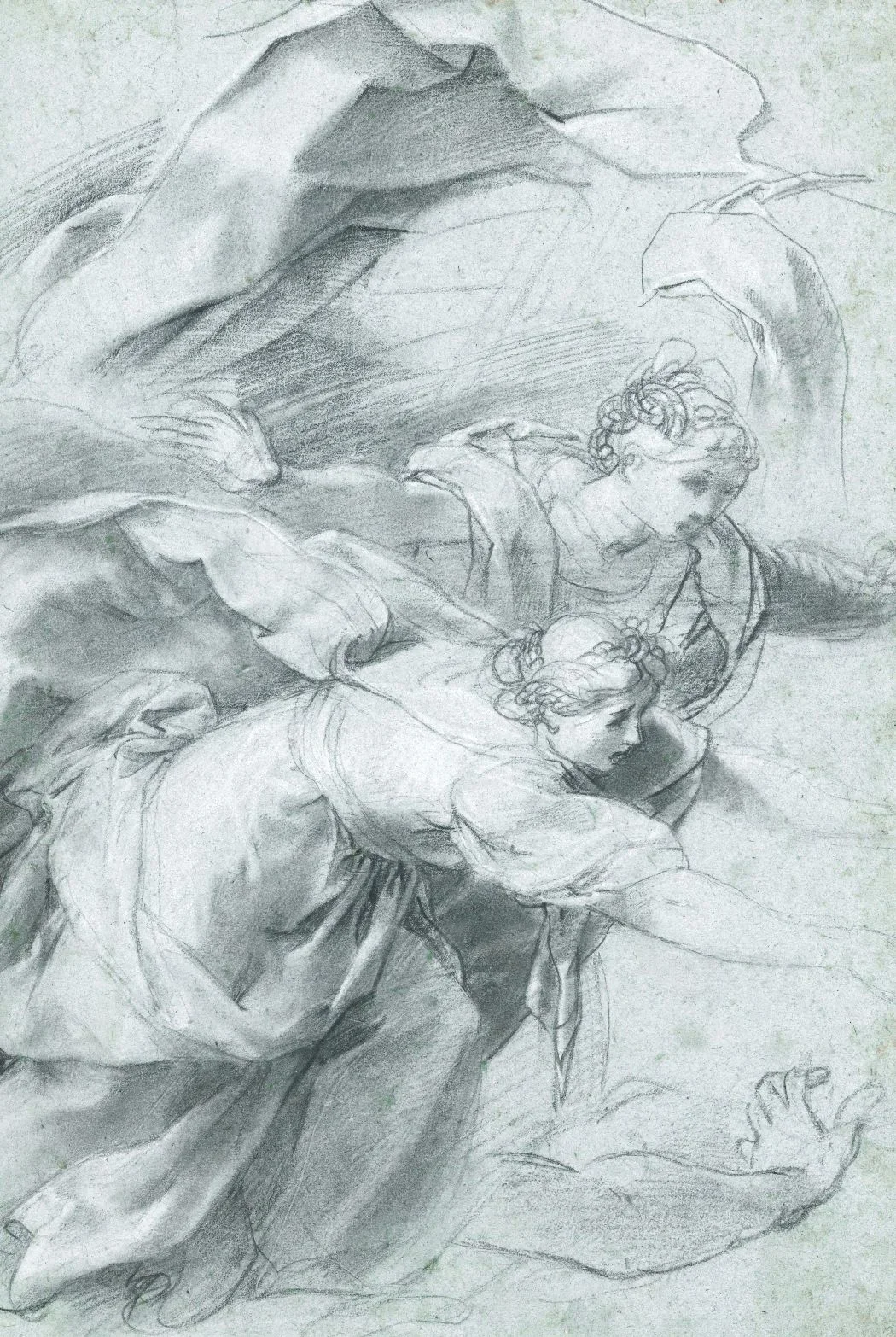
Federico Barocci (1535–1612), Study for The Perugia Deposition © GrandPalaisRMN-Domaine de Chantilly - René-Gabriel Ojeda.
The show includes over fifty drawings, typically with one representative work per artist, chosen from the museum’s collection and from private collections. How did you arrive at your selection, and how do these loans serve to enhance the collection’s holdings?
The selection was built according to a deliberately focused principle, drawing on the Musée Condé’s core holdings and the specific characteristics of each work—artist, technique, and, above all, period of activity. It allows for the presentation of precise stylistic moments, such as Giovanni Benedetto Castiglione after his stays in Rome, or Bernardino Poccetti between Pistoia and Florence during the last ten years of his activity.
The loans place the Musée Condé’s drawings within particularly active networks of exchange in seventeenth-century Florence and Rome, notably in landscape painting and major decorative projects.
Several works concretely illustrate these circulations. The frieze project held at the Fondation Custodia, attributed to Giovanni Francesco Grimaldi, sheds light on collaborations between landscape painters and quadraturists (illusionistic ceiling painters) in the palace decorations of Rome. It directly dialogues with marine and ship studies preserved at Chantilly, particularly those by Filippo Napoletano, revealing the circulation of common motifs between Rome and Tuscany in the early decades of the Seicento.
These comparisons allow us to reconstruct not only workshop practices but also collaborative logics that often escape a strictly monographic reading. Loans thus play a decisive role: they do not merely fill material gaps in the collection but renew its interpretation.
Compared with other areas of the collection – such as the paintings of the Renaissance or the Ancien Régime – Seicento drawings have received relatively little attention at Chantilly. Did the research process yield any surprises, or lead to discoveries that are being presented to the public for the first time?
Yes, the systematic re-examination of the corpus led to several significant reattributions and reclassifications, revealing the true scope of the seventeenth-century holdings, long underestimated. Several sheets previously attributed to other schools or more famous masters have been returned to Seicento artists, notably a sensitive study by Alessandro Tiarini (once thought by Reiset to be by Correggio or Schedoni) and a rare landscape by Dughet, formerly attributed to the Carracci school.
These new attributions, often based on precise stylistic comparisons and material study of the sheets, now allow a better understanding of the chronological coherence of the collection. Several drawings are thus presented in a renewed reading, often for the first time to the public, such as works by Baglione, Ribera, or Domenichino. The same applies to most loans from the Louvre or private collections, with works by the Carracci, Baglione or Arpino which had never before been publicly exhibited.

Agostino Carracci (1557–1602), Three Studies of Women in Draperies © GrandPalaisRMN-Domaine de Chantilly - Sylvie Chan-Liat
A recent conservation campaign uncovered historic mounts, inscriptions, and watermarks that helped refine both provenance and attribution. What were the most significant discoveries to emerge from this process?
The conservation campaign revealed for instance preparatory stylus lines or corrections that were difficult to discern on works never before cleaned, making the stages of the graphic elaboration more directly visible. It also uncovered marks from major European collections, such as those of Count John Spencer, revealing the circulation of baroque Italian drawings and prints early in the eighteenth century.
Moreover, the identification of watermarks allowed for more precise dating and a better understanding of production contexts. For example, one of the most monumental sheets in the collection—a head of Christ previously attributed to the circle of Sebastiano del Piombo—was reattributed to Giuseppe Cesari. The watermark dates from after 1550, a chronological discrepancy that was decisive in rejecting an early sixteenth-century attribution and placing the sheet in the context of early seventeenth-century Rome.
More broadly, the study of old mounts helped reconstruct certain historical groupings made by collectors, providing valuable insight into the reception of Italian drawings in the eighteenth and nineteenth centuries: for instance, the Barocci sheet revealed an interesting light green English mount from the eighteenth century.
If you had to choose one drawing from the exhibition to take home with you, what would it be and why?
I would choose the preparatory drawing by Bernardino Poccetti for a fresco cycle in Pistoia, which I had the chance to identify in a private collection.
Beyond the personal connection of its rediscovery, this sheet seems particularly emblematic of the exhibition’s project: it occupies a pivotal moment between the late decorative culture of Florentine Mannerism and the new narrative demands of early Seicento. It displays both the linear precision inherited from the sixteenth century and a more direct attention to the rhythm of figures and the visual effectiveness characteristic of large wall cycles.
It is also a drawing that reminds us how these works, often created for now-transformed or fragmentary sites, can be among the most vivid witnesses of vanished or, in this case, even forgotten decorations. In return, it helped reattribute the Chantilly drawing, also preparatory for Poccetti’s Pistoia cycle, rather than the better-known, later Florence cycle.
Seicento in Carta. 17th-Century Italy, in the Musée Condé’s Graphic Collections is open at the Musée Condé, Château de Chantilly, from 7 March 2026 – 14 June 2026.