Rosso and Primaticcio: Renaissance at Fontainebleau at the Beaux-Arts de Paris, Paris
Trois Crayons Magazine, March 2026
Reviewed by Nicolas Bousser, Coupe-File Art
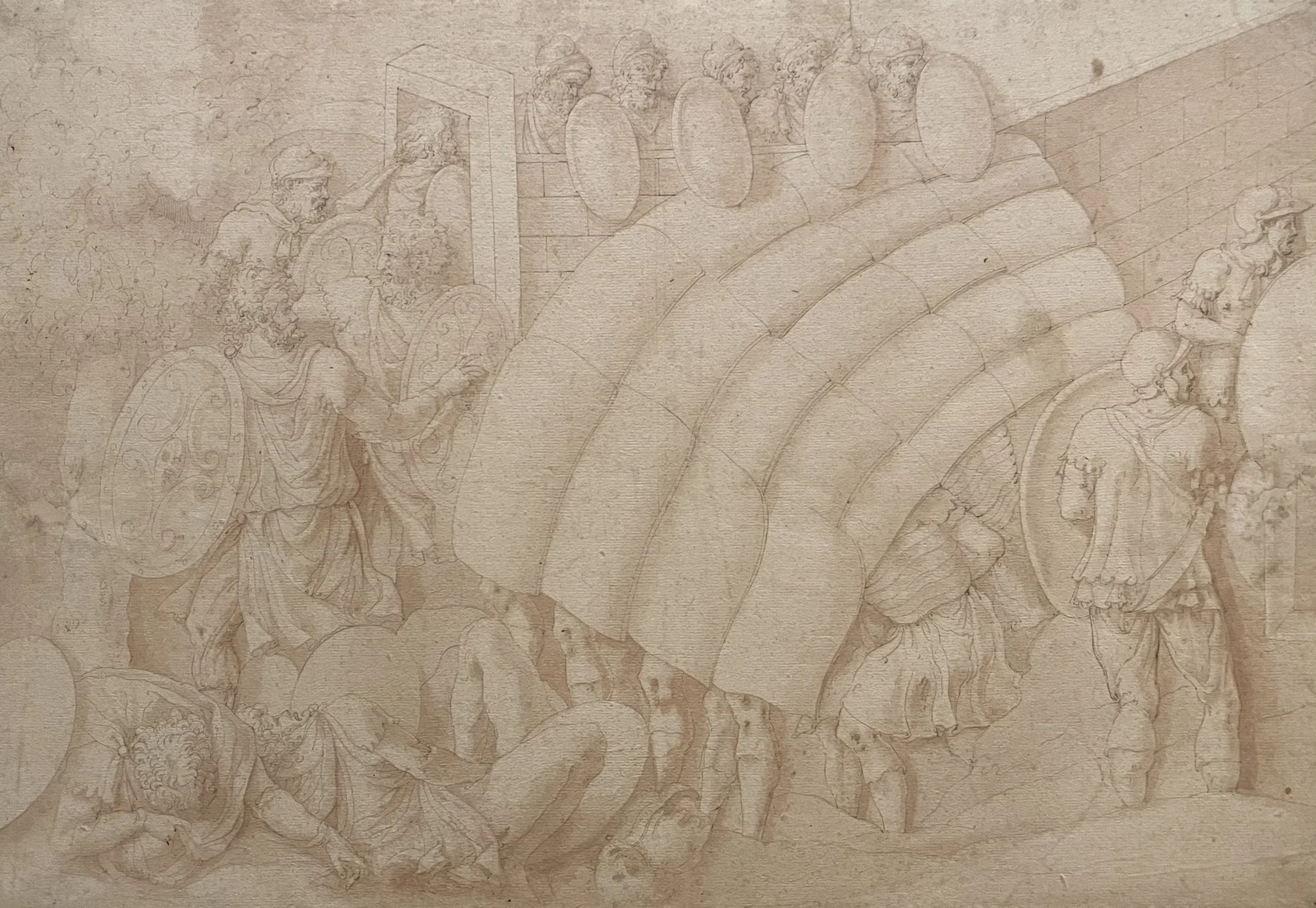
Circle of Francesco Primaticcio (1504–1570), Ancient battle scene inspired by Trajan's Column with Roman soldiers forming a tortoise formation, Beaux-Arts de Paris, Paris, Gift of Monroe Warshaw in honour of Dominique Cordellier
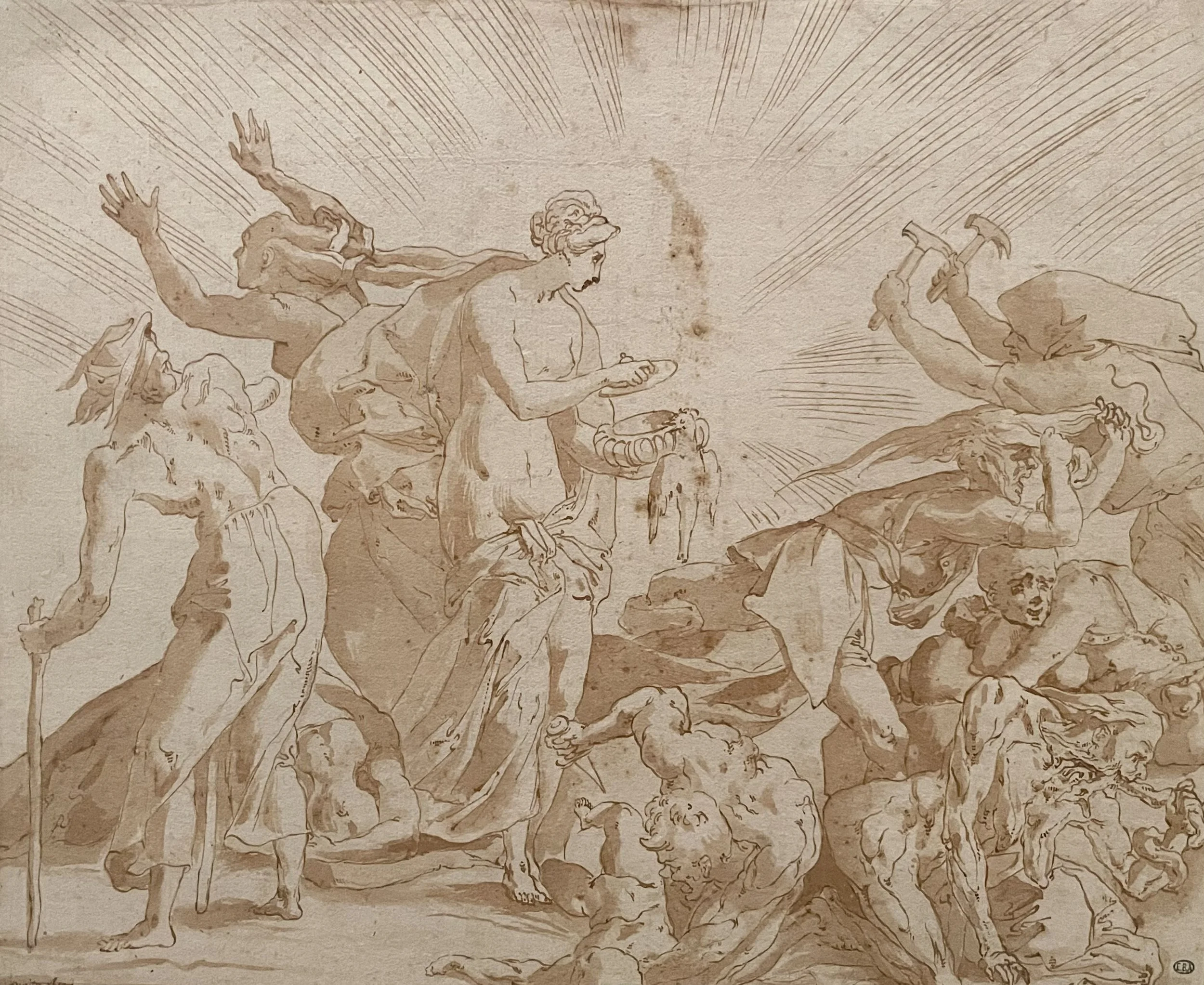
Giovanni Battista di Jacopo, called Rosso Fiorentino (1494–1540), Pandora Releasing the Plagues from Her Box, Beaux-Arts de Paris, Paris
Fontainebleau: a subject that continues to offer ample material for art historians. Since the exhibition The School of Fontainebleau held at the Grand Palais from 17 October 1972 to 15 January 1973, presentations, acquisitions, and discoveries have followed in procession, culminating in the most recent exhibition devoted to the early years of the building project, Rosso and Primaticcio: Renaissance at Fontainebleau open at the Cabinet des dessins Jean Bonna at the École des Beaux-Arts in Paris from 21 October 2025 to 1 February 2026. The curators of this interesting presentation, Hélène Gasnault and Giulia Longo, have drawn from the institution's collection of drawings and engravings – highly significant in terms of production from Fontainebleau. Given the size of this group, the curators have chosen to limit the presentation to the years 1530–1560 for the drawings and 1542–1547 for the engravings. The presentation is accompanied by a catalogue in the Carnet d’étude series of the Cabinet Jean Bonna, which draws heavily on the work of leading voices in Fontainebleau studies like Dominique Cordellier and Sylvie Béguin.
The exhibition naturally revisited several key locations, whose positions were indicated by a large map of the castle attached to the picture rail. This has notably led to a lengthy and ongoing exploration of Rosso Fiorentino's work in the François I Gallery up until his suicide in 1540. The exhibition opened with one of the master's finest surviving drawings, Pandora Releasing the Plagues from Her Box, evidence of an abandoned project or a lost decorative scheme. The Golden Gate and its frescoes by Primaticcio were also examined in detail, as was the now heavily remodelled bedroom of the Duchess d’Étampes, and of course, the ballroom. But the curators also highlighted vanished decorative schemes that continue to fascinate the scholarly community. First, there is the ‘apartment des bains’, decorated between 1540 and 1550, which was located beneath the François I Gallery, and of course, the Gallery of Ulysses, destroyed in 1739. Primaticcio's vault in this gallery, nearly 155 meters long and 6 meters wide, was long celebrated; it remains an immense loss to this day. Also evoked, through a drawing from Primaticcio's circle, was the Pavilion of Pomona, a small open-air structure also now destroyed.
The second half of the presentation focused on the engravers active on the site in the mid-sixteenth century (the École des Beaux-Arts de Paris holds one of the world's most important collections of their work). The catalogue presents them in a series of biographies. First are the most prolific artists: the well-known Léon Davent and his mysterious Garden of Pomona after Primaticcio, and Antonio Fantuzzi, both very active on the site in the early 1540s. Then come Domenico Fiorentino, Juste de Juste, Jean Mignon, the still unidentified Master I♀V, and Master N.D., the only artist on the site to have practiced chiaroscuro woodcutting. The exhibition also explores the contemporary and ancient sources of the masters active at Fontainebleau and their critical reception in the following years, notably by focusing on the Anet project and the figure of Charles Carmoy. It is worth noting that some previously unseen works were on display, such as a drawing by Primaticcio's circle inspired by one of the bas-reliefs on Trajan's Column, donated in 2025 by Monroe Warshaw in honour of Dominique Cordellier.
The recent publication by Arthena of Vladimir Nestorov's thesis, Painting in Paris at the Dawn of the Grand Siècle (1590-1620), extends the exhibition's theme by examining later phases of the Fontainebleau construction project, focusing in particular on the team working on the Pavillon des Poêles in the 1590s, including Ruggiero de Ruggieri, Toussaint Dubreuil, and later Ambroise Dubois. The ‘Second School of Fontainebleau’ (a term which is now obsolete) also deserves to be highlighted.
Rosso and Primaticcio: Renaissance at Fontainebleau continues at the Beaux-Arts de Paris, Cabinet des Dessins Jean Bonna, Paris, until 1 February 2026