Drawing of the Month #27
Monday, 1 December 2025. Newsletter 27.
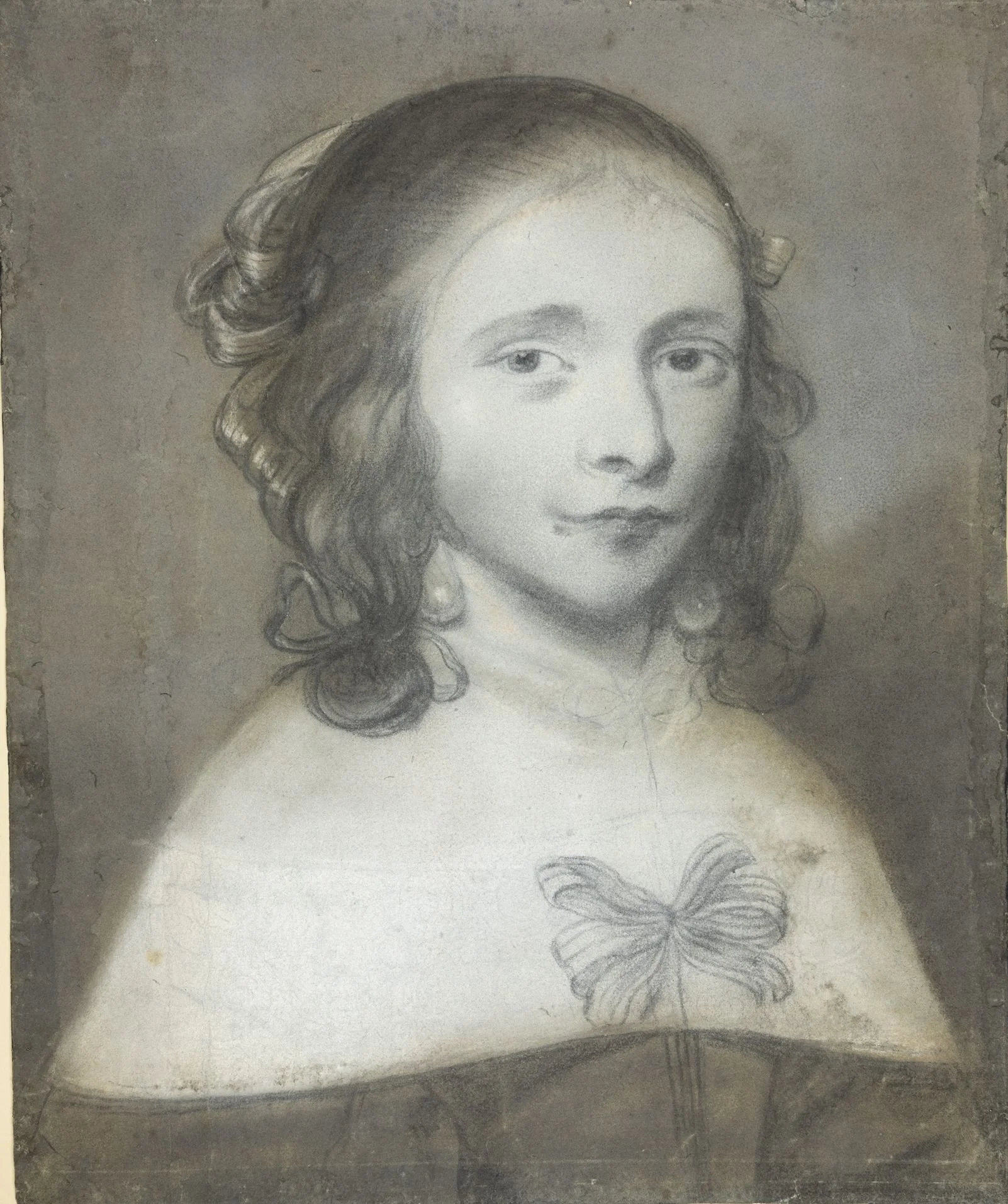
Michiel D. van Limborch (c. 1615–1675), Portrait of a Girl, c. 1650/60, Wallraf-Richartz-Museum & Fondation Corboud, Cologne
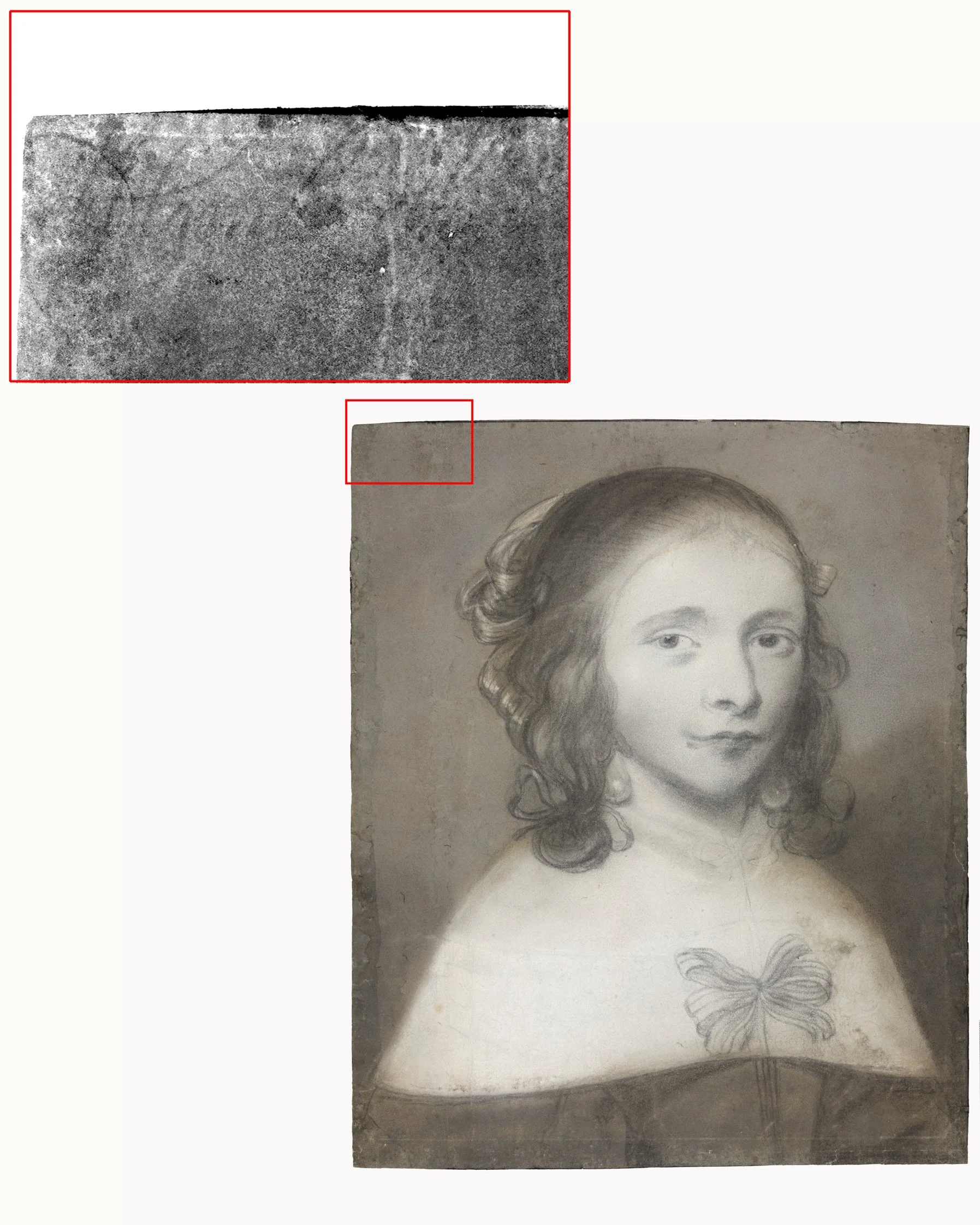
Detail: infrared reflectogram of the signature
Michiel D. van Limborch (c. 1615–1675)
Portrait of a Girl, c. 1650/60
Black chalk, some black ink, over graphite and some diluted white body colour, heightened with opaque white and some opaque apricot, touched up with ochre ink, on blue laid paper; signed upper left: “MDLimborch“, 404/400 x 335/332 mm, Wallraf-Richartz-Museum & Fondation Corboud, Graphische Sammlung, inv. no. Z 1854
Dr Annemarie Stefes, independent art historian and curator of the exhibition Expedition Drawing. Masters from the Low Countries in Close-Up, has kindly chosen our drawing of the month.
It was no easy task: having to choose one of the ninety drawings currently on display in Cologne. But then, I was used to the casting process, because the ninety exhibits themselves only make up a tenth of Wallraf-Richartz Museum’s drawings by Netherlandish, Dutch and Flemish artists from the 15th to the 18th centuries. What helped me pick this Portrait of a Girl? It has wall power, is a rare example of non-finito in this genre and presents new research findings, resulting in a rather last-minute attribution.
But one thing at a time.
In large format, our drawing depicts a girl, dressed in the fashion of the 1650s. Her hair is pinned up at the back of her head with silk ribbons. Two loose strands on either side of her face are tied together at the bottom with a bow. The large teardrop-shaped pearl earrings create a beautiful contrast to her dark hair. Her neckline is covered by a shirt and a wide collar, held together by a bow. The delicate lace pattern of the collar is left unfinished, as is the small bow at the top of her shirt. This non-finito is also evident in the features of her face. Pentimenti on her nose and mouth, with different sets of chalk strokes, show how the artist was trying to capture her features.
Until recently, the drawing was kept under the name of Wallerant Vaillant (1623–1677). Vaillant is known for his large portrait drawings in a highly accomplished manner. Wallraf-Richartz-Museum owns three such works that invite direct comparison and further investigations. From the present drawing’s atypical non-finito style, we hoped to gain insights into the artist’s working methods. We: that was Thomas Klinke, restorer and art technologist for drawings and prints at the museum, and myself as an art historian researching drawings from the Netherlandish schools for a collection catalogue.
In the first round, we noticed consistency in materials and technique among the four sheets. The only significant difference we found in Portrait of a Girl were some accents in opaque apricot on her neck next to the pearl. However, our investigation gained momentum when using infrared reflectography and Thomas suddenly discovered some letters in the upper left corner. I was of course expecting Vaillant's signature. But imagine my surprise: the inscription – although difficult to read, it was clearly written in seventeenth-century handwriting – began with what looked like an “H” or an “L” and contained an “m" and a “b”. This could in no way be interpreted as referring to “Vaillant”.
What to do with parts that do not fit? We put them aside and left it as an open question – perhaps as a reference to the sitter – while retaining the traditional attribution to Vaillant. As such, the sheet was loaned together with the other three portrait drawings to the monographic exhibition on the artist in Museum Van Loon in Amsterdam.
This exhibition provided the missing link to solve our puzzle. Among Vaillant’s followers, its catalogue mentions Michiel D. van Limborch. This artist met Vaillant in Middelburg and later in Amsterdam where he worked in the latter’s style. Drawings in the Six Foundation, Amsterdam, or in Städel Museum, Frankfurt am Main, are closely related to our Portrait of a Girl, except for the latter’s non-finito that still makes it stand out. But apart from that, the letters discovered by Thomas Klinke can now be specified as the signature of this very artist, starting with the ligated initials “MDL”, followed by “imborch”. Cologne’s Portrait of a Girl thus adds to the small drawn œuvre of Van Limborch, as a beautiful example of interdisciplinary collaboration and just in time before our own exhibition.
The only question that remains unanswered is why it was left unfinished.
The exhibition Expedition Drawing. Masters from the Low Countries in Close-Up continues at Wallraf-Richartz-Museum & Fondation Corboud, Cologne, until 15 March 2026.