Early Netherlandish Drawings
The British Museum, London
Trois Crayons Magazine, June 2026
Reviewed by Vittoria Cervini, Assistant Curator of Paintings at the Royal Collection Trust
Early Netherlandish Drawings at the British Museum, curated by Olenka Horbatsch and Charlotte Wytema, masterfully exemplifies how scholarly research and public engagement are not antonymic concepts. Free of charge, the exhibition proves the considerable advantages of investing time and resources in researching, (re)cataloguing, conserving and understanding one’s own collections – especially works traditionally viewed as being of marginal importance.
Drawings from the Low Countries produced before the age of Rubens, Rembrandt and Van Dyck are exceedingly rare compared to sheets made and collected across the Italian peninsula and German-speaking countries. The exhibition stresses that Netherlandish drawings had different functions, social and collecting histories. Perhaps, then, we should learn to see them in a different optic.
The curators have brilliantly selected 110 drawings of various subject matters and techniques out of their own vast collection of 1,200 drawings, with no external loans. The simplicity of the exhibition title, Early Netherlandish Drawings, belies the real complexity of bringing together such a diverse group of sheets. By placing the focus on the drawings themselves – how, why and for whom they were made – the exhibition encourages visitors to pause and closely engage with works by celebrated masters such as Rogier van der Weyden, Lucas van Leyden, and Hendrick Goltzius, while also discovering the often-unexpected allure of anonymous sheets and fragments.
Opening with a drawing by Maarten van Heemskerck of a semi-fantastical view of Roman ruins (cat. 112), the introduction contextualises how important a trip to Italy was for the development of an artist’s career, and how artistic and technical developments cannot be detached from cultural and material cross-contaminations. Heemskerck’s drawing gives way to the main exhibition space, which is broken up into four main portions. The first two of these are arranged according to chronological criteria whilst the latter two are broadly thematic.
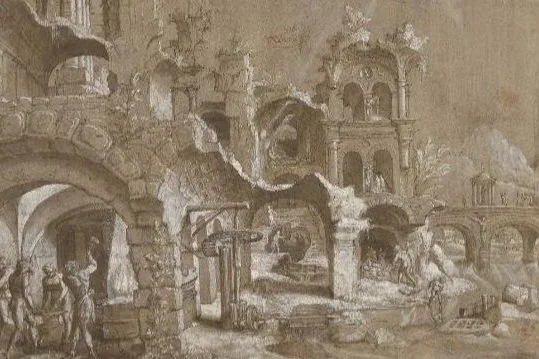
Maarten van Heemskerck, Ruins with the Vulcan's forge beneath an arch, 1538 © The Trustees of the British Museum
The first section of the exhibition, Early Drawings (1400-1500), traces the development and changing function of Netherlandish drawings from the early fifteenth century to the dawn of the sixteenth century. Originally intended as functional objects, used and reused in busy artistic workshops, these sheets were either made to develop compositions or served as visual records of works that had already left the studio. Despite their utilitarian function, some exquisite examples are on show. The delicate handling of silverpoint in an anonymous drawing of The Arrest of Christ (cat. 1) and Rogier Van der Weyden’s celebrated Portrait of a Woman (cat. 10) clearly shows what extraordinary effect can be achieved with a notoriously unforgiving medium. Another highlight of this first display is constituted by two drawings made by different artists working in Rogier’s studio (cat. 11-12), both making copies after the Mary Magdalen from the right wing of the Braque triptych (Louvre): a fun and self-explanatory compare-and-contrast exercise that encourages close and interactive looking.

Rogier van der Weyden, Portrait of an Unknown Young Woman, c. 1435–1440 © The Trustees of the British Museum
The second section, Drawing to Design (1500-1530), could not have started with a better drawing than Jan de Beer’s St Luke painting the Virgin (cat. 41), probably made in preparation for a painted glass roundel in the chapel of the homonymous guild in the Church of our Lady in Antwerp. The drawing provides valuable insight into how artistic workshops functioned, not only through its visual representation but also through its physical evidence: small holes along the contour lines that enabled the design to be transferred across media while allowing the sheet itself to remain in the studio. The label text for this sheet (and indeed, all the labels more broadly) strikes a delightful balance between technical, visual and contextual information, which compensates for the impracticality of displaying the versos of the drawings.
This section also incorporates an interesting selection of sheets whose functions span across media, including designs for engravings, glass roundels, tapestries and paintings. Despite the focus on the drawings’ materiality and purpose, excellent draughtsmanship dominates the visual rationale of the display. Two rare red chalk drawings recently attributed to Jan Cornelisz. Vermeyen (cat. 116-117) and seven astonishing drawings by Lucas van Leyden (cat. 54-60) cannot be missed. As the British Museum is fortunate to possess the largest collection of Lucas’s drawings in the world, the display offers a rare glimpse into how brilliantly (and differently) the artist could handle different media. His extraordinary black-chalk portrait of a man wearing spectacles and holding a pen (cat. 55) raises intriguing questions: is he writing or drawing? A tantalising and complex question which can be answered only by close and attentive looking.

Lucas van Leyden, An old man drawing, c. 1512 © The Trustees of the British Museum
The final sections in the show address two broad, thematic arguments. The The Antique and the Vernacular display gathers a range of sheets of varying quality and subject matter, with superb drawings by Pieter Bruegel the Elder (cat. 126), Jan Gossart (cat. 68), and Bartholomeus Spranger (cat. 148-149), alongside a vividly coloured and meticulously executed Allegory on Life and Death by Joris and Jacob Hoefnagel (cat. 132). Yet the protagonist of this section, and perhaps of the entire exhibition, is Hendrick Goltzius. His small confident self-portrait (cat. 150) and his exquisite Ceres and Bacchus (cat. 152), with bronze-like sculptural bodies accentuated by confident strokes of brown ink, push the boundaries of the drawing medium and format to unbelievable effects.

Hendrik Goltzius, Self-portrait, c. 1589 © The Trustees of the British Museum
Landscapes concludes the show. Among fine examples by the likes of Roelant Savery (cat. 168) and Paul Bril (cat. 163), a beautifully rendered and illuminated view of Bethlehem by Jan van Scorel (cat. 66) stands out. A talented artist who travelled extensively (even being appointed Keeper of the Papal collections in Rome), his sheet provides a meaningful link with the Heemskerck drawing which opened the exhibition. Although the reviewer noted that visitors tended to spend less time in this section, its presence in the exhibition is crucial, underscoring the pivotal role that drawn landscapes played in the development of a distinctly Northern graphic tradition.
Beyond constituting a unique opportunity to see these rare drawings first-hand, the exhibition allowed for the production of a superb catalogue, the first to discuss Early Netherlandish drawings at the British Museum since Arthur Ewart Popham’s volume published in 1932. While Popham’s work remains an important source of knowledge, encompassing a much larger number of drawings than the 180 in the exhibition catalogue, different methodologies and lines of enquiry have been developed over the past century. New technical research and scientific examination have enriched and nuanced the field. New material research has challenged uncertain attributions. Each catalogue entry is thoroughly researched and well-written, with important visual and contextual references. For those who will miss the exhibition and for those keen to keep this field of research alive, the volume is a sound investment: it will undoubtedly remain a reference work for decades.
At a time when resources in the museum sector are lacking and curatorial research is often de-prioritised, this exhibition and its accompanying catalogue are useful reminders of how crucial it is to devote time to cataloguing and conservation. Only one question remains open to debate: how accessible is this exhibition? Why would general visitors with the most varied backgrounds ‘care’ about drawings? And why specifically Early Netherlandish sheets, which to be frank, as much as it pains the reviewer to admit, have rarely garnered broad interest? A personal response would be that an entirely free exhibition on a subject unfamiliar to most visitors, yet one that encourages slow looking, curiosity, and reflection on how we reconstruct the past from the scant evidence that survives, more than justifies itself. If it can make visitors care about a group of objects they had never previously considered, then it has already succeeded.
Early Netherlandish Drawings continues at the British Museum until 20 September 2026.