Lucian Freud: Drawing into Painting
The National Portrait Gallery, London
Trois Crayons Magazine, May 2026
Reviewed by Dr Jasmine Clark
It is clear from the outset of Lucian Freud: Drawing into Painting at The National Portrait Gallery that Lucian Freud (1922–2011) was an intensely restless artist whose daily practice echoed his uncompromising character. Entering the exhibition, a monumental image of Freud’s studio – where streaks of paint violently explode up the walls and piles of artistic detritus litter every surface – sets the stage for a small self-portrait (1985). Rapid smudges of charcoal roughly mark out the composition of the unfinished piece, an example of Freud’s repeated attempts to capture his own likeness.
Curated by Sarah Howgate, in collaboration with the Lucian Freud Archive, the exhibition offers an alternative perspective into Freud’s unflinching observations of character through the centrality of drawing in his process. Over 170 drawings, etchings, and paintings chronicle the artist’s lifelong obsession with portraiture. “Everything is autobiographical and everything is a portrait,” said Freud, “even if it’s a chair,” a sentiment that is tangible in the exhibition’s first section. Freud pays equal attention to people, plants, objects, and animals in these early pieces, humanising the inhuman. His unexpected colour placement in Botanical gardens (landscape with Scillonian Pine) (1945) and Self Portrait with a Hyacinth (1947-8) anticipates his work in oil, using instead a mixture of subtle conté crayons, coloured chalks, and pen and ink.
A selection of Freud’s childhood drawings and letters, which the artist’s mother Lucie preserved when the family emigrated from Nazi Germany to London in 1933, points to an early appreciation of his surroundings. During these formative years, Cedric Morris, a tutor at the East Anglian School of Painting and Drawing, encouraged Freud’s creativity; in a portrait of his tutor made in 1940, the artist played with texture by mixing sand into paint. His art-school friend David Kentish and the poet Stephen Spender further stimulated Freud. In the bleak January of 1940, the group stayed in an isolated cottage in Capel Curig, Snowdonia; pages of a rare sketchbook belonging to this pivotal trip, known as ‘The Freud-Schuster Book’, are on display, filled with Freud’s expressive line drawings.
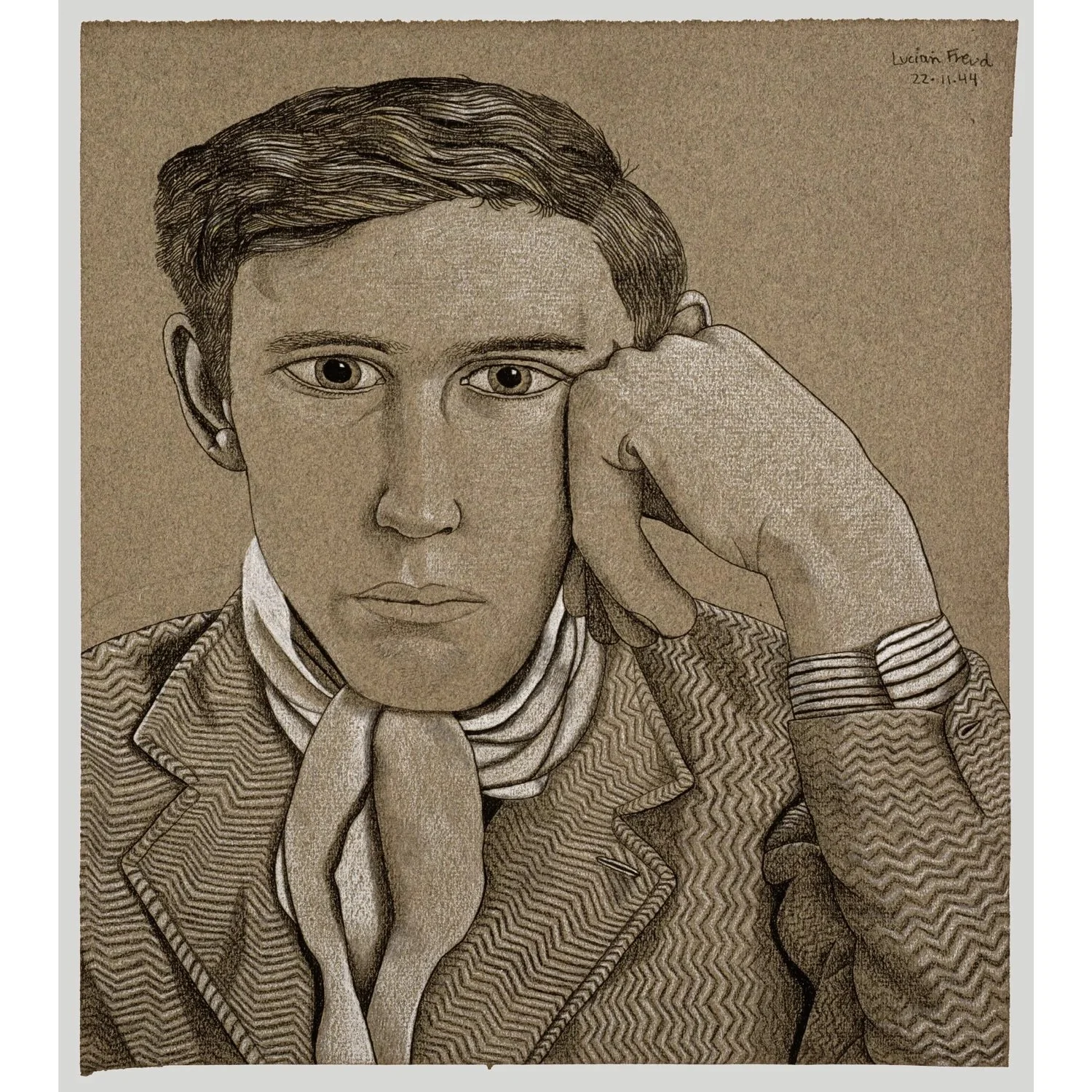
Lucian Freud, Portrait of a Young Man, 1944. Black crayon and chalk on paper. (© The Lucian Freud Archive. All Rights Reserved 2025. Bridgeman Images, lent by a private collection)
Freud began his career as a relentlessly precise yet stylish draughtsman. A decade of some of his finest draughtsmanship can be seen in this section, titled Beginnings. “I would have thought I did 200 drawings to every painting in those early days. I very much prided myself on my drawing,” recalled Freud. After attending Goldsmiths College in London, his social circle expanded to include the bohemian and aristocracy alike. He started sitting uncomfortably close to his sitters. We are brought almost nose-to-nose with his friends in portraits of John Craxton (1944) and Christian Bérard (1948). His first wife and artist Kitty Garman, who appears abundantly in this section, described sitting for Freud as “like being arranged”. There is a meticulous linearity to Freud’s early work, a common thread of forensic attention to detail that transcends medium.
We are subsequently met by the face of Caroline Blackwood, the writer and Guinness heiress who had a short-lived marriage to Freud in the 1950s. His paintings of her, Girl in Bed (1952) and Hotel Bedroom (1954), exude with both tenderness and a disconcerting scrutiny; her diverted gaze undeniably self-assured yet the artist lays bare every freckle and vein for us to inspect. Accompanying pages from a sketchbook show his dynamic compositional workings. Freud claimed that Hotel Bedroom was the last painting he made from a seated position, insisting “when I stood up I never sat down again”. It was a crucial turning point in his career, and in the exhibition.

Lucian Freud, Girl in Bed, 1952 © The Lucian Freud Archive. All Rights Reserved 2025. Bridgeman Images
What follows is a room of endings – visual meditations on his aging parents, relationship breakdowns, and a startling self-portrait made using a coarse hog-hair brush titled Reflection (1985). After the death of her husband in 1970, his mother Lucie fell into a deep and isolating depression. The artist began creating daily paintings, drawings, and etchings of his mother between 1972 and 1989 as a way to reconnect, a small group of which are sympathetically displayed here.

Lucian Freud, Bella in her Pluto T-Shirt (etching), 1995 © The Lucian Freud Archive. All Rights Reserved 2025. Bridgeman Images
A notably formidable Freud emerges as we head towards the last rooms in the exhibition. Now in the late 1980s and 1990s, he became obsessed with the authenticity, strength, and vulnerability of the naked human body. “I want to observe them and paint them as they are and feel,” Freud once said. A plethora of sketches and etchings are exhibited alongside his big-hitter paintings, like the impressively confronting Sleeping by the Lion Carpet (1996) and Naked Man on a Bed (1989–90). Etching was a practice Freud returned to with vigour in this decade after 34 years. Often made in tandem, his etchings and paintings share an affinity in style and approach.
The artist seems tantalisingly close to the visitor in a section that explores his responses to Old Masters, where we find his splattered palette, hog-hair brushes, and paint tubes squeezed right to the last drop. Freud left the materials at the National Gallery after spending countless nights poring over paintings by Jean-Siméon Chardin, John Constable, J.M.W. Turner, and Jean-Antoine Watteau. It is his responses to Watteau’s exquisite Pierrot Content (c. 1712) that disclose this practice not as a slavish act of copying, but rather a way for Freud to digest and metamorphose these works through his own idiosyncratic lens; subverting the typical order, his paintings frequently prompted further drawings in a reciprocal exchange of problem-solving.

Lucian Freud, David Hockney, 2002 (oil on canvas) © The Lucian Freud Archive. All Rights Reserved 2025. Bridgeman Images. Private Collection
In the final room, aptly titled Drawing into Painting and Painting into Drawing, hang some of Freud’s last great portraits. From his fellow artists David Hockney and Frank Paul to Queen Elizabeth II, these works expose to varying degrees Freud’s preference for capturing familiar sitters over a prolonged period. He continued etching until the end of his life, sometimes after painting his sitter and often for himself. Perhaps it was his time spent amongst the Old Masters that instilled in him a fondness for the historic medium. A copper etching plate of the restaurateur Jeremy King (2008–11) glows under the exhibition lighting, illuminating a feverish network of scratched lines made by Freud’s still-energetic hand in the final year before his death.
Lucian Freud was, and remains, a looming titan who boldly dares us to confront his urgent, anarchic brushstrokes. At the same time, he could be an intensely insular man, obsessively exploring the world he had constructed for himself through his etchings and drawings. The exhibition allows both identities to breathe, presenting an artist who never ceased to push the boundaries of the human form, of taboo, and of artistic mediums.
Lucian Freud: Drawing into Painting at The National Portrait Gallery in London ran from 12 February to 4 May 2026.