Trois Crayons Magazine, September 2026
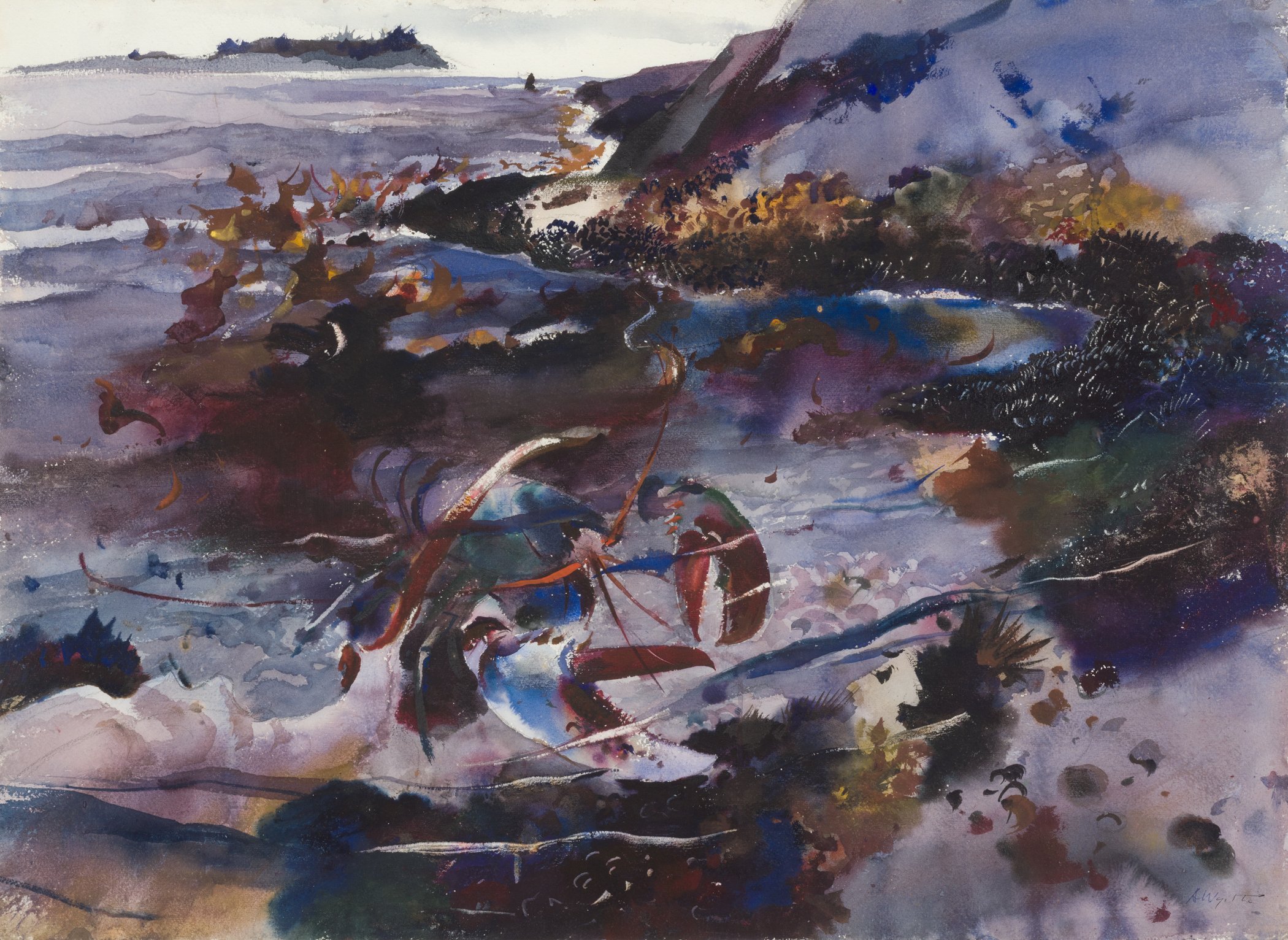
Andrew Wyeth (1917–2009), Lobster #7, 1940. Wyeth Foundation for American Art Collection, M1035. © 2026 Wyeth Foundation for American Art / Artists Rights Society (ARS), New York
Britany Salsbury, Curator of Prints and Drawings, Cleveland Museum of Art, has kindly chosen our drawing of the month.
Watercolour on paper, 54.6 x 74.63 cm. Wyeth Foundation for American Art Collection, M1035. © 2026 Wyeth Foundation for American Art / Artists Rights Society (ARS), New York
One of the aspects that draws me most to Andrew Wyeth’s work is his ability to highlight unnoticed, uncanny, or unusual aspects of the everyday. Wyeth’s wife and creative partner, Betsy, once referred to this practice as ‘the emergence of something more’—a description that especially applies to his watercolours. Wyeth drew endlessly, using his drawings and watercolours to both define and shift his perspective. This especially stood out to me throughout the process of studying hundreds of works on paper from his estate collection in preparation for the Cleveland Museum of Art’s exhibition Spectacular Freedom: Andrew Wyeth and the Modern American Watercolor, opening this month, and it is my hope that others in our field will feel the same.
Among the extensive holdings of the Wyeth Foundation of American Art collection, Lobster #7 became and remained one of my favourites from the exhibition checklist. In layers of wash, we see a lobster nearly camouflaged in a shallow pool in Midcoast Maine, where Wyeth summered throughout his entire life. Both the creature and its surroundings are rendered in the blue and purple tones that the artist used almost exclusively for such works during the 1930s and ‘40s, highlighted by unexpected areas of deep gold tone. Wyeth allowed watercolour to pool and bleed around the sheet, evoking the visual effects of seeing both the lobster and the surrounding plants and rocks through a layer of cloudy seawater.
Lobster #7 belongs to a series of thirteen versions of the same composition—four of which will be on view at the CMA—throughout which the lobster and his environs move between realism and abstraction. For me, the seventh lobster occupies a fascinating space between representation and pure form—a quality that is significant given Wyeth’s reputation. For much of his career, the artist was known far better for his exactly rendered tempera paintings (think Christina’s World) than his watercolours. This is due in large part to the fact that most remained in his own holdings—today the Wyeth Foundation for American Art collection—throughout his lifetime and were exhibited infrequently. It was only in the past half-decade that these works have become accessible for exhibition through a partnership between the Foundation, and both the Brandywine Museum of Art and the Farnsworth Art Museum. Spectacular Freedom will be the first product of this collaboration and will reveal just how much of Wyeth’s career was spent thinking about and working on paper.
This focus on watercolour is important, because the medium established Wyeth’s reputation around the time Lobster #7 was created. In 1937, the artist opened his first New York solo exhibition of works on paper at Macbeth Gallery, famously selling everything on view within days of opening. Then, as now, his images of the Maine coast immediately called to mind Winslow Homer, and the CMA exhibition highlights the ways in which Wyeth deliberately situated himself and his work within an explosion of interest in watercolour beginning with the elder artist and lasting through the following century. Created outdoors, directly from nature, sheets like Lobster #7 were meant to evoke the freedom and accessibility that watercolour offered artists, and the ways in which these qualities led them to be seen by critics and collectors as distinctly American.
Perhaps most notably to me, however, Lobster #7 overturns the expectations that any viewer familiar with Wyeth is likely to have of his work. The loose, quickly applied brushstrokes directly counter the exacting precision of his tempera paintings, and layers of gestural marks recall the postwar abstraction with which he was consistently said to be at odds. Taken together, the drawing shows that it is possible to rethink an artist about whom so much has already been said.
Spectacular Freedom: Andrew Wyeth and the Modern American Watercolor will be on view at the Cleveland Museum of Art from 20 September 2026 through 18 January 2027, before travelling to the de Young Museum, San Francisco. The accompanying publication is available through Yale University Press.