Odilon Redon (1840–1916), The Battle of the Bones, c. 1881
Trois Crayons Magazine, July 2026
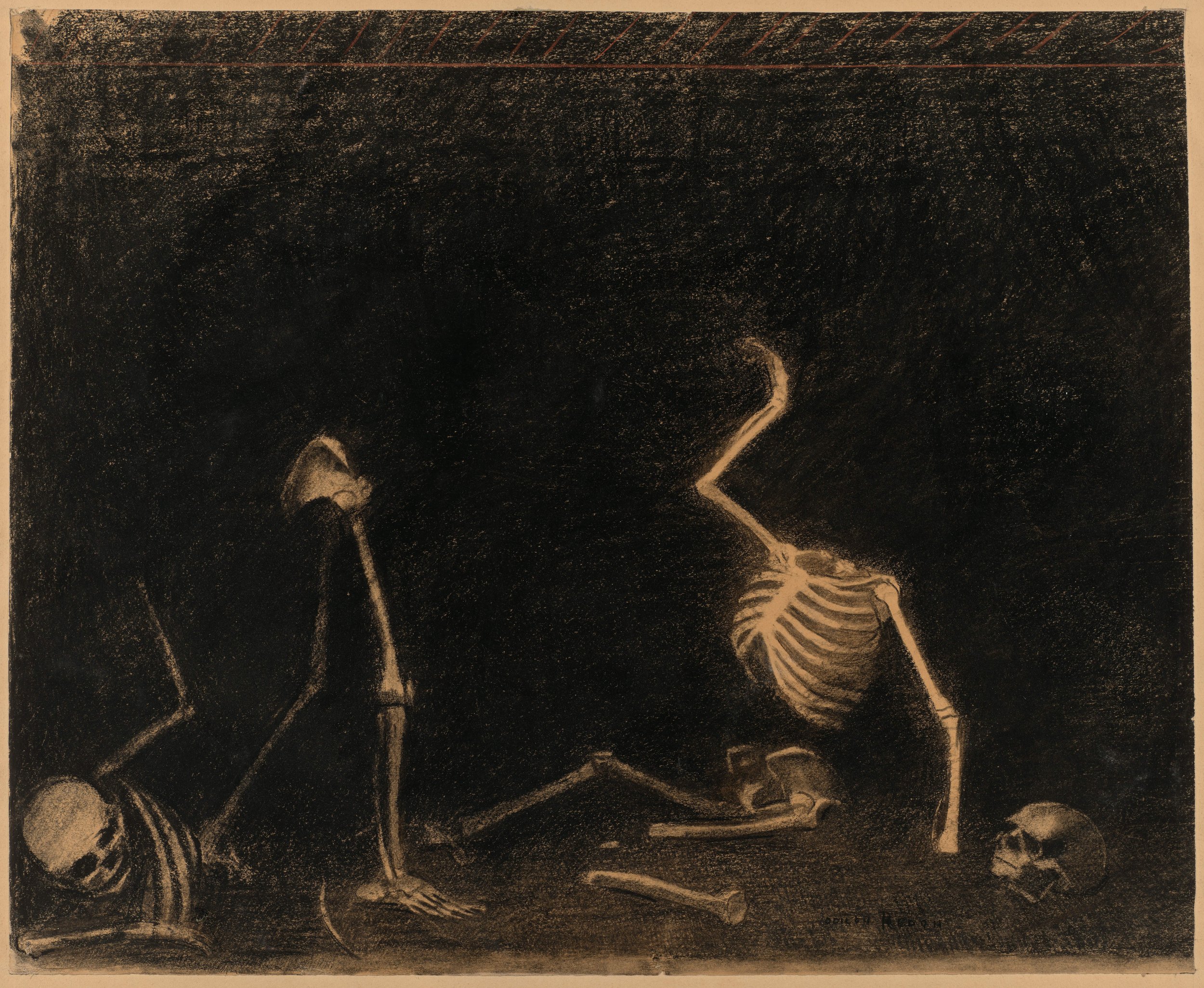
Odilon Redon (1840–1916), The Battle of the Bones, c. 1881. J. Paul Getty Museum, Los Angeles, 2024.17
Danielle Canter, Assistant Curator in the Department of Drawings at the J. Paul Getty Museum and curator of Odilon Redon: Otherworldly Visions, has kindly chosen our drawing of the month..
Charcoal and pastel with stumping and removal on tan paper, 36.5 × 45 cm (14 3/8 × 17 11/16 in.),
J. Paul Getty Museum, Los Angeles, 2024.17
Upon entering the exhibitionOdilon Redon: Otherworldly Visions, on view at the Getty from 14 July to 18 October, you are immersed in darkness. The first gallery features examples of Redon’s noirs, drawings and prints made in black media with often equally shadowy subject matter. A highlight of the room is this study of two skeletons in the aftermath of a battle; their broken bones scattered across the foreground as they attempt to keep fighting.
Between 1870 and 1890 Redon worked almost exclusively in shades of black, establishing a distinct visual language through enigmatic imagery and highly personal symbolism. This unusual composition was inspired by a passage from Maurice Bouchor’s 1880 poem La Bataille des Os, which tells the story of two men who kill each other in a duel over a lover and, after death and burial, return to her home to continue the battle. Redon responded to the sights and sounds of Bouchor’s macabre scene: “Sometimes it was an arm that, severed from the body, fell with a crash; sometimes a half-dislocated jaw; a leg dislocated by a blow of the shovel; a broken tibia that littered the carpet.”
Set against an opaque background of deep black charcoal, the wounded skeletons in the drawing are composed of reserves of pale tan paper rather than the addition of media. With careful application of the powdery charcoal and its selective removal, Redon fashioned the fine details of the bones from the bare sheet.
The simplicity of the composition is in sharp contrast to a related drawing in the collection of theKröller-Müller Museum, in which Redon depicted an earlier scene of the two skeletons feasting and cavorting in their former lover’s home. In the Getty drawing, Redon eschews the descriptive setting to place the figures against an ambiguous black field.
Scientific analysis conducted in the lead-up to the exhibition has unveiled a more complex story buried beneath the darkness. Scans reveal that Redon struggled to arrange the animated skeletons, shifting their positions and breaking them into pieces before covering the remains of his own bodily violence under a thick layer of charcoal. The altered composition helps to explain the row of angled red lines that mark off a strip of charcoal at the top of the sheet. Once the standing skeleton on the left was dismantled and strewn across the foreground, the expanse of black media overwhelmed the drawing. With bright red pastel, Redon indicated where the work could be trimmed or framed over to balance the weight of the scene.
The drawing was acquired by the Getty in early 2024, not long after I arrived at the museum. Fascinated by the darkly comic subject and the unusual use of the paper reserve, I delved deep into Redon literature and closely examined the other charcoal drawings and pastels in the Getty collection. This research was the foundation of the current exhibition, in which visitors can encounter Redon’s dark and fantastic world.
Odilon Redon: Otherworldly Visions is on viewat the Getty from 14 July – 18 October 2026.