François Boucher (1703–1770), A Female Nude Reclining on a Chaise-longue, c. 1752
Trois Crayons Magazine, August 2026
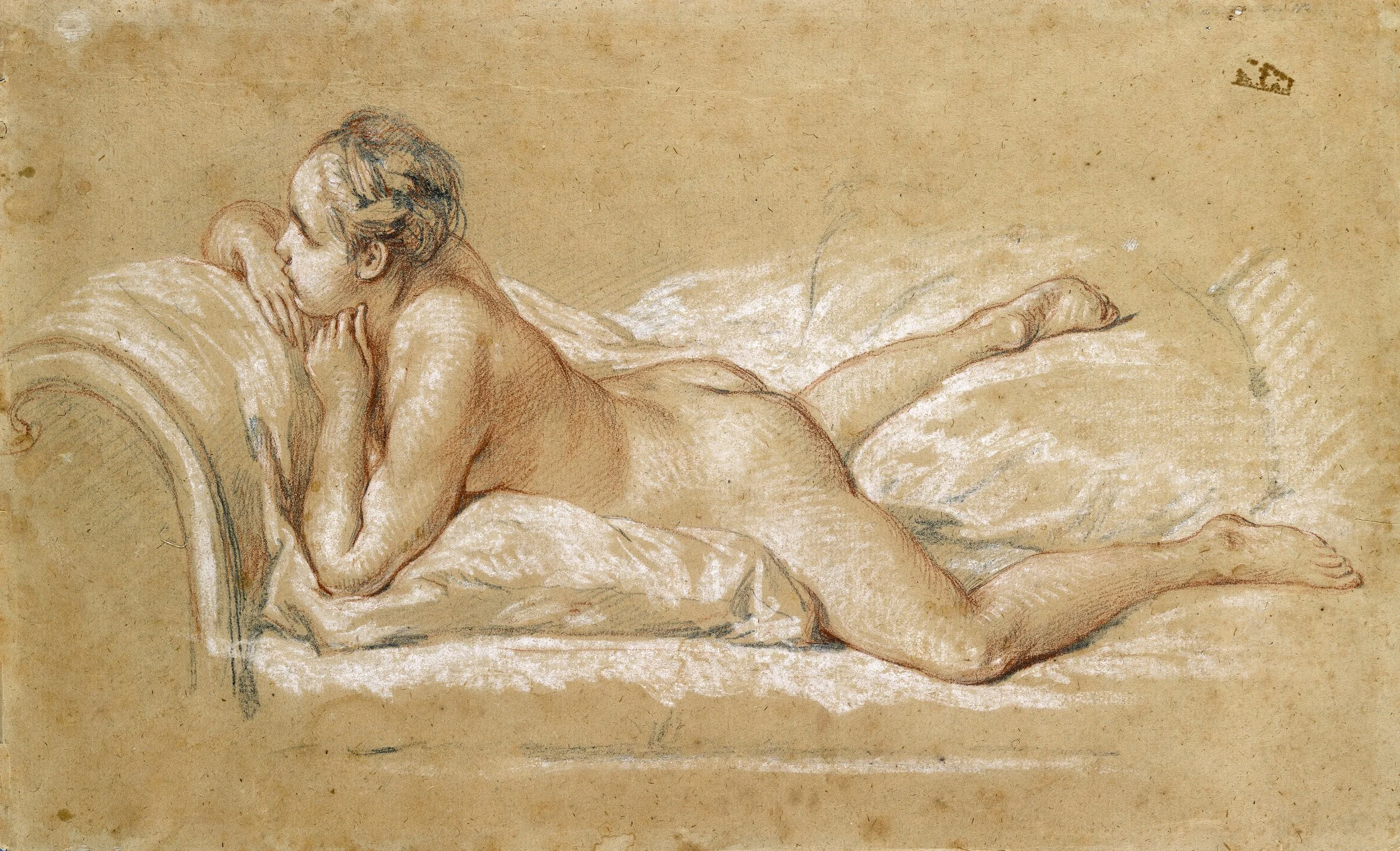
National Gallery of Ireland Collection. Photo, National Gallery of Ireland.
National Gallery of Ireland Collection. Photo, National Gallery of Ireland.
Graphite, red and white chalk on brown paper, 222 × 362 mm, National Gallery of Ireland, Dublin, Purchased, 2007, inv. NGI.2007.3
The exhibition Rembrandt to Matisse – A Celebration of European Works on Paper, on view at the National Gallery of Ireland from 18 July to 6 December, marks Ireland’s Presidency of the Council of the European Union. It comprises both well-known highlights from the collection and new acquisitions by a host of European artists from the fifteenth century to the present day. One of the many prized drawings on show is François Boucher’s A Female Nude Reclining on A Chaise-Longue (c. 1752). This fine drawing relates to Boucher’s celebrated painting The Blonde Odalisque (L’Odalisque Blonde), of which two versions survive, one in the Wallraf–Richartz Museum in Cologne (1751) and the other in the Alte Pinakothek in Munich (1752), where it is also known as Resting Girl.
A major proponent of the Rococo style, Boucher was a prolific and pioneering draughtsman. He developed life-drawing, previously considered to be an academic exercise, into a fully-fledged branch of drawing. He is regarded as one of the first artists to realise the marketable potential of drawings as artworks in their own right. He not only produced preparatory studies for his paintings, but also picked out details from his finished works, such as a figure or a head, to create autonomous drawings. Boucher’s patrons delighted in his depictions of the female nude. He often drew this subject specifically for collectors, who generally hung them in their cabinets, or intimate private rooms. This chalk study exudes a freshness and immediacy, which suggests it was drawn from life, however the identity of the young girl has long been the subject of debate. Traditionally, the model is thought to be Mademoiselle Marie-Louise O’Murphy (1737–1814), one of five sisters of Irish descent, who modelled for Boucher when she was around fifteen years old, and notoriously became a mistress of King Louis XV of France. Her father was Daniel O’Murphy, a Dublin soldier who emigrated to Rouen, where he worked as a shoemaker.Commonly known as Mlle O’Murphy, La Morphil or La Morphise, she resided for a couple of years at the Parc aux Cerfs, just steps away from the Palace of Versailles, and prior to her 17th birthday had a daughter named Agathe-Louise de Saint-Antoine (1754–1774).
Alastair Laing (1944–2024), an expert on Boucher’s art, confirmed the authenticity of this sheet when it was acquired by the National Gallery of Ireland from Christie’s, New York, in 2007. The drawing reflects his interpretation of Boucher’s nudes as flesh-and-blood women in a state of undress rather than classical nudes. In this lively drawing on buff paper, the adolescent girl lies prone on a chaise-longue, her limbs splayed out over soft cushions. Unperturbed by her own nakedness and oblivious to her audience, she raises her head, as if to look at something beyond the picture. The round, angelic face and innocent expression shown here also appear in the Munich painting. In contrast, Boucher conveys a more erotic and provocative image of the female nude in his painting titled, Dark-haired Odalisque, of which two versions exist, one in the Musée du Beaux-Arts, Reims (1743) and the other in the Musée du Louvre, Paris (1745). In this work, a half-naked courtesan is shown lying on a divan, gazing back at the viewer with a knowing glance. In both The Blonde Odalisque and Dark-haired Odalisque paintings, a perfume-burner is shown placed on a stool in the left foreground. However, that particular detail, which augments the sensual nature of the scene, does not feature in this delicate drawing.
In Boucher’s numerous drawings of the female nude, his mastery of the trois crayons technique is apparent. It allowed him to render the subtle tonal qualities of skin along with the volume, texture and folds of abundant drapery. In this drawing, the girl’s body has been carefully delineated with red chalk and sensitively modelled with diagonal hatch marks, using a combination of red chalk, graphite and white highlights. In addition, white chalk is skilfully used to capture the highlights across her face, while graphite is used to define details of her upswept hairstyle and sketch in aspects of the chaise-longue and cushions. The large cushions, heightened with broad areas of white chalk, enhance the picture’s overall sense of volume and provide stability for the figure within space. The artist’s virtuoso handling of subjects like the female form led to his drawings being enthusiastically collected during his lifetime and widely circulated as prints. Visitors to this exhibition will both appreciate Boucher’s exceptional draughtsmanship and be intrigued by the model’s Irish associations and colourful early life.
Rembrandt to Matisse – A Celebration of European Works on Paperis on view at The National Gallery of Ireland, Dublin, from 18 July – 6 December 2026.