
Overview #24
Monday, 1 September 2025. Newsletter 24.
Reform to Restoration: French Art from Louis XVI to Louis XVIII from the Horvitz Collection
(June 1 – September 14, 2025)
Crocker Art Museum, Sacramento
Sarah Farkas, Associate Curator of Art at the Crocker Art Museum
Spanning 60 years of artistic production, this exhibition highlights three extraordinarily pivotal epochs in French history: the French Revolution (1789–1799) and the creation of the French Republic, the rise of Napoleon Bonaparte and the establishment of the First French Empire, and the Restoration of the French monarchy (1814–1830) under Louis XVIII and Charles X. This period was marked by an artistic shift from the ornate Rococo style favoured in the French court to a revival of interest in the themes and aesthetics of classical antiquity known as Neoclassicism. Eventually, this led to the emergence of Romanticism, a movement emphasising subjectivity and emotion, as a response to a growing disillusionment with the Enlightenment ideals of reason and logic in the aftermath of the Revolution.
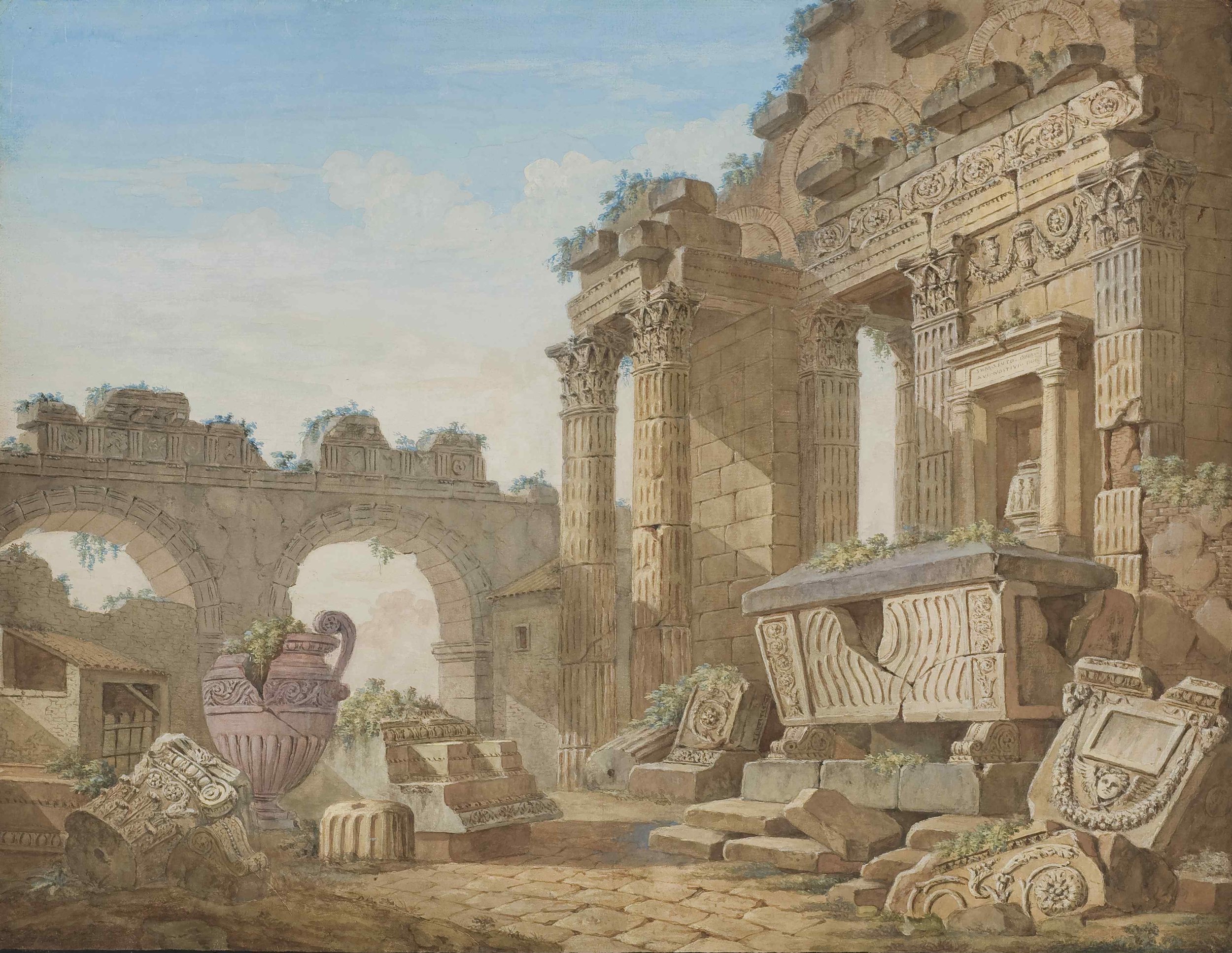
Charles-Louis Clérisseau (French, 1722–1820), Capriccio with Ruins, n.d. Gouache and watercolor with touches of pen with brown ink and brush with brown wash over traces of black chalk on cream antique laid paper, laid down on cream antique laid paper, 18 5/16 x 23 3/4 in. The Horvitz Collection, Wilmington.
All the objects in Reform to Restoration are drawn from the Horvitz Collection, one of the most important private collections of French art in the United States. More than 100 drawings and paintings are organized around six thematic categories: Antiquity, Revolution, Devotion, Service, Empire, and Honour. Each grouping reflects the variety of social concerns, political events, and visual movements that influenced artists living in the tumultuous period between 1770 and 1830, including many well-known artists such as Jacques-Louis David and Jean-August-Dominique Ingres. The exhibition begins by exploring the French Royal Academy of Painting and Sculpture, which was founded in Paris in 1648. This state-sponsored institution promoted a curriculum based on mastering the human form through drawing after sculpture and live models. At the same time, the Academy encouraged studying the Greek and Roman classical tradition, as seen in the work of Charles-Louis Clérisseau, the architect and artist, who spent roughly two decades in Rome. In his Capriccio with Ruins (1789), for instance, we see an imagined landscape of ancient Roman monuments that combines real architectural elements with fantasy, a popular eighteenth-century genre.
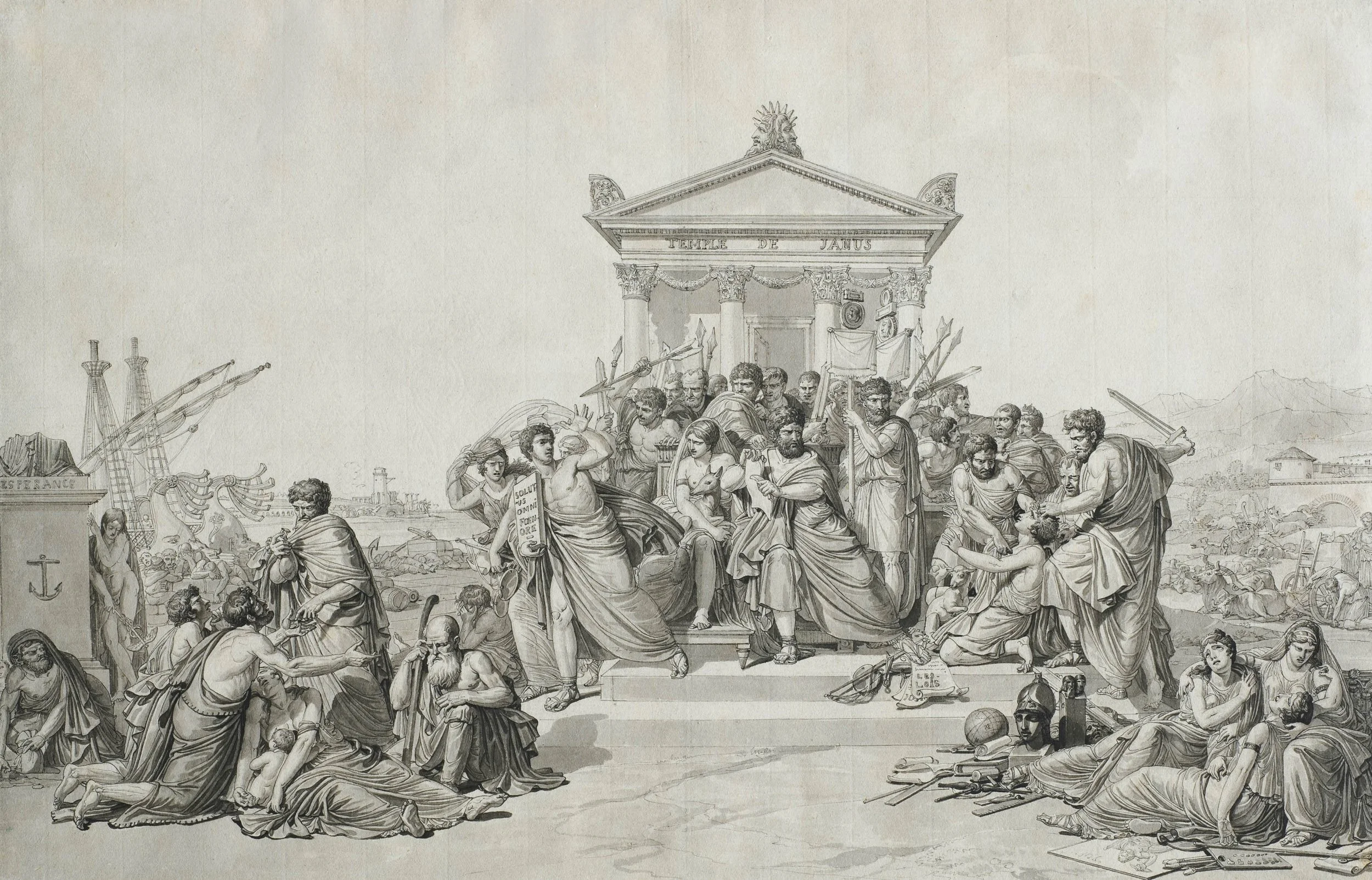
Louis Lafitte (French, 1770–1828), Allegory of the Revolutionary Regime, n.d. Pen with black ink and brush with gray wash on off-white wove paper, 11 1/4 x 17 9/16 in. The Horvitz Collection, Wilmington.
The enthusiasm for the classical past had significant resonance across French politics and culture, most notably in the wake of the Revolution, when the government was reconceived in the model of the ancient Roman Republic (circa 509–27 BCE). In the Allegory of the Revolutionary Regime, artist Louis Lafitte utilizes classical sources, such as the ancient Roman poets and historians Horace and Livy, to critique the Revolution, particularly its most violent phase known as the Reign of Terror. In the foreground, before a Temple to Janus (the god of transition and time), the allegorical figures of War and Conflict overcome Justice, suggesting the Revolution led to injustices similar to early Republican Rome.
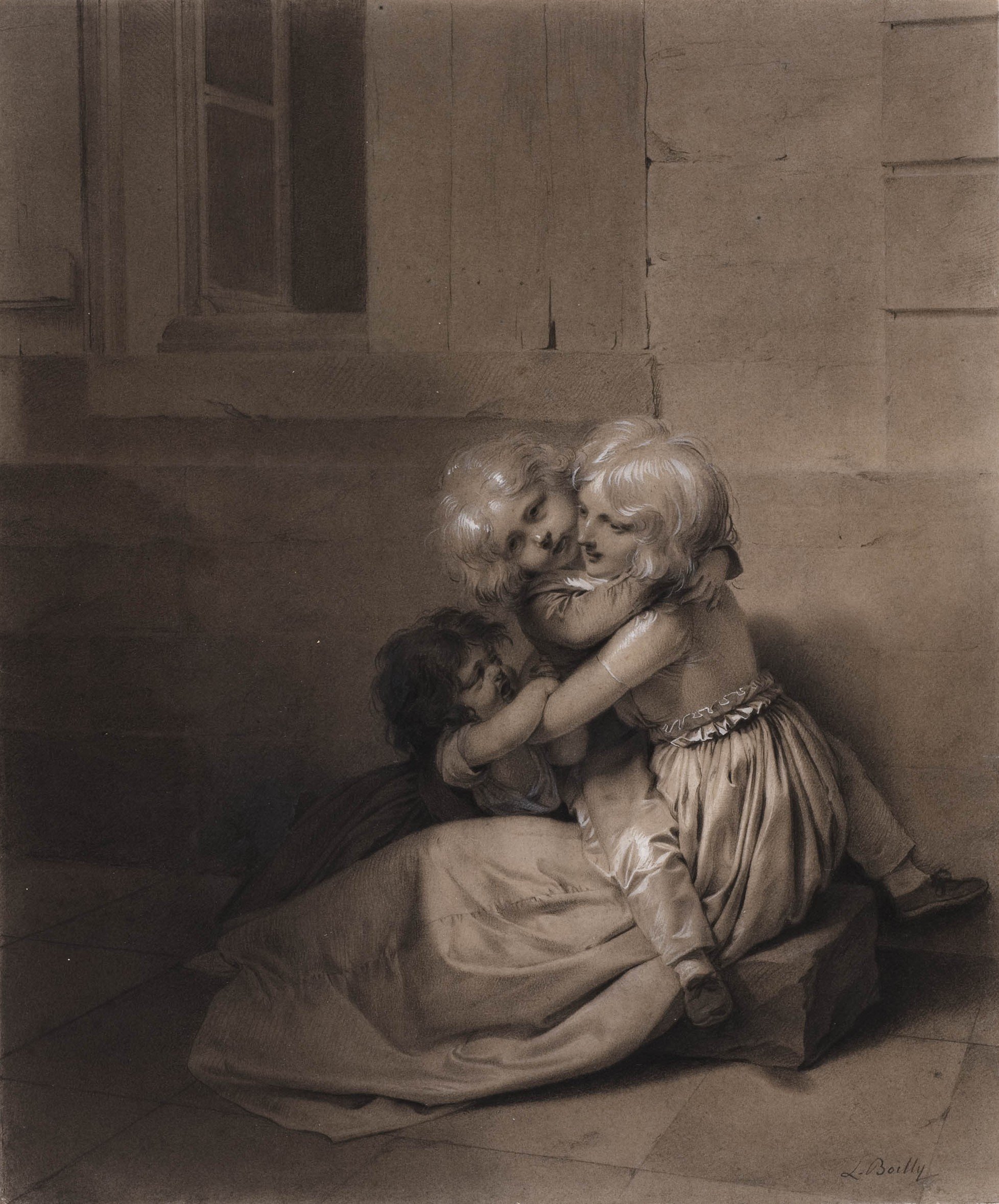
Louis-Léopold Boilly (French, 1761–1845), The Big Sister, n.d. Black chalk, extensively stumped, and brush with black chalk sauce, heightened with white gouache over traces of graphite on cream wove paper prepared with brown wash; partial framing lines in black chalk, laid down, 13 3/4 x 11 9/16 in. The Horvitz Collection, Wilmington.
Other works in this exhibition deal with the theme of devotion: romantic, religious, parental, or patriotic. One example is Louis-Léopold Boilly’s The Big Sister, a tender depiction of siblings vying for the attention of their elder sister. A keen observer and chronicler of everyday life, Boilly’s penchant for subtle humour comes through in the deep shadow cast across the face of the youngest child, on the brink of a tantrum as she attempts to infiltrate the joyful embrace shared by her elder brother and sister, both highlighted by touches of white gouache.
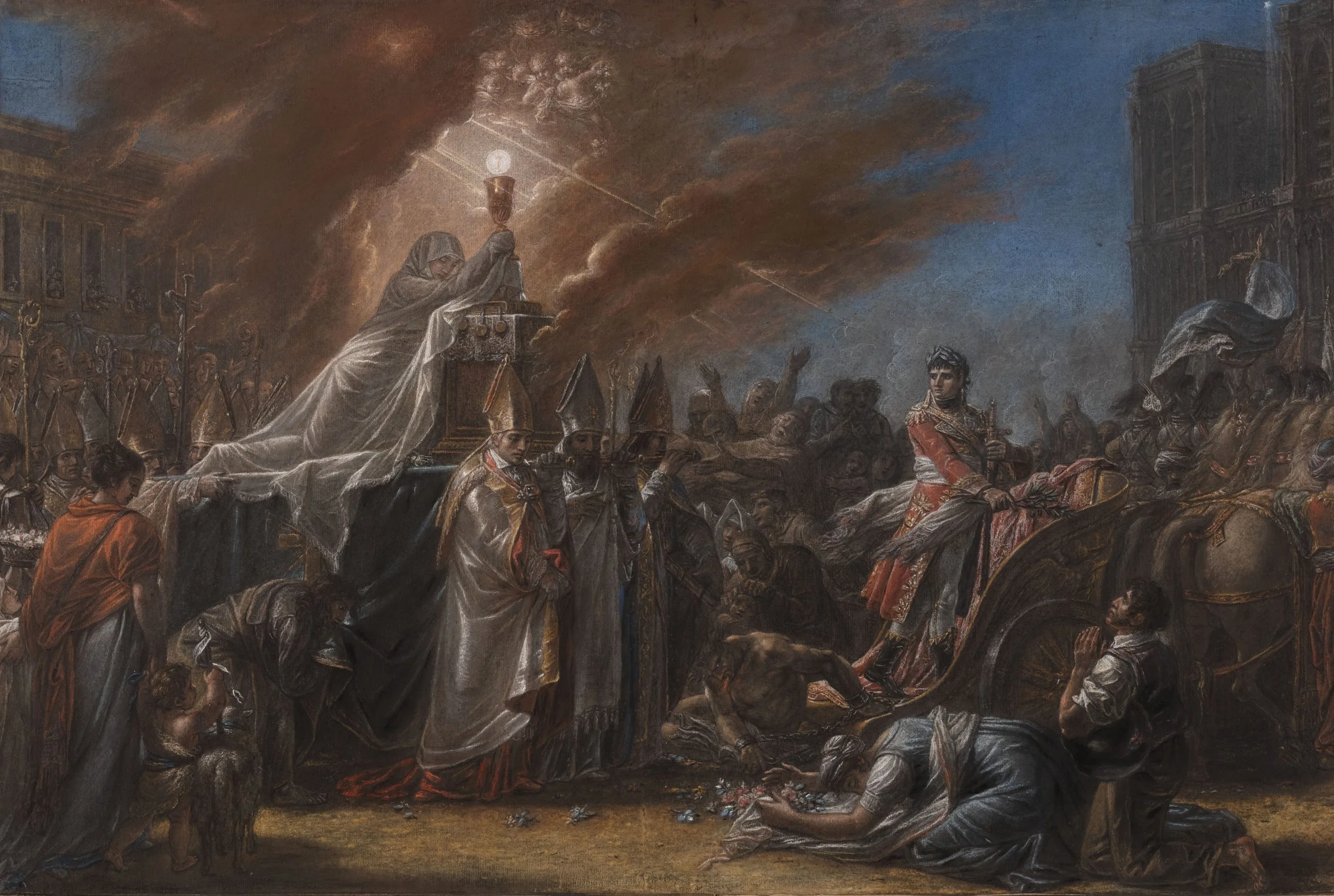
Antoine-François Callet (French, 1741–1823), Allegory of the Concordat, n.d. Pastel on paper, 21 3/4 x 32 7/16 in. The Horvitz Collection, Wilmington.
Though Boilly mostly avoided political themes, many artists found success serving the interests of the State. Allegory of the Concordat by Antoine-François Callet is either the preparatory drawing or a record of the now-damaged oil sketch submitted to an art competition in 1802. The competition celebrated both the Treaty of Amiens, temporarily ending a war with Spain and Britain, and the signing of the Concordat of 1801, a restoration of ties between France and the Catholic Church, which were severed during the Revolution. Previously the portraitist of King Louis XVI, Callet skilfully adapted to the changing political tides and here renders Napoleon Bonaparte in a fictional scene of triumph, modelled on Roman precedents. The future emperor, crowned with a laurel wreath and illuminated by heavenly rays emanating from behind the Holy Eucharist, drives a chariot toward Notre-Dame, dragging a representation of Heresy in chains.
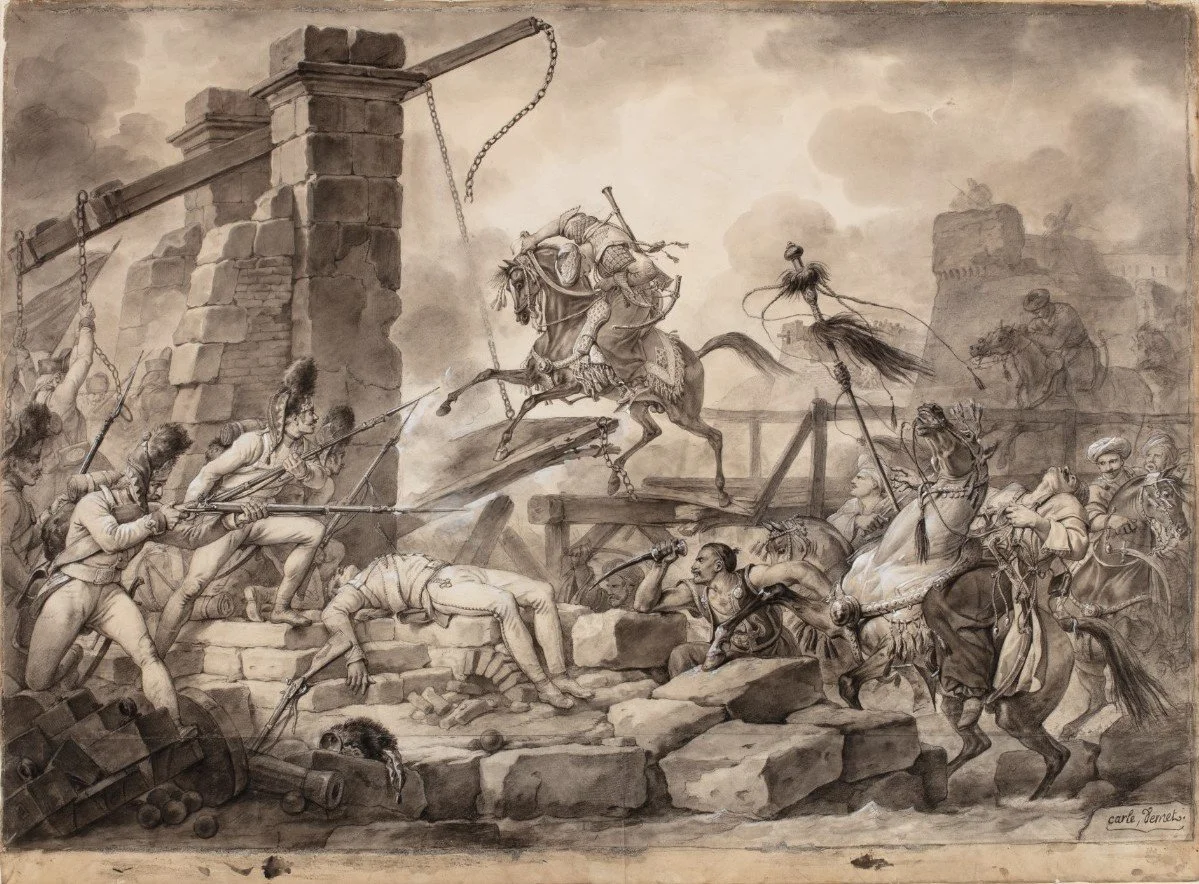
Antoine-Charles-Horace Vernet, called Carle Vernet (French, 1758–1836), Scene of Combat in Egypt, n.d. Black chalk, stumped, and brush with brown and gray wash, heightened with white gouache on three joined sheets of off-white wove paper, 28 1/4 x 38 3/16 in. The Horvitz Collection, Wilmington.
Colonial ambitions were strong under Napoleon’s rule, an idea explored in the exhibition’s section on empire. The French government became known as the First French Empire, a deceptive designation given France had maintained colonies in the Americas and Asia since the seventeenth century. In 1798, Napoleon’s forces invaded Egypt and returned with numerous looted art objects, many of which ultimately entered the collections of the Louvre and the British Museum. Antoine-Charles-Horace Vernet’s Scene of Combat in Egypt depicts the violent clash between Napoleon’s forces and Mamluk fighters, but the Orientalizing depiction of the Mamluks—who brandish long curved knives and dramatically rear and buck along with their horses—stands in stark contrast to Charles Meynier’s scene of Napoleonic conquest on European soil, Napoleon Entering Berlin (1809–1810), in which the local citizens appear to welcome the emperor’s arrival. The tendency by European artists to portray people of Middle Eastern, Asian, or North African origins in sensational and stereotyped ways was common in this period and at times a propagandistic tool to justify imperial desires.
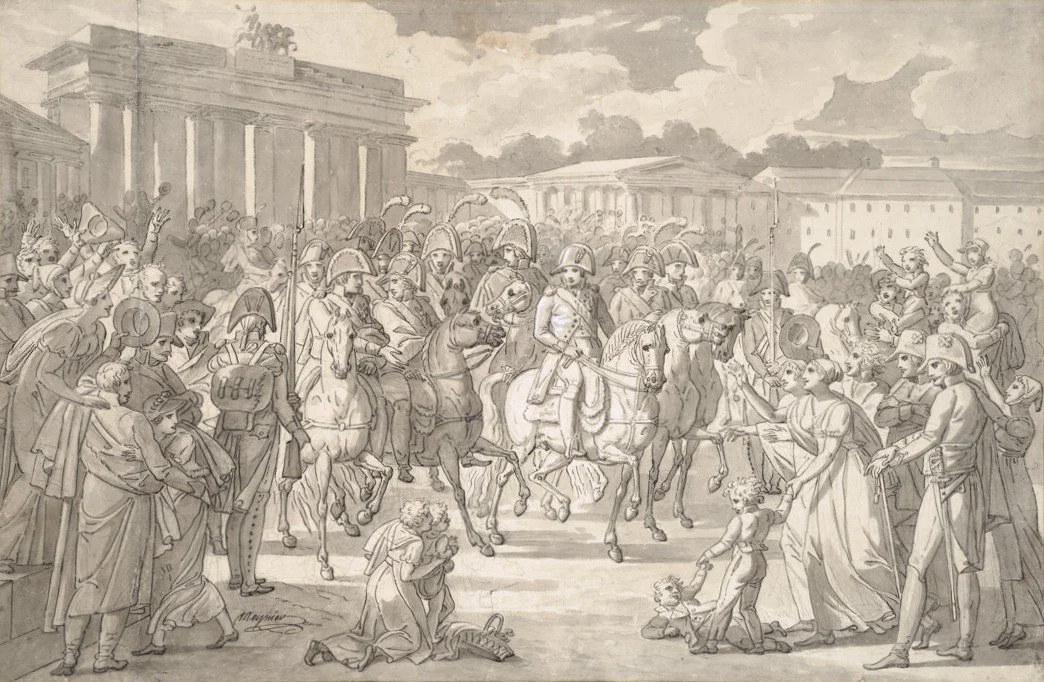
Charles Meynier (French, 1763–1832), Napoleon Entering Berlin, 1809–1810. Pen with black ink and brush with gray wash heightened with white gouache over black chalk on two joined pieces of off-white laid paper, 17 11/16 x 26 13/26 in. The Horvitz Collection, Wilmington.
The exhibition concludes with a selection of paintings that consider the concepts of honour and leadership in the face of crisis, themes relevant to multiple conflicts in this era. Many of the drawings in the exhibition were either recordings of or preparatory drawings for history paintings. Drawing from live models and the study of classical art and architecture were the foundations of history painting, which often focused on or were inspired by Biblical or classical mythological and historical events. As a genre, it was considered to be superior to all others—such as portraiture, landscape, or still life—by the French Royal Academy because it was intended to educate and inspire the viewer through moral examples, requiring that the artist possess an exemplary mastery of not only the technical skills of representation but also the intellectual and philosophical concepts of the day. The paintings that conclude the exhibition exert this to full effect, each concerned with a protagonist who asserts his or her moral worthiness, such as the philosopher Socrates, the conqueror Alexander the Great, or the fictional knights Ubaldo and Rinaldo. As an epilogue to an exhibition primarily centred on drawings, these paintings are a testament to the centrality of drawing from models to the artistic process among French artists at the turn of the nineteenth century.
This essay draws upon insights regarding the works in the exhibition Reform to Restoration from Alvin L. Clark Jr., Isabelle Mayer-Michalon, and Dana Cowen. The exhibition continues until September 14.