
Real or Fake #24
Monday, 1 September 2025. Newsletter 24.
Can we fool you? The term “fake” may be slightly sensationalist when it comes to old drawings. Copying originals and prints has formed a key part of an artist’s education since the Renaissance and with the passing of time the distinction between the two can be innocently mistaken.

Scroll for more information.
The original, of course, is the upper image.
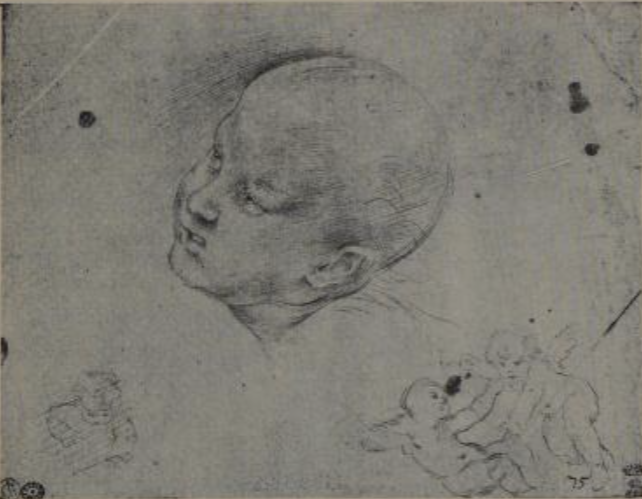
Lower Image: Late imitator of Raphael, Study of a Child’s Head and Other Studies, Location Unknown
This modern fake is a partial copy of an original drawing from Raphael’s "pink sketchbook”. The fake was probably not executed from the drawing itself, but from a reproduction in a sales catalogue. The head of the child was copied with great skill and accuracy, but the forger omitted almost all the other figures from the original.
They copied just one of the sketches of children. In the original, these figures clearly represent the Christ Child, and this sketch was intended for one of Raphael's Madonnas, but the forger ignored these elements and accompanied the Christ Child with a small winged Cupid. This figure, for which he had no model, is in a completely different style. The same goes for the child drawn in the lower left corner, which he vigorously crossed out to give the impression that Raphael had tried and rejected several ideas. The forger embellished his drawing with a few blots and three "restored" corners. In addition, he added three collector's stamps, all fakes. The two on the left are attributed to the J. F. Gigoux and Carlo Prayer collections, while the third is a copy of Lugt's 1916 issue, which he adorned with a crown. The forger was canny enough to include an inscribed number as well. His model bears the number 74; he did not copy it, but wrote 75 in the corresponding corner of his imitation.
The works and methods of this forger were discovered by D. A. Scharf. The collector's stamp with the crown is a sort of trademark; we find it, for example, on a drawing in the style of Guardi copied from a plate in the same catalogue as the Raphael. The illustrations in the sales catalogues seem to have been the main source of inspiration for the forger.
For further reading, see: Otto Kurz, Faux et Faussaires, Paris, 1983, pp. 96-97.