
September 2025
MONDAY, SEPTEMBER 1
Coming Up
Greetings from Trois Crayons HQ, where we are celebrating our second birthday and the 24th edition of this newsletter.
This month’s issue includes news, exhibition openings, video recordings from our events programme at Tracing Time, and an overview of the travelling exhibition, Reform to Restoration: French Art from Louis XVI to Louis XVIII from the Horvitz Collection, now at the Crocker Art Museum. All this is followed by a selection of literary, video and audio highlights, along with the return of the ‘Real or Fake’ section.
For next month’s edition, please direct any recommendations, news stories, feedback or event listings to tom@troiscrayons.art.
TROIS CRAYONS MUSEUM FORUM
Museum Partner Highlight: The Courtauld Gallery
As part of a new monthly feature highlighting works posted for discussion on the Trois Crayons Museum Forum we are pleased to introduce a drawing from The Courtauld Gallery: Composition studies for ‘The departure of the prodigal son’ (Luke 15:11-32) by an unknown artist.
To participate in this and other ongoing discussions, please click here. To register as a Museum Partner and pose your own Discussions, please email info@troiscrayonsforum.org.
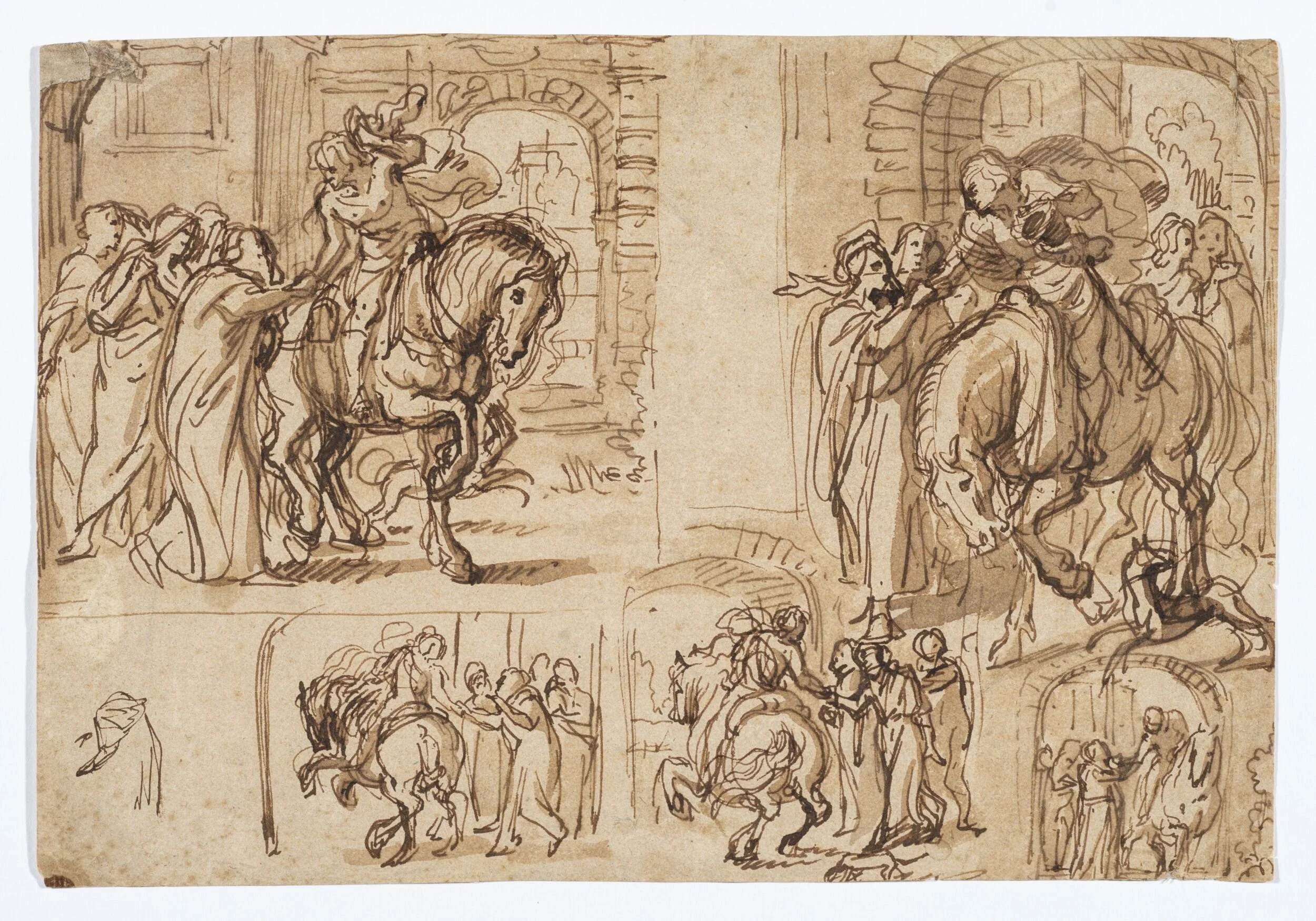
Credit: The Courtauld, London (Samuel Courtauld Trust)
Curator’s comments: This drawing was purchased by Robert Witt in 1952 as ‘Italian? Or Flemish school’. Frits Lugt suggested it could be by H. (Hieronymus?) Francken. An inscription in Witt’s hand on the verso of the sheet implies he thought it could be by Luca Cambiaso, while in Spain. The drawing had been missing since 2001 and was only recovered in 2023; recent in-person examination has raised questions about whether the drawing is Italian or Flemish, and any possible attributions. Theodoor van Thulden has been suggested but with no strong comparisons found. Pietro Sorri has also been suggested, but with no similar drawings by him known.
NEWS
In Art World News
As the art world returns from its summer recess, the Bayeux Tapestry heads to the British Museum in a historic loan agreement, and a new season of exhibitions is set to open to the public. In addition to this month’s openings (see Events section below), devotees of drawings have much to look forward to, including the second edition of the Royal Collection’s Drawing the Italian Renaissance at the Palace of Holyroodhouse in October; Renoir Drawings at the Morgan Library & Museum in October; Learning to Draw at the Getty Center in October; The Carracci Drawings: The Making of the Galleria Farnese at the Louvre in November; and Tate Britain’s blockbuster Turner and Constable, opening in late November. Beyond these, the Metropolitan Museum has announced the first comprehensive exhibition on Raphael in the United States, scheduled for March 2026. Mark your diaries.
In other news, the Dutch newspaper AD has reported on the remarkable story of a looted painting by Giuseppe Ghislandi, stolen from the Jewish art dealer Jacques Goudstikker and later spotted in an estate agent’s advertisement for a home near Buenos Aires. For English readers, ARTnews and other sources have the story. Wartime documents suggest that the work came into the possession of Friedrich Kadgien, an SS officer and senior financial aide to Göring, who fled to Argentina in the 1940s. In a development to the story, the house was recently raided by Argentine police, but the painting was missing.
In Gallery and Art Fair News
10–14 September – Panorama Pozzuoli conceived by ITALICS (Pozzuoli).
11 September – 24 October – Jacob Kramer – Rhythmic Lines: Paintings & Works on Paper at Brooke-Walder Gallery (London).
18–23 September – Arte + Collezionismo a Roma at Palazzo Barberini (Rome).
18–27 September – Selected Works from a Private Collection at Marty de Cambiaire (Paris).
18 September – 31 October – Jewels on Paper: Secrets of Creation at Les Enluminures (Paris).
20–24 September – FAB PARIS at Grand Palais (Paris).
25–28 September – Brussels Art Square at various locations (Brussels).
25–28 September – British Art Fair at Saatchi Gallery (London).
26 September – 19 October – Sickert: Love, Death & Ennui: The Herbert and Ann Lucas Collection at Piano Nobile (London).
30 September – 5 October – The Decorative Fair at Evolution London, Battersea Park (London).
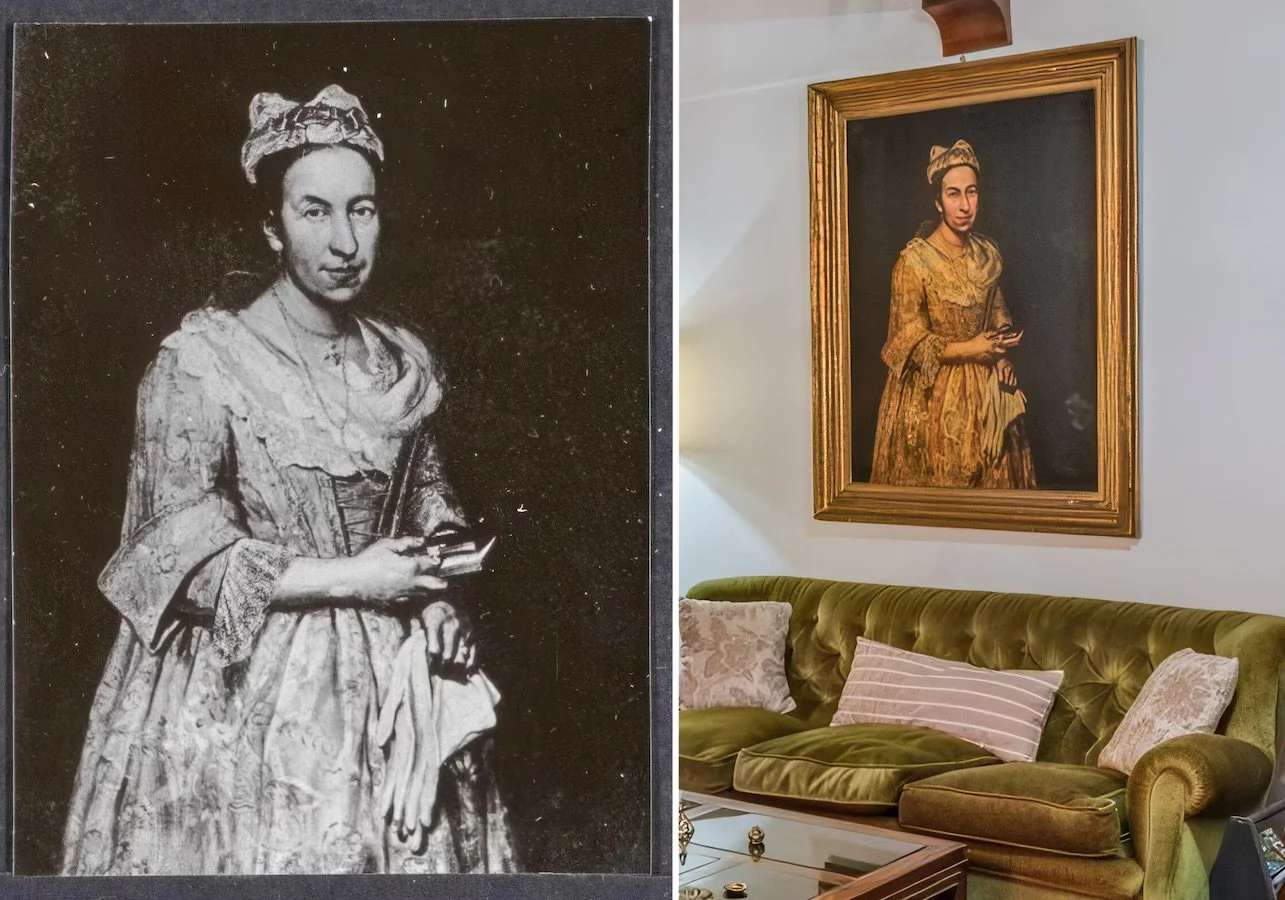
A deleted real estate listing for a home in Argentina appeared to have featured a Nazi-looted painting by Giuseppe Ghislandi. © Cultural Heritage Agency of the Netherlands/Robles Casas & Campos
In Literary and Academic News
New publication – The Italian art issue of The Burlington Magazine: The September issue of The Burlington Magazine is out now and includes two articles on drawings: ‘An unpublished Bernini drawing of the Fonseca Chapel’ by Marco Coppolaro and ‘Canaletto's use of drawing in Venetian buildings’ by Gregorio Astengo and Philip Steadman. In a limited-time offer, Trois Crayons newsletter subscribers can read the article on the Fonseca Chapel drawing for free here.
New publication – The Walpole Society, vol. 86: includes two drawings articles by Richard Stephens: Thomas Carwitham (1701/2–45), History Painter and Mathematician and A Checklist of Drawings by Thomas Carwitham (1701/2–45). Membership of The Walpole Society starts at £45 a year and provides access to over 100 years of cutting-edge scholarship in British art, as well as members-only events.
Job opportunity – Research Assistant in Prints and Drawings, Cleveland Museum of Art (Cleveland): The fellow will work with the Curator of Prints and Drawings on a project related to 20th-century American art and the watercolours of Andrew Wyeth. Part-time, two days per week for 60 weeks. Applications due: 30 September 2025.
Essay prize – Sir Denis Mahon Essay Prize: £2,000 awarded for an essay of distinction on subjects relating to Sir Denis’ studies, including Seicento art, Guercino, Carracci, Caravaggio and Poussin as well as his much wider range of art historical interests. Open to undergraduate and postgraduate students aged 30 or below. Send applications to comune.cento@cert.comune.cento.fe.it. Deadline: 6 October 2025.
Essay prize – Ricciardi Prize: Just two months remain to enter to win the $5,000 Ricciardi Prize. The award is given for the best new and unpublished article on a drawing topic (of any period) by a scholar under the age of 40. Articles are due by November 15, 2025.
Funding – Paul Mellon Centre: The current funding programme includes eleven different grants and is open for applications until 30 September 2025. Outcomes will be communicated by the end of November.
Educational opportunity – Art History Link Up: Applications for Art History Link Up’s free Art History EPQ at the Courtauld Institute for state sponsored sixth form students are due 5 September 2025.
In Lecture and Event News
4 September – Exhibition Opening Conversation: William Blake — Artist, Poet, Maker, and Radical Thinker, Yale Center for British Art (New Haven). Exhibition co-curators Elizabeth Wyckoff and Timothy Young introduce William Blake: Burning Bright. Lecture Hall and Livestream. 4–5 pm ET. Free.
5 September – In Conversation: Colour and Line: Watteau Drawings, British Museum (London). Grant Lewis (British Museum) and Alison Smith (Wallace Collection). 6.30 pm. £10.
10 September – Conference:The Art Business Conference, Church House Conference Centre (London). Presentations, panels and Q&As on current issues in the art market, including legislation and best practice. Tickets from £336.
11 September – Opening Lecture: Sketch, Shade, Smudge: Drawing from Gray to Black—Sticks, Stumps, and Fingers: Drawings Revealed, Harvard Art Museums (Cambridge, MA). Kimberly Schenck (former head of paper conservation, National Gallery of Art, Washington, D.C. on black drawing media. 6–7.30 pm. Free, registration encouraged. The event will be livestreamed.
13 September – Curator Panel Discussion: Reimagining Revolution, Reform, and Restoration in Three Museums: The Horvitz Collection of French Drawings, Crocker Art Museum (Sacramento). Presentations with Sarah Farkas (Crocker) and curators from the Ackland Art Museum (Chapel Hill) and the Art Institute of Chicago. Followed by Q&A. Organised by The Drawing Foundation. Free for Crocker members, free with admission for nonmembers. Advance registration suggested.
18 September – Opening Lecture: Greuze, l’enfance en lumière, Petit Palais (Paris). Annick Lemoine (Petit Palais) and Mickaël Szanto (Sorbonne University). 12.30 pm. Free.
18 September – Lecture: A View From the Streets of Georgian London: Antonio Van Assen’s The Busy World or London dissected, 1793, Sir John Soane’s Museum (London). Sue Palmer. 6–8 pm. £18. In partnership with The Georgian Group.
20 September – Event: The Story of Art at 75, Warburg Institute (London). Screenings, discussions and archive displays. £8. Advance booking required.
20 September – Conference: Écrire et dessiner la danse: la “belle dance” (XVIIe et XVIIIe siècles), INHA (Paris). With historians, choreographers and performers on dance, writing and drawing. In partnership with the Museum of Fine Arts and Archaeology of Besançon. 2.30 pm. Free.
In Acquisition News
Gainsborough Dupont (1754-1797), A cottage with two figures in a landscape and A cottage in a wooded landscape: Acquired by the British Museum (Funded by the Ottley Group), from Karen Taylor Fine Art.
Jean-Jacques Henner (1829-1905), Study for Joseph Bara: Acquired by the Musée des Beaux-Arts d’Orléans (via Facebook).
EVENTS
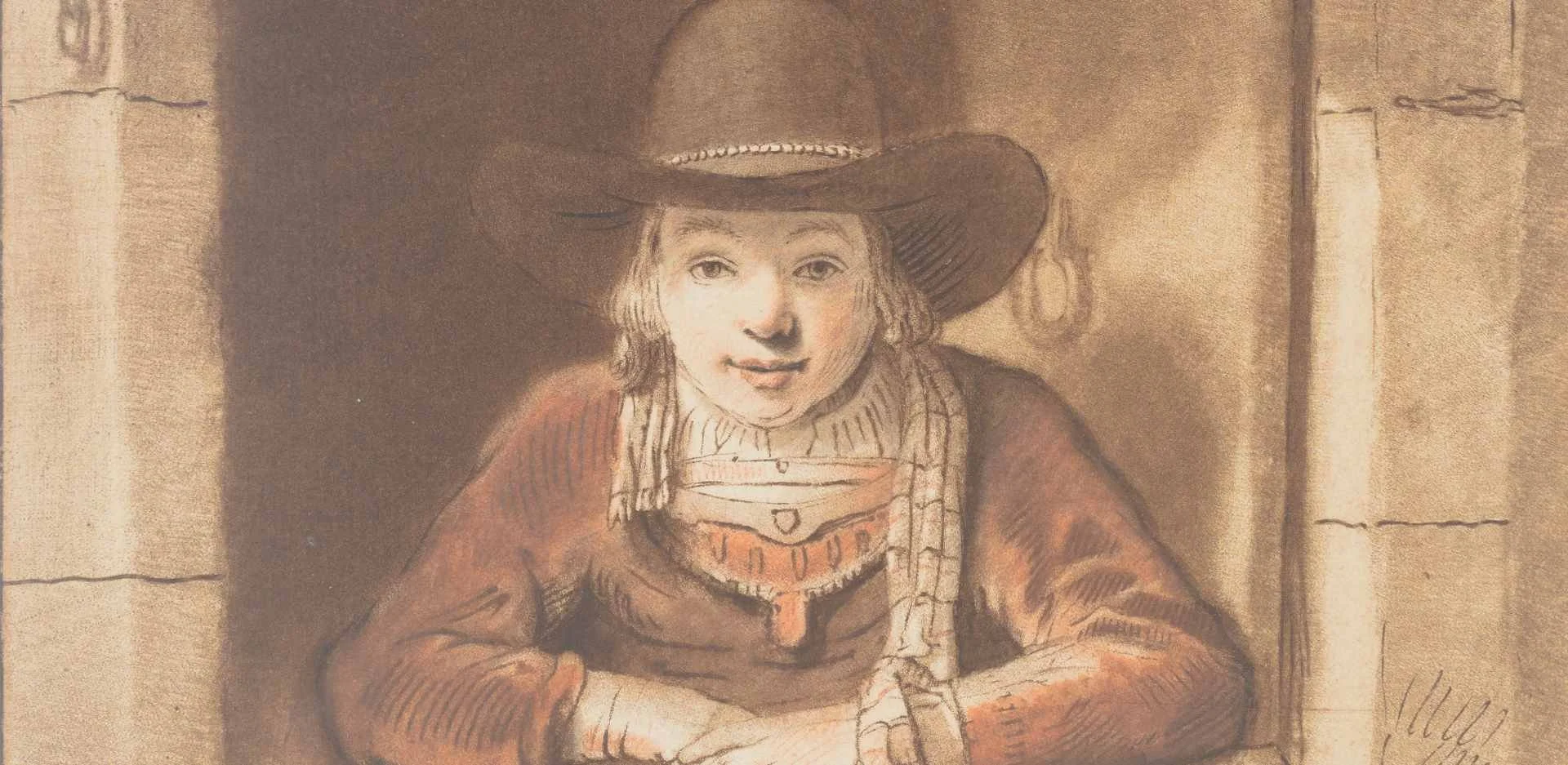
Cornelis Ploos van Amstel after Samuel van Hoogstraten, Boy with a Hat in a Doorway, 1763, etching, roulette in brown and red; Photo: Christoph Müller Stiftung / Kilian Beutel
This month we have picked out a selection of new and previously unhighlighted events from the UK and from further afield. For a more complete overview of ongoing exhibitions and talks, please visit our Calendar page.
UK
Worldwide
Tracing time event recordings
The recordings of the Tracing Time events programme are now online and can be viewed in full on Youtube. Thank you to all the speakers, partners and attendees who came to the No.9 Cork Street auditorium and supported our many partnership events.
Timeless Materials: A Conversation on Drawing with Contemporary Artists
Presented in partnership with The Drawing Foundation.
Friday, 27 June, 4pm

Piccadilly Jim: The Discovery of James Gibbs’s Designs for the Façade of Burlington House
Presented in partnership with The Burlington Magazine.
Tuesday, 1 July, 4pm
New Ways of Looking at Italian Renaissance Drawings
Presented in partnership with L’IDEA.
Wednesday, 2 July, 4pm
The Intimate Collector: Why Drawings Thrive in the Digital Age
Presented in partnership with Arcarta.
Thursday, 3 July, 4pm
Presented in partnership with Maak.
Friday, 4 July, 4pm
The Drawings of Jean-Antoine Watteau
Presented in partnership with Master Drawings.
Saturday, 5 July, 4pm
OVERVIEW
Reform to Restoration: French Art from Louis XVI to Louis XVIII from the Horvitz Collection (June 1 – September 14, 2025)
Crocker Art Museum, Sacramento
Sarah Farkas, Associate Curator of Art at the Crocker Art Museum
Spanning 60 years of artistic production, this exhibition highlights three extraordinarily pivotal epochs in French history: the French Revolution (1789–1799) and the creation of the French Republic, the rise of Napoleon Bonaparte and the establishment of the First French Empire, and the Restoration of the French monarchy (1814–1830) under Louis XVIII and Charles X. This period was marked by an artistic shift from the ornate Rococo style favoured in the French court to a revival of interest in the themes and aesthetics of classical antiquity known as Neoclassicism. Eventually, this led to the emergence of Romanticism, a movement emphasising subjectivity and emotion, as a response to a growing disillusionment with the Enlightenment ideals of reason and logic in the aftermath of the Revolution.
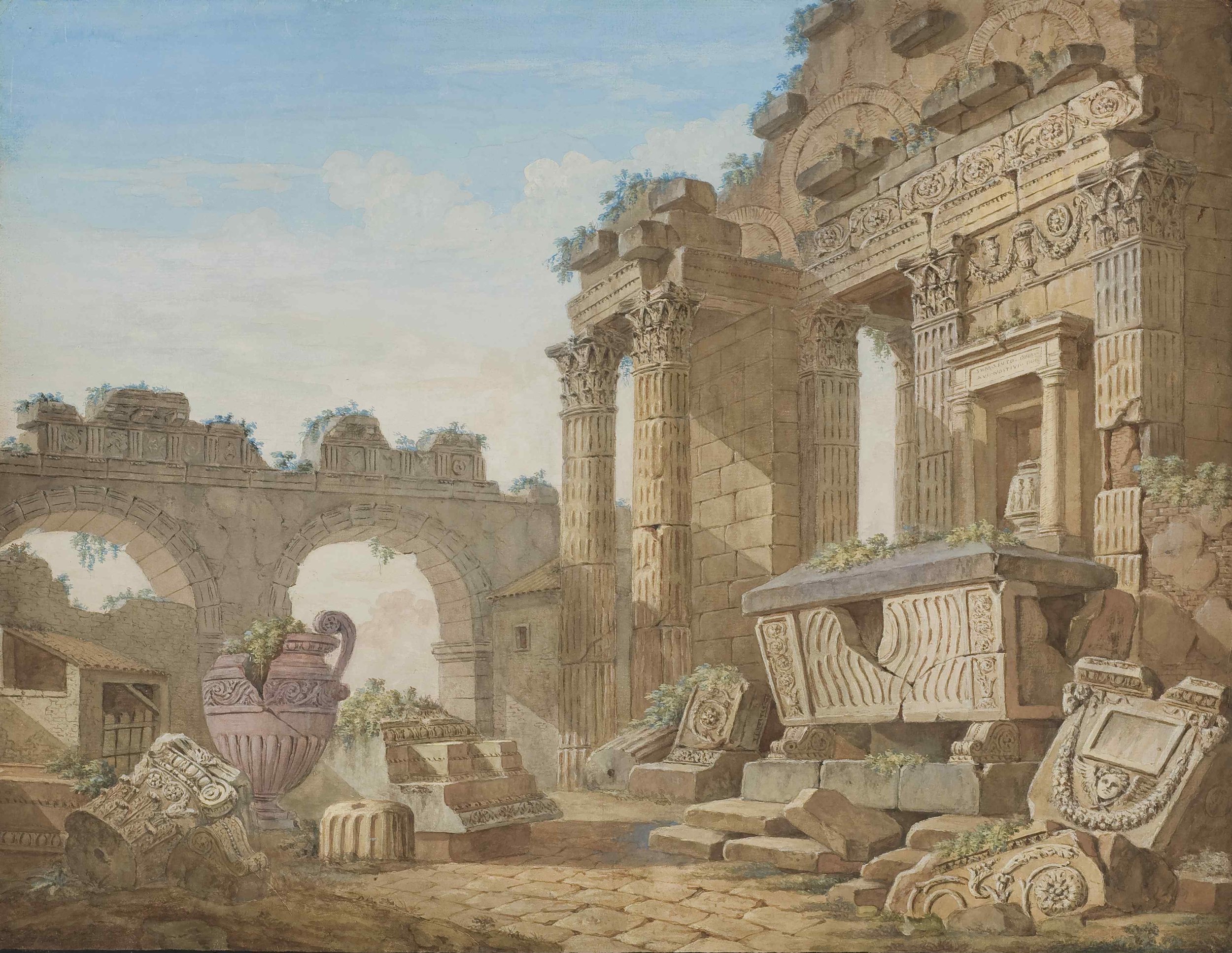
Charles-Louis Clérisseau (French, 1722–1820), Capriccio with Ruins, n.d. Gouache and watercolor with touches of pen with brown ink and brush with brown wash over traces of black chalk on cream antique laid paper, laid down on cream antique laid paper, 18 5/16 x 23 3/4 in. The Horvitz Collection, Wilmington.
All the objects in Reform to Restoration are drawn from the Horvitz Collection, one of the most important private collections of French art in the United States. More than 100 drawings and paintings are organized around six thematic categories: Antiquity, Revolution, Devotion, Service, Empire, and Honour. Each grouping reflects the variety of social concerns, political events, and visual movements that influenced artists living in the tumultuous period between 1770 and 1830, including many well-known artists such as Jacques-Louis David and Jean-August-Dominique Ingres. The exhibition begins by exploring the French Royal Academy of Painting and Sculpture, which was founded in Paris in 1648. This state-sponsored institution promoted a curriculum based on mastering the human form through drawing after sculpture and live models. At the same time, the Academy encouraged studying the Greek and Roman classical tradition, as seen in the work of Charles-Louis Clérisseau, the architect and artist, who spent roughly two decades in Rome. In his Capriccio with Ruins (1789), for instance, we see an imagined landscape of ancient Roman monuments that combines real architectural elements with fantasy, a popular eighteenth-century genre.
Nicholas C Williams, Sheet from pocket sketchbook: Initial sketch for a painting (2017), charcoal and pastel, 10.2 x 14.7 cm
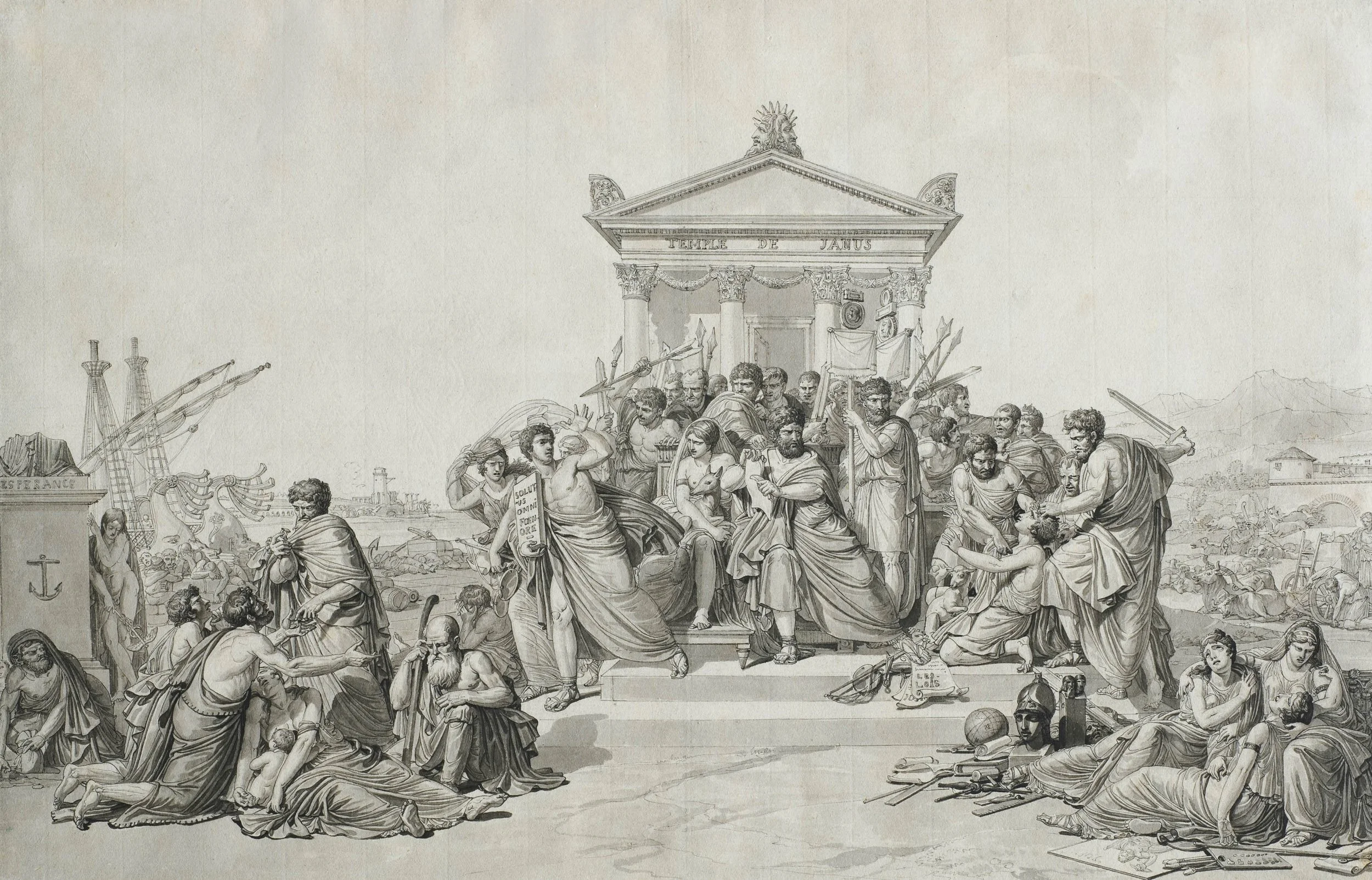
The enthusiasm for the classical past had significant resonance across French politics and culture, most notably in the wake of the Revolution, when the government was reconceived in the model of the ancient Roman Republic (circa 509–27 BCE). In the Allegory of the Revolutionary Regime, artist Louis Lafitte utilizes classical sources, such as the ancient Roman poets and historians Horace and Livy, to critique the Revolution, particularly its most violent phase known as the Reign of Terror. In the foreground, before a Temple to Janus (the god of transition and time), the allegorical figures of War and Conflict overcome Justice, suggesting the Revolution led to injustices similar to early Republican Rome.
Nicholas C Williams, Point (2018), oil on canvas, 107 x 138 cm
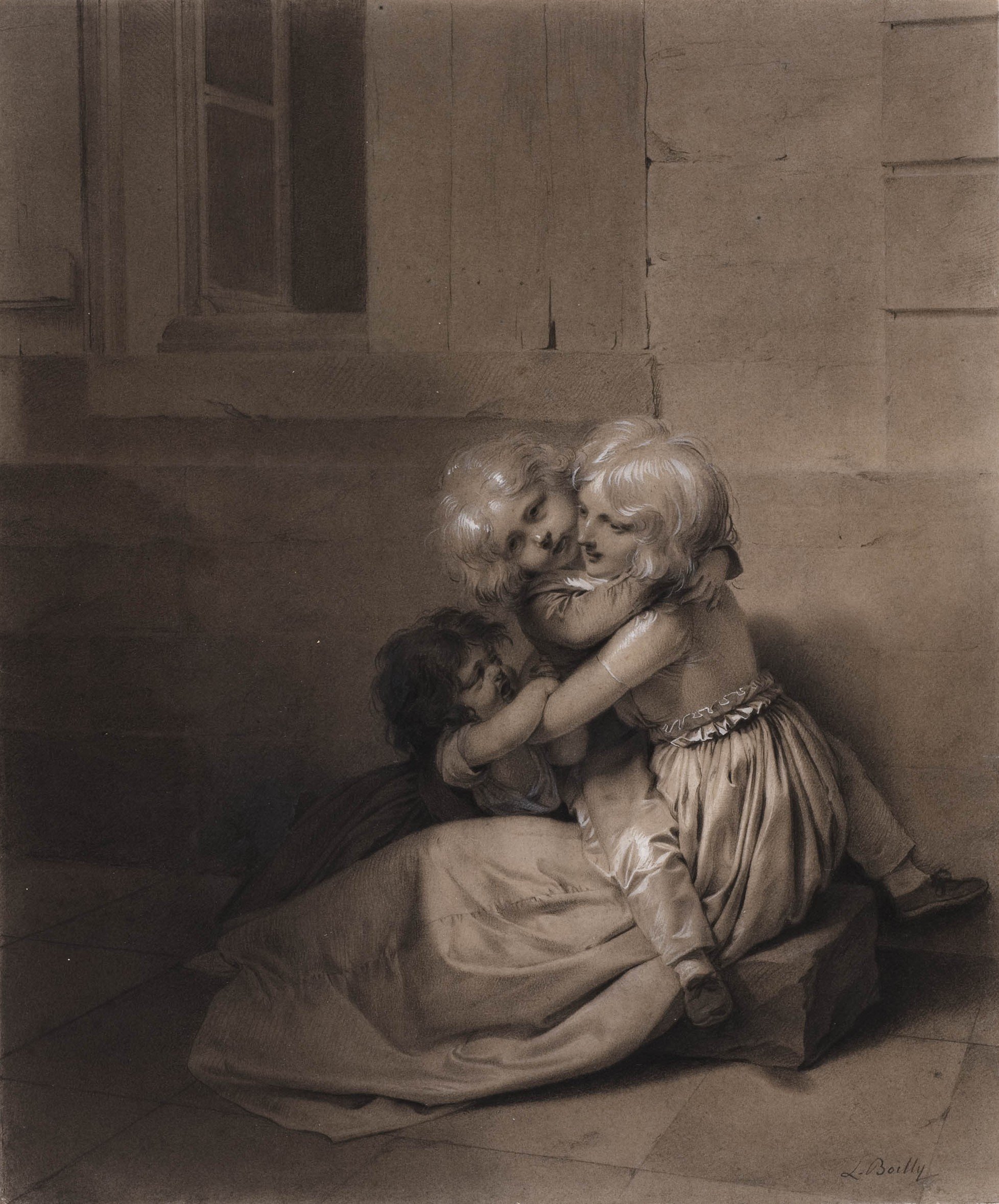
Other works in this exhibition deal with the theme of devotion: romantic, religious, parental, or patriotic. One example is Louis-Léopold Boilly’s The Big Sister, a tender depiction of siblings vying for the attention of their elder sister. A keen observer and chronicler of everyday life, Boilly’s penchant for subtle humour comes through in the deep shadow cast across the face of the youngest child, on the brink of a tantrum as she attempts to infiltrate the joyful embrace shared by her elder brother and sister, both highlighted by touches of white gouache.
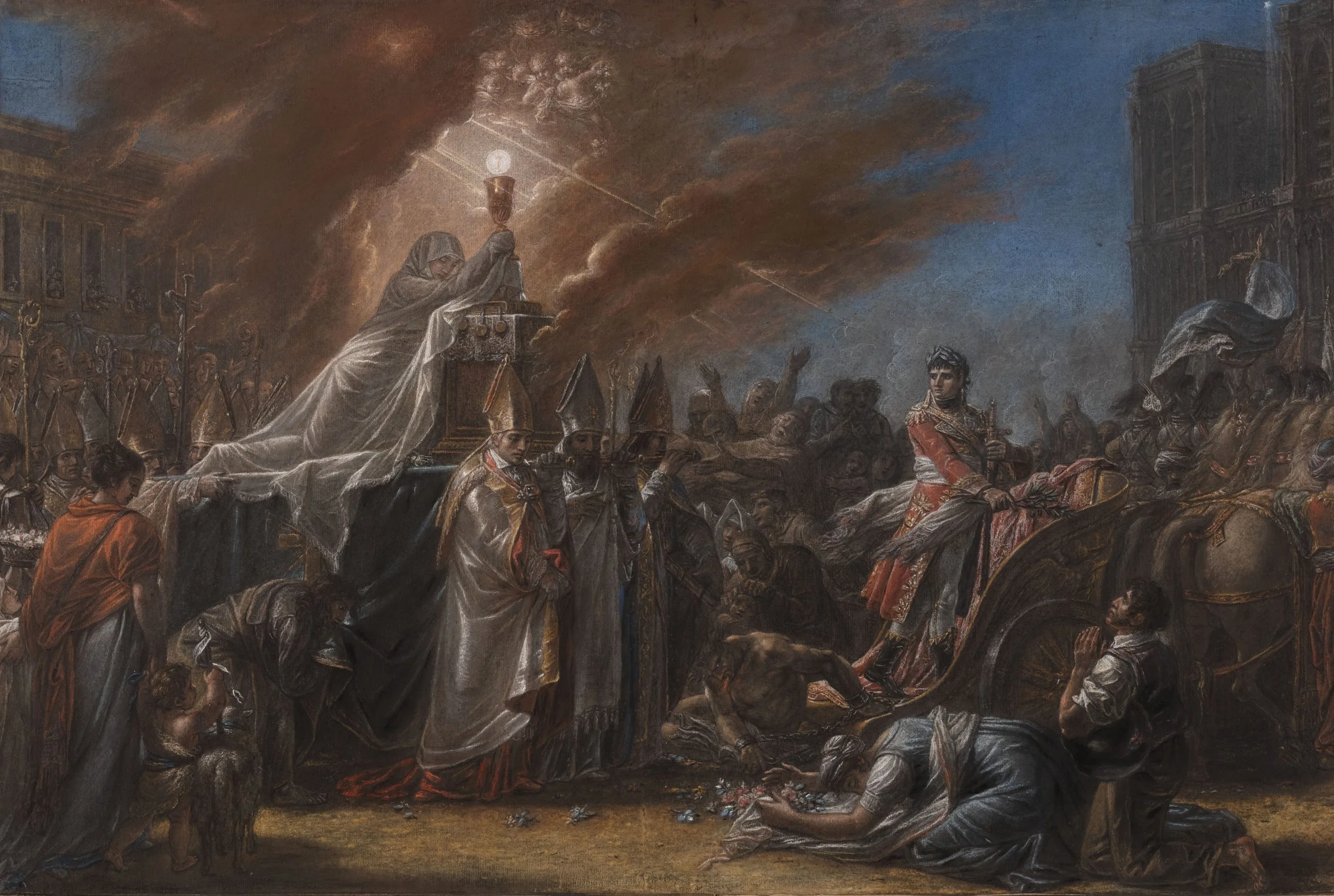
Antoine-François Callet (French, 1741–1823), Allegory of the Concordat, n.d. Pastel on paper, 21 3/4 x 32 7/16 in. The Horvitz Collection, Wilmington
Though Boilly mostly avoided political themes, many artists found success serving the interests of the State. Allegory of the Concordat by Antoine-François Callet is either the preparatory drawing or a record of the now-damaged oil sketch submitted to an art competition in 1802. The competition celebrated both the Treaty of Amiens, temporarily ending a war with Spain and Britain, and the signing of the Concordat of 1801, a restoration of ties between France and the Catholic Church, which were severed during the Revolution. Previously the portraitist of King Louis XVI, Callet skilfully adapted to the changing political tides and here renders Napoleon Bonaparte in a fictional scene of triumph, modelled on Roman precedents. The future emperor, crowned with a laurel wreath and illuminated by heavenly rays emanating from behind the Holy Eucharist, drives a chariot toward Notre-Dame, dragging a representation of Heresy in chains.
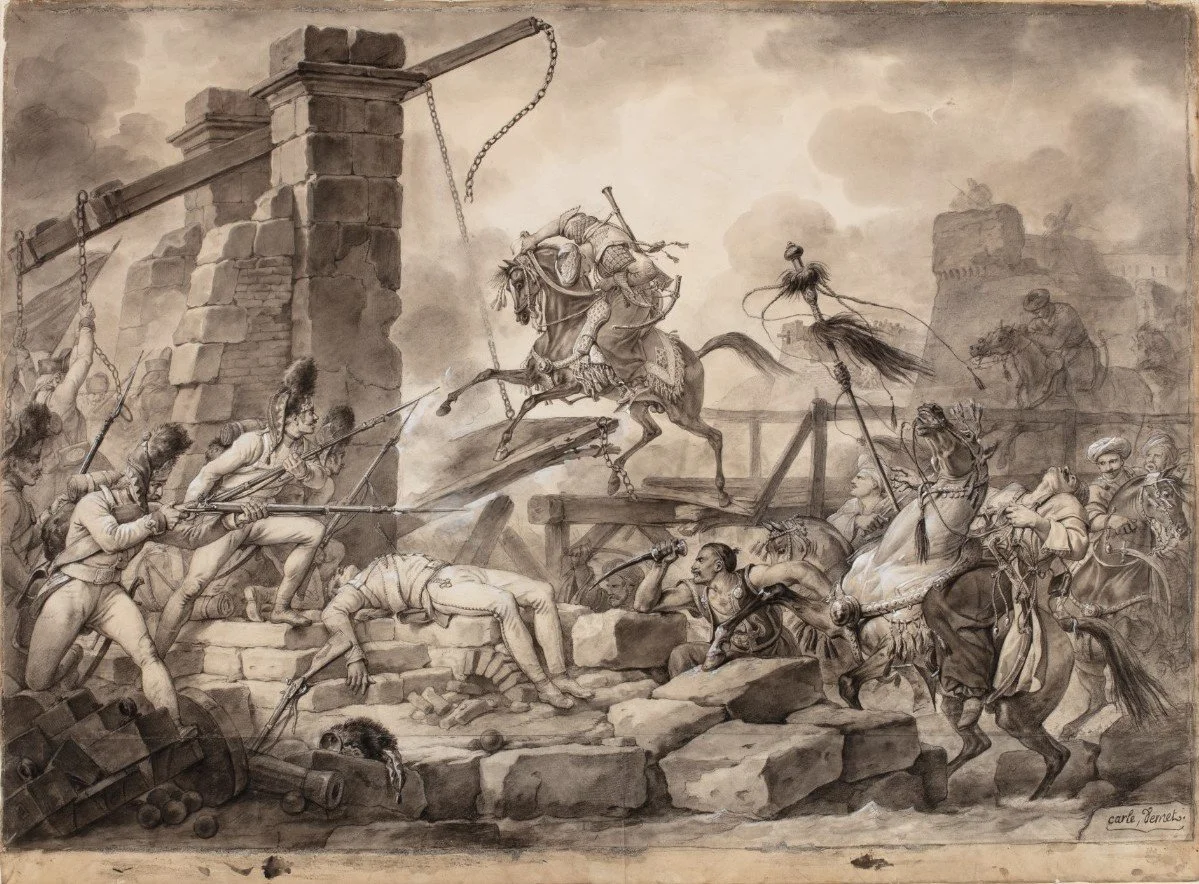
Antoine-Charles-Horace Vernet, called Carle Vernet (French, 1758–1836), Scene of Combat in Egypt, n.d. Black chalk, stumped, and brush with brown and gray wash, heightened with white gouache on three joined sheets of off-white wove paper, 28 1/4 x 38 3/16 in. The Horvitz Collection, Wilmington
Colonial ambitions were strong under Napoleon’s rule, an idea explored in the exhibition’s section on empire. The French government became known as the First French Empire, a deceptive designation given France had maintained colonies in the Americas and Asia since the seventeenth century. In 1798, Napoleon’s forces invaded Egypt and returned with numerous looted art objects, many of which ultimately entered the collections of the Louvre and the British Museum. Antoine-Charles-Horace Vernet’s Scene of Combat in Egypt depicts the violent clash between Napoleon’s forces and Mamluk fighters, but the Orientalizing depiction of the Mamluks—who brandish long curved knives and dramatically rear and buck along with their horses—stands in stark contrast to Charles Meynier’s scene of Napoleonic conquest on European soil, Napoleon Entering Berlin (1809–1810), in which the local citizens appear to welcome the emperor’s arrival. The tendency by European artists to portray people of Middle Eastern, Asian, or North African origins in sensational and stereotyped ways was common in this period and at times a propagandistic tool to justify imperial desires.
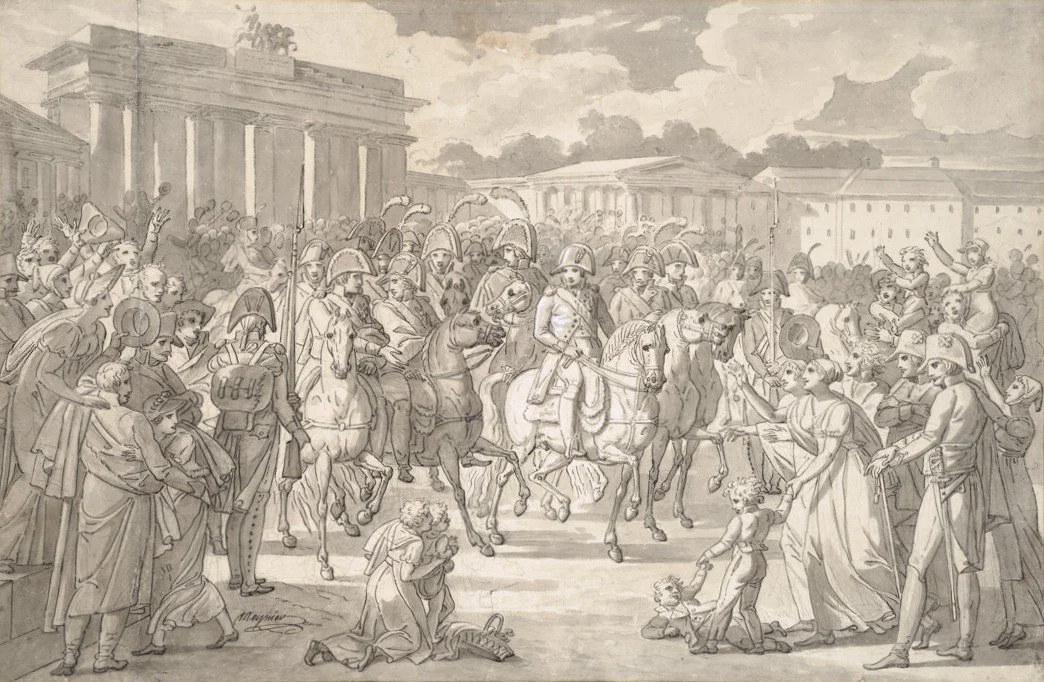
Antoine-Charles-Horace Vernet, called Carle Vernet (French, 1758–1836), Scene of Combat in Egypt, n.d. Black chalk, stumped, and brush with brown and gray wash, heightened with white gouache on three joined sheets of off-white wove paper, 28 1/4 x 38 3/16 in. The Horvitz Collection, Wilmington
The exhibition concludes with a selection of paintings that consider the concepts of honour and leadership in the face of crisis, themes relevant to multiple conflicts in this era. Many of the drawings in the exhibition were either recordings of or preparatory drawings for history paintings. Drawing from live models and the study of classical art and architecture were the foundations of history painting, which often focused on or were inspired by Biblical or classical mythological and historical events. As a genre, it was considered to be superior to all others—such as portraiture, landscape, or still life—by the French Royal Academy because it was intended to educate and inspire the viewer through moral examples, requiring that the artist possess an exemplary mastery of not only the technical skills of representation but also the intellectual and philosophical concepts of the day. The paintings that conclude the exhibition exert this to full effect, each concerned with a protagonist who asserts his or her moral worthiness, such as the philosopher Socrates, the conqueror Alexander the Great, or the fictional knights Ubaldo and Rinaldo. As an epilogue to an exhibition primarily centred on drawings, these paintings are a testament to the centrality of drawing from models to the artistic process among French artists at the turn of the nineteenth century.
This essay draws upon insights regarding the works in the exhibition Reform to Restoration from Alvin L. Clark Jr., Isabelle Mayer-Michalon, and Dana Cowen. The exhibition continues until September 14.
REAL OR FAKE

Resources and Recommendations
to listen
Corot’s Impressionist Lunchbox
Only nine times in his seventy-eight years did Jean-Baptiste-Camille Corot paint on anything other than canvas, paper, and panel. On one occasion, offended by the crude wooden lunchbox carried by his friend Alfred Robaut, Corot had a new one constructed, which he decorated with a plein air painting, "Fraîcheurs matinales" ("Morning Freshness"). It’s a mini-masterpiece made all the more charming by its humble setting, a breezy landscape of trees and hills awash with sunlight and enlivened by one of Corot’s favorite motifs: a flash of red, the hat of a small figure coming over a rise. Host Ben Miller gets the story from the dealer who sold it, Jill Newhouse, and the collector who bought it, Ray Vickers.
TO watch
Departing from our usual remit of pre-modern drawings but remaining within the broader ‘art world’, this month’s recommendation is a two-part BBC Two documentary on the rise and fall of Inigo Philbrick. Once heralded as the rising star of the contemporary gallery scene, the documentary charts his journey “from paradise to prison” in an art fraud worth $86 million. Now available on BBC Iplayer.
to read
‘Gas found in space could help repair damage to Old Masters, say researchers’: The Art Newspaper
Conservators discovered that lead white on these important works was deteriorating at an “alarming” rate. Could oxygen from the Earth's orbit be the solution?
Hello, World!
REAL OR FAKE ANSWER
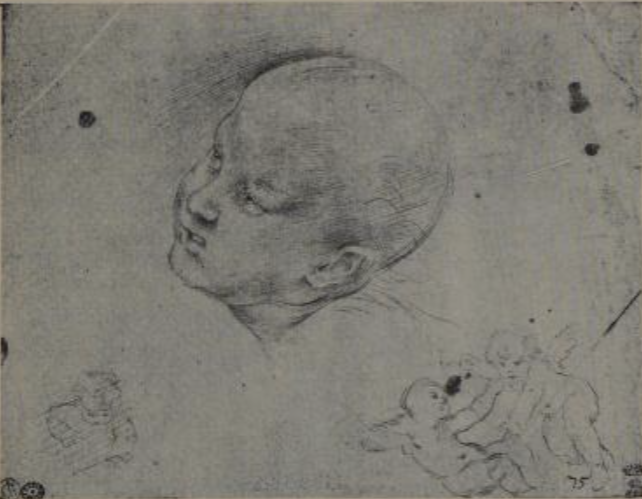
The original, of course, is the upper image.
Lower Image: Late imitator of Raphael, Study of a Child’s Head and Other Studies, Location Unknown
This modern fake is a partial copy of an original drawing from Raphael’s "pink sketchbook”. The fake was probably not executed from the drawing itself, but from a reproduction in a sales catalogue. The head of the child was copied with great skill and accuracy, but the forger omitted almost all the other figures from the original.
They copied just one of the sketches of children. In the original, these figures clearly represent the Christ Child, and this sketch was intended for one of Raphael's Madonnas, but the forger ignored these elements and accompanied the Christ Child with a small winged Cupid. This figure, for which he had no model, is in a completely different style. The same goes for the child drawn in the lower left corner, which he vigorously crossed out to give the impression that Raphael had tried and rejected several ideas. The forger embellished his drawing with a few blots and three "restored" corners. In addition, he added three collector's stamps, all fakes. The two on the left are attributed to the J. F. Gigoux and Carlo Prayer collections, while the third is a copy of Lugt's 1916 issue, which he adorned with a crown. The forger was canny enough to include an inscribed number as well. His model bears the number 74; he did not copy it, but wrote 75 in the corresponding corner of his imitation.
The works and methods of this forger were discovered by D. A. Scharf. The collector's stamp with the crown is a sort of trademark; we find it, for example, on a drawing in the style of Guardi copied from a plate in the same catalogue as the Raphael. The illustrations in the sales catalogues seem to have been the main source of inspiration for the forger.
For further reading, see: Otto Kurz, Faux et Faussaires, Paris, 1983, pp. 96-97.