
Drawing of the Month #25
Wednesday, 1 October 2025. Newsletter 25.
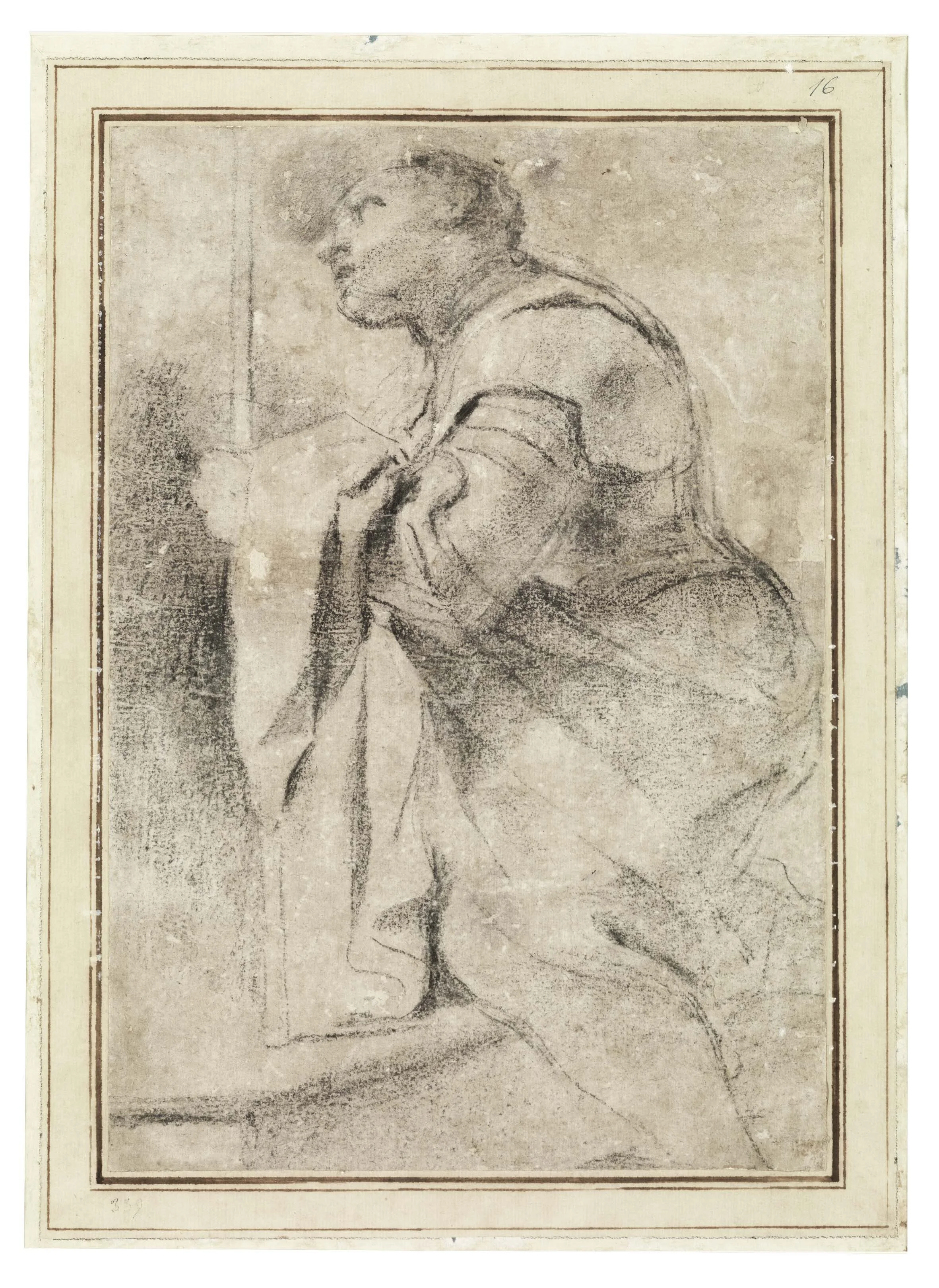
Giovanni Francesco Barbieri, called Guercino (1591–1666)
Saint William of Aquitaine kneeling, in armour, receiving the monastic habit, 1620
Slightly oiled charcoal on grey paper, 405 × 278 mm, Civica Pinacoteca “il Guercino”, Cento (Ferrara), inv. 105
Dr. Giovanni Sassu, Director of the Civica Pinacoteca "il Guercino", Cento, has kindly chosen our October drawing of the month.
This drawing is among the highlights of the Pinacoteca of Cento’s collection of works on paper—not only for its accomplished draughtsmanship, but because it clearly documents the method by which Guercino defined figures before committing them to canvas.
The sheet is preparatory for The investiture of Saint William, the large altarpiece made for the church of San Gregorio in Bologna in 1620 (now in the Pinacoteca Nazionale), shortly before the artist’s departure for Rome. No fewer than 23 drawings are associated with this canvas: an unusually large corpus that allows close tracing of the compositional development.
Here Guercino focuses on the protagonist, refining poses and attributes later reworked in the painting. The head and torso, shown in profile here, change orientation in the final work; the staff on which William leans becomes the hilt of a sword; the white monastic habit, shown as newly received from the bishop in the drawing, is depicted in the painting as being lifted to be donned. The sequence makes immediately legible the decision to renounce military life in favour of religious vows. The drawing thus serves as a narrative proving ground: examining legibility, balance, and visual hierarchies before the pictorial execution.
The provenance of the sheet is exemplary. It comes from Casa Gennari in Bologna; Carlo Gennari (1712–1790), a descendant of Cesare Gennari, Guercino’s nephew, sold it to the Bolognese painter Francesco Giusti (1752–1828), who kept it until his death. The Giusti collection then passed to Count Zorzi. In 1891 Zorzi transferred the drawing to the Committee for the Celebrations of the Third Centenary of Guercino’s Birth, which acquired it for the Pinacoteca together with Saint Teresa of Ávila kneeling. Both were included in the catalogue of the photographic-documentary exhibition curated by Antonio Orsini and held in Cento that same year at Palazzo Falzoni Gallerani, formerly Scarselli Tassinari.
An exceptional drawing, then, combining formal quality with documentary value, historical significance with civic identity.
Lastly, it should be recalled that the placement of the large canvas in the very church that also housed Ludovico Carracci’s Saint George altarpiece—Carracci had died only a year earlier—has been read by scholars as an ideal passing of the torch between two great Emilian masters of the seventeenth century.