
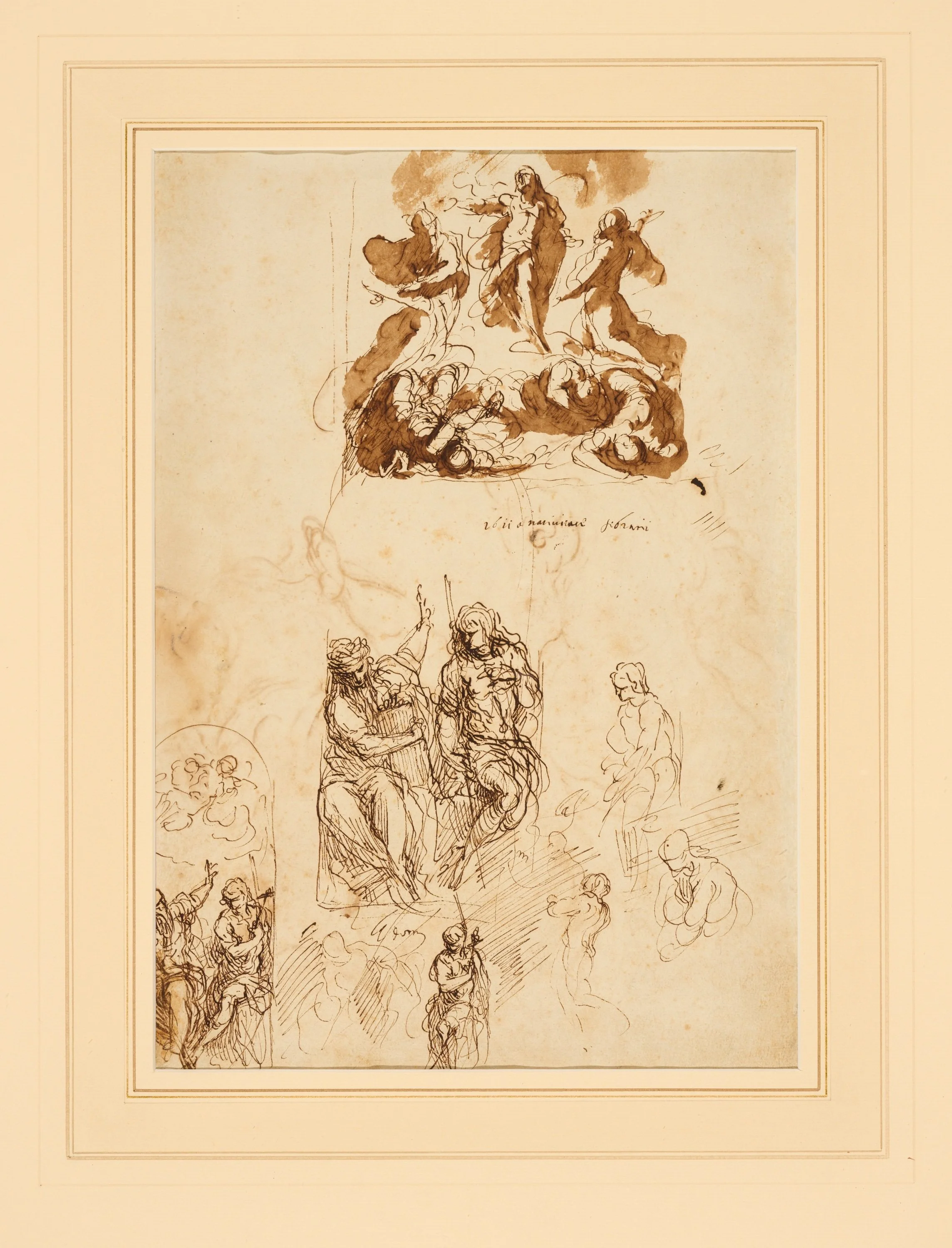
Palma il Giovane (Jacopo Negretti) (1548–1628), Studies for a Transfiguration and Saint John the Baptist
Trois Crayons Magazine, January 2026.
Michiel D. van Limborch (c. 1615–1675), Portrait of a Girl, c. 1650/60, Wallraf-Richartz-Museum & Fondation Corboud, Cologne
Detail: infrared reflectogram of the signature
Furio Rinaldi, Curator in Charge, Achenbach Foundation for Graphic Arts, Fine Arts Museums of San Francisco, has kindly chosen our drawing of the month
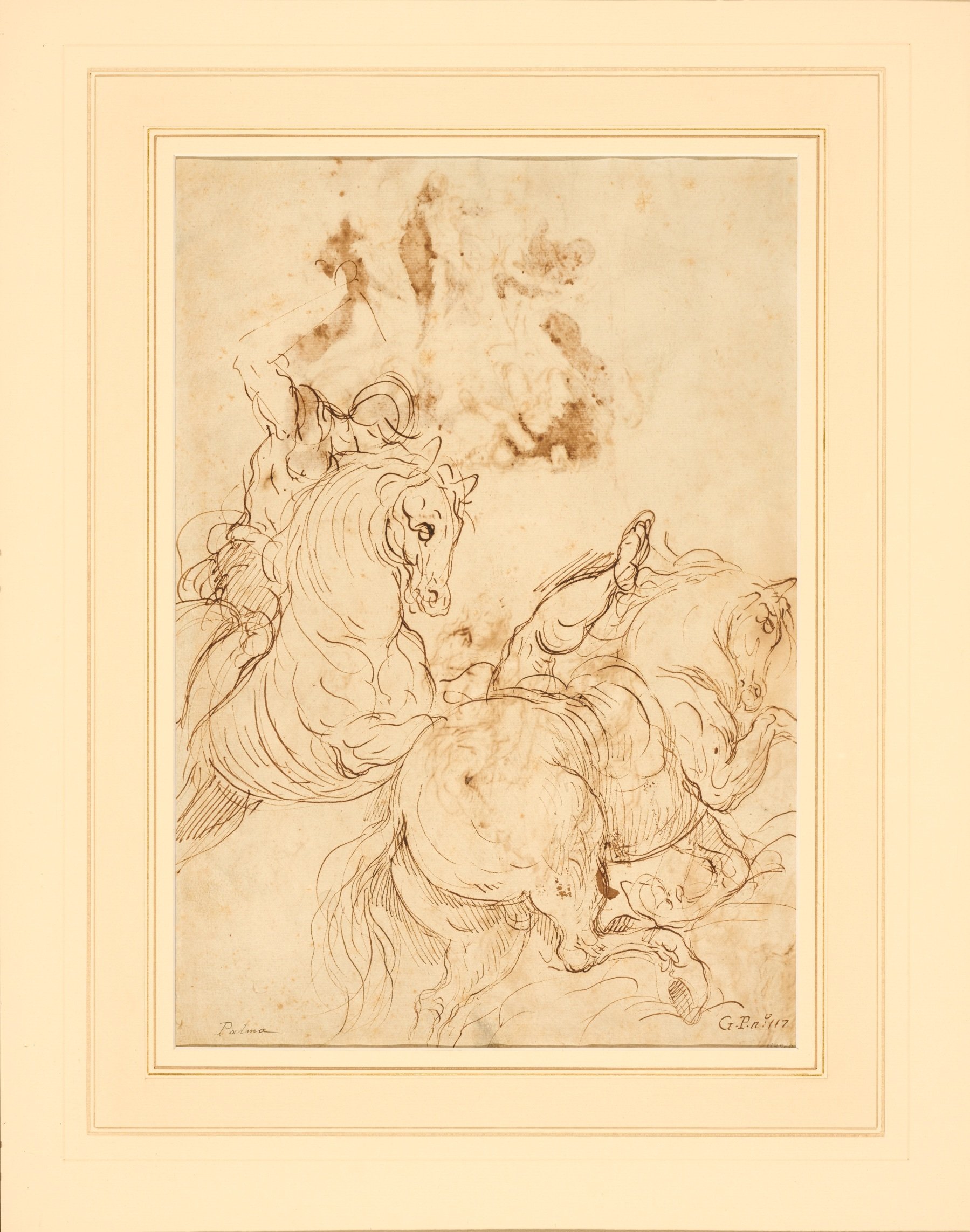
Palma il Giovane (Jacopo Negretti) (1548–1628)
Studies for a Transfiguration and Saint John the Baptist (recto), Studies for Horsemen in Combat (verso), 1611
Pen and brown ink, brush and brown wash (recto), pen and brown ink (verso), 36.4 x 25.8 cm, Fine Arts Museums of San Francisco, Museum Purchase, William H. Noble Bequest Fund (1979.2.27a-b)
From January 2026, to coincide with the larger exhibition Monet and Venice co-organised with the Brooklyn Museum, the Fine Arts Museums of San Francisco will display a selection of drawings and prints by artists from Venice and the larger Veneto region belonging to the permanent collection of the Achenbach Foundation for Graphic Arts, the museums’ department of works on paper. On display at the Legion of Honor, Drawn to Venice celebrates and chronicles the artistic vitality, originality, identity and poetic nature of drawings from this memorable place in art history, with more than thirty rarely or never seen works on paper, spanning from the sixteenth to the nineteenth century, and featuring works by artists like Jacopo, Giovanni Battista Zelotti, Girolamo Romanino, Rosalba Carriera, Francesco Fontebasso, Canaletto, Francesco Guardi, and the Tiepolos.
The first section of this display will be dedicated to the Renaissance in Venice and the Veneto during the fifteenth and sixteenth centuries, a period when the Republic of Venice had aggressively expanded beyond today’s confines of the lagoon to many mainland possessions (known as terraferma) in Northern Italy up to the borders of Milan. Artists from these peripheral regions sought to maintain their native artistic languages while being influenced by the lush pictorial style and virtuoso draughtsmanship promoted in Venice by the three great heroes of Venetian Renaissance – Titian, Jacopo Tintoretto, and Paolo Veronese – thus creating an original and eclectic style. In the late sixteenth century, Venice also surged as it became a European epicentre for publishing and printmaking in Europe, attracting many draughtsmen from surrounding areas. Palma il Giovane, Giuseppe Scolari, and Domenico Campagnola, whose linear drafting skills were well suited to be translated for prints, combined their activity as painters with a significant output in print which, thanks to its higher diffusion, helped popularise their work and style throughout Europe.
Drawn in Palma il Giovane’s dynamically vibrant and characteristic pen style, this double-sided sheet (exceptionally dated 1611) gathers a number of several spontaneous studies for different projects developed by the artist for commissions outside of Venice. At the top, the study for Christ’s Transfiguration is preparatory for the monumental altarpiece (338 x 211 cm) painted for the church of Santa Barbara, Udine, northeast of Venice (then transferred to the local Musei Civici). This scene illustrates the resurrected Christ flanked by the prophets Moses and Elijah, who welcome him back to Heaven. In the foreground, three apostles sleep. In his drawings and paintings, Palma, the leading artist active in the Veneto in the Late Cinquecento, updated references to the great masters of the Venetian Cinquecento with a heightened sense for drama and stark light effects, foreshadowed on paper in the rich passages of brown wash spread with the brush. For inspiration, he turned here to Titian’s Transfiguration of Christ (ca. 1560, Church of San Salvador, Venice), adopting both the Renaissance master’s compositional structure and his strong tonal effects and contrasts. The studies on the lower part of the sheet show ideas for an unrealized altarpiece with Saint John the Baptist and an unidentified saint. Similarly, the horsemen in combat on the verso can’t be linked to a precise commission. The sheet, previously owned by the famed seventeenth-century Venetian collector Zaccaria Sagredo (1653-1729), who marked the sheet with the initials "G.P." (for Giacomo Palma), is one of the thirty drawings to be on display at the Legion of Honor.
We look forward to welcoming the Trois Crayons community in the galleries!
Drawn to Venice at Legion of Honor, San Francisco, runs from 24 January – 2 August.