Trois Crayons Magazine | November 2025
Marchons! Marchons! Although the Louvre has appeared on front pages this month as the target of a major jewellery heist befitting of Arsène Lupin (see Didier Rykner’s dissection in La Tribune de l’Art), it should also be observed that the Paris institution has recently opened a significant monographic exhibition on the towering revolutionary figure of Jacques-Louis David, and this coming week it opens a second exhibition, The Carracci Drawings: The Making of the Galleria Farnese, a must-see for drawings devotees. This bullishness in the face of gathering storm clouds is an attitude that has been echoed in the pre-modern drawings market this autumn. Frieze Masters in London, the first instalment of the Hegewisch collection sale at Christie's, and an array of exhibitions in Paris around the art fairs FAB Paris and Art Basel Paris have collectively emitted a sense of resilient optimism.
Looking ahead to November, drawings are in focus in New York with the Cooper Hewitt’s symposium on the sixteenth-century Flemish artist Stradanus, and The Drawing Foundation’s two-day events programme ON DRAWINGS. In Haarlem, the Teylers Museum is hosting a symposium on Michelangelo and the male form to coincide with the newly opened exhibition Michelangelo and Men, and in London, Tate Britain opens its blockbuster exhibition Turner and Constable at the end of the month, concluding the 250th anniversary celebrations of Turner’s birth and initiating the reciprocal celebrations for Constable, born just a year after his rival.
This month’s magazine features a submission to the Trois Crayons Museum Forum from the Metropolitan Museum of Art, news headlines and announcements from the drawings world, gallery listings, lectures, events and recent institutional acquisitions. Julian Brooks, Senior Curator of Drawings at the J. Paul Getty Museum, Los Angeles, candidly writes on Gabriel de Saint-Aubin for the Drawing of the Month. Exhibition listings are followed by Daniel Lowe’s interview with Chiara Betti, Curatorial Research Assistant at the Society of Antiquaries of London, discussing the Society’s history, collection and future plans. And lastly, after the Real or Fake quiz, a trio of audio, video and literary recommendations.
For next month’s edition, please direct any recommendations, news stories, feedback or event listings to tom@troiscrayons.art.
Tom Nevile
Editor
In Milan, at the Biblioteca Ambrosiana a complete digitisation of Leonardo Da Vinci’s Codex Atlanticus, the largest collection of his drawings and writings, has been made freely available online.
In Paris, the Salon du Dessin has come under new leadership. After 11 years at the helm, Louis de Bayser will step down as president. Florence Chibret-Plaussu and Hervé Aaron have been appointed co-presidents.
In London, The Courtauld Institute of Art has received a gift of £30 million from the Reuben Foundation. The gift will support the development of displays and exhibitions at the Courtauld and fund the construction of the new Somerset House campus, slated to open in 2029.
In Birmingham, the Birmingham Museum & Art Gallery has completed another phase of its reopening with four newly refurbished galleries showcasing its Pre-Raphaelite collection.
In Bayonne, the musée Bonnat-Helleu is due to re-open on 27 November after 14 years of closure.
In Princeton, the Princeton University Art Museum opened the doors to its new building yesterday with a 24-hour open house.
In Norfolk, Virginia, at the Chrysler Museum of Art, the new Goode Works on Paper Center has recently opened and allows visitors access to some 10,000 works—nearly a third of the Museum’s collection— that includes photographs, prints, and drawings. Appointments Tuesday through Thursday. Full details are available here.
In New York, Sotheby's is due to open its new premises at the Breuer building, 945 Madison Ave, on 8 November. The auction house will host a sale of important master drawings from the collection of Diane A. Nixon on 4 February. Highlights from the collection are currently on view in Paris (until 4 November), and will be travelling to Amsterdam (by appointment, 6–7 November), and London (28 November – 3 December).
In Oxford, new research has revealed that the defining childhood portrait of Marie Antoinette by Jean-Étienne Liotard really depicts her sister. The newly identified drawing will feature in an exhibition of Liotard’s portraits at the musée d'art et d'histoire de Genève: MAH in the autumn of 2026.
IN ART NEWS
1–9 November – PAN Amsterdam at Amsterdam RAI (Amsterdam).
Continues until 2 November – Flashback at Corso Giovanni Lanza 75 (Turin).
4–10 November – Holding the Line presented by Sim Fine Art at 54 The Gallery (London).
5–7 November – The Manny Davidson Collection at Sotheby’s (Paris).
5–9 November – Amart at the Museo della Permanente (Milan).
8 November – ADAA Upper East Side Gallery Walk at various locations (New York).
8–16 November – Antica Namur at Namur Expo (Namur).
11 November – 30 January – Oltre il Futurismo presented by Matteo Salamon at Palazzo Cicogna (Milan).
13 November – 5 December – Théodule Ribot (1823–1891) at Galerie Ambroise Duchemin (Paris).
19 November – 19 December – Sir Francis Grant. A Society Sketchbook at Dickinson (London).
19 November – 19 December – Miniatures from the Bearsted Collection: An intimate exhibition of eight exceptional Elizabethan and Jacobean portrait miniatures at Philip Mould Gallery (London).
28 November – 7 December – La Semaine des galeries parisiennes de l’estampe et du dessin at various locations (Paris).
Continues until 21 November – Women: Subject and Object at Jill Newhouse Gallery (New York).
Continues until 28 November – Trees at Karen Taylor Fine Art (Online).
Continues until 12 December – Alchemy and the Painter: Fidele Fischetti’s The Triumph of Night at Christopher Bishop Fine Art (New York).
Continues until 20 December – Picasso. Dessin 1903–1972 presented by Marc Lebouc and Galerie de l’Institut at the three 6th arrondissement spaces of Galerie de l’Institut (Paris).
Continues until 9 January – Dreams and Journeys: Revisiting Orientalism at Colnaghi (London).
IN GALLERY, ART FAIR AND AUCTION NEWS
6 November – Evening reception: Past Matters: Drawn to Discovery at the Antiquaries at Society of Antiquaries of London (London). 5pm. £30.
6–7 November – Symposium: The Stradanus Project, at Cooper Hewitt (New York). 9am – 4:30pm. Free with registration.
6–7 November – Events: ON DRAWINGS 2025at various venues (New York). All events are open to members of The Drawing Foundation.
7 November – Symposium: Devenir John Singer Sargent at the musée d’Orsay (Paris). 9:30am. Free with registration.
13 November – Exhibition presentation: Carracci Drawings at the Louvre (Paris). Victor Hundsbuckler. 12:30pm. €10.
14 November – Exhibition presentation: Jacques-Louis Davidat the Louvre (Paris). Sébastien Allard, Côme Fabre. 7pm. €10. Livestream here.
24 November – Symposium: Michelangelo and Men Symposium, Teylers Museum (Haarlem). 8.30am. €27.50.
26 November – Events: Book Night at The Paul Mellon Centre (London). Richard Ormond, Lynda Nead, Elizabeth Goldring, Christine Casey, Sam Smiles. 5:30 – 8:00pm. Free with registration.
13 December – Symposium: 9th Forum Bella Maniera at Institut national d'Histoire de l'Art, Salle Vasari (Paris). 2pm.
IN LECTURE AND EVENT NEWS
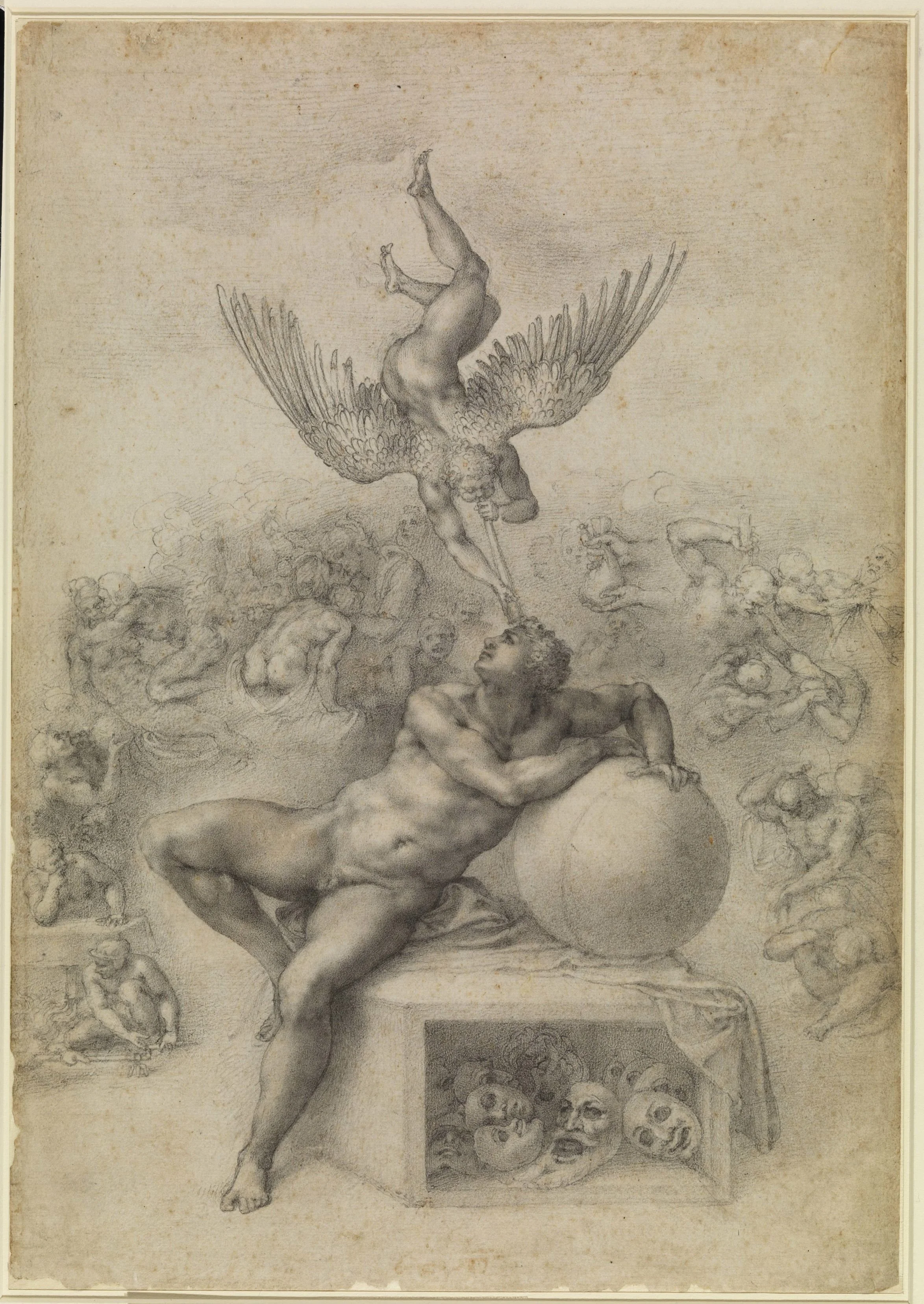
Michelangelo Buonarroti (1475-1564), The Dream [il Sogno], ca. 1533 © Courtauld
Announcement – The Division of Prints and Drawings at the National Gallery of Art in Washington DC is embarking on a major collection storage move that will render portions of its collection inaccessible for extended periods of time. Due to a major collection storage move, the National Gallery of Art has instituted a temporary closure of its study rooms for prints and drawings through August 2026. Study room appointments after 31 August 2026, will be pending until further notice. The National Gallery of Art has also instituted a temporary moratorium on all new loan requests for prints and drawings until 1 July 2027.
Call for proposals – The History of Drawings Conservation and Its Ethics. The J. Paul Getty Museum and the Rijksmuseum invite contributions for the upcoming online symposium, “The History of Drawings Conservation and Its Ethics”. Submit proposals (max. 500 words) to drawings@getty.edu with the subject line “History of Drawings Conservation. Submission deadline: 15 January 2026. Symposium dates: 12–13 May 2026.
Call for papers –Monographic focus on Raphael, his school, and legacy. L’IDEA, Volume III, 2026 | Issue 2. Drawings.In anticipation of the 500th anniversary of the Sack of Rome (1527–2027), this monographic issue will be devoted to Raphael, his school and followers, and to his artistic legacy within and beyond the Cinquecento. Deadline for the abstracts: 15 December. Deadline for the articles: 15 March 2026.
Job opportunity – Collections Assistant, Drawings, Prints and Graphic Design, at the Cooper Hewitt, Smithsonian Design Museum, New York. Application deadline: 10 November.
Fellowship opportunity – Fellowship & Workshop on 17th century Italian drawings. Museum Boijmans Van Beuningen, Rotterdam, and The Netherlands University Institute for Art History (NIKI) in Florence are now accepting applications for student fellowships to participate in a collaborative project to research and catalogue a group of seventeenth-century Italian drawings from the Boijmans collection. Students must be pursuing a Master’s or PhD at one of the six Dutch universities that support the NIKI. Application deadline: 1 December.
Fellowship opportunity – Moore Curatorial Fellowship in Drawings and Prints, at the Morgan Library & Museum, New York. Application deadline: 15 November.
Fellowship opportunity – Morgan-Menil Fellowship 2026-27, at the Morgan Library & Museum, New York, and the Menil Collection, Houston. Application deadline: 15 December.
Fellowship opportunity – Postdoctoral Fellowship, The Morgan Drawing Institute at the Morgan Library & Museum, New York. Application deadline: 1 December.
Fellowship opportunity – Andrew W. Mellon Postdoctoral Fellowship in Prints and Drawings at the National Gallery of Art, Washington. The applicant must have a doctoral degree in hand by the start of the fellowship in February 2026. Application deadline: 1 December (not 3 November, as listed).
Funding opportunity – Le Prix d'aide à la publication, from the association Bella Maniera. The €3,000 prize aims to support the production of a publication: article, exhibition catalogue, monographic or thematic book on old master and nineteenth-century drawings in Europe. Application deadline: 1 December.
New publication –Holbein: Renaissance Master, Elizabeth Goldring. Released 11 November with The Paul Mellon Centre. £40.
New publication – Renoir Drawings, Edited by Colin B. Bailey, Anne Distel, Sarah Lees, and Paul Perrin, with additional contributions by Sylvain Amic, Paul-Louis Durand-Ruel, and Flavie Durand-Ruel Mourau. Released by the Morgan Library & Museum in association with the Musée d’Orsay, RMN-Grand Palais, and DelMonico Books • D.A.P. €43.95
IN LITERARY, MUSEUM AND ACADEMIC NEWS
Jan Lievens (1607–1674), Saint John the Evangelist. Acquired by The Rijksmuseum, Amsterdam, from Sabrier & Paunet, Paris. The drawing was exhibited at Tracing Time in 2025.
Frantisek Kupka (1871–1957), Study of a Seated Man in Profile. Acquired by The Museum of Fine Arts, Houston, from Ambroise Duchemin, Paris.
School of Fontainebleau, 16th century, Scène de Sacrifice. Acquired by the École des Beaux-Arts, Paris, in 2024. Now on display in the exhibition Rosso and Primaticcio: Renaissance at Fontainebleau.
The European Fine Art Foundation (TEFAF) has announced major institutional acquisitions made during the 2025 editions of TEFAF Maastricht and TEFAF New York.
LACMA, Los Angeles, has secured a landmarkgift of Austrian Expressionist works from the Kallir Family. The gift of more than 130 works includes over 100 drawings by Schiele, Klimt, Kokoschka and others. A group of 24 works will be featured in the special exhibition Austrian Expressionism and Otto Kallir opening on 23 November.
IN ACQUISITION NEWS
Gabriel de Saint-Aubin (1724–1780)
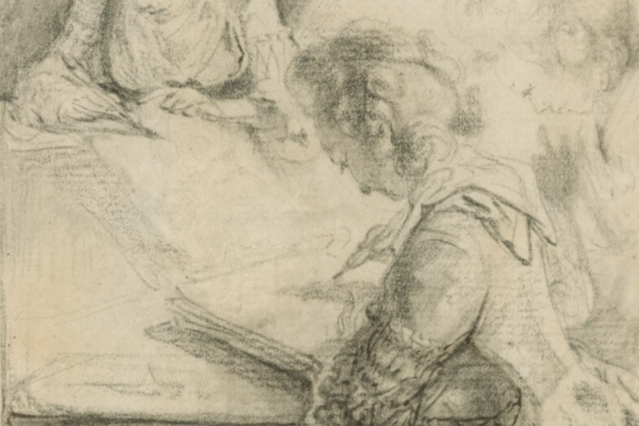
Three Young Women Drawing at a Table, c. 1778
Black chalk with selective wetting and pen and grayish-brown ink, 179 × 119 mm, J. Paul Getty Museum, Los Angeles, 2024.81
I often think of a drawing as a form of time machine to another period and place, a fragile and intimate piece of paper that—if you hold it and imagine the journey it has undertaken, right back to the moment of its creation—provides a distinct glimpse into a fragment of our history. I like to picture the artist, the circumstances, the scene.
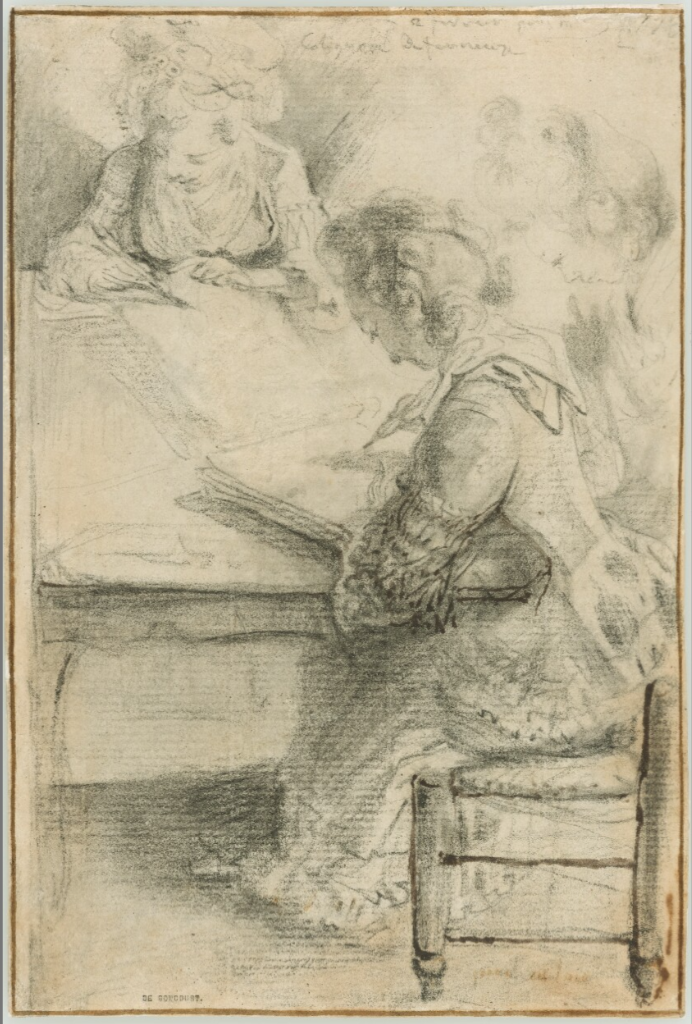
In this sheet by the indefatigable draughtsman Gabriel de Saint-Aubin we can imagine the mixture of quiet concentration, the scratching of chalk on paper, perhaps nervous chitter-chatter, as the women sit around the table engaged in their pastime: drawing. Their own sketches may or may not survive for us today, but Saint-Aubin captures the moment and hands it to us. His focus is on their elegant hairstyles and dresses. Although the drawing is swiftly made in black chalk, he uses brown ink to convey details of the dress nearest him and to accentuate the solidity of the table and chair: an inscription at lower right in ink charmingly notes of the principal figure that one of her feet is in the air: pied en l’air.
This is one of thousands of sketches made by Saint-Aubin, who was described as drawing “at all times and in all places.” His sketchbook pages and annotated, self-illustrated auction catalogues provide us with a trove of information and an extraordinarily palpable sense of his age. Although this drawing was almost certainly made in a sketchbook, it was Saint-Aubin himself who detached it: a dedication in his handwriting at the top reads: 2 février - pour Mme[?] Colignon de Freneuse. 1778.
This is very possibly Louise-Victoire Fligny, the second wife of Charles-Clément Colignon de Freneuse de l’Épinard (1729-1785), or—if the dedication is read “Mlle Colignon de Freneuse”—it could be the only child from Charles-Clément’s first marriage, Louise-Charlotte Colignon de Freneuse (1763–1805), who would have been fifteen years old when the drawing was made. It’s appealing to think that she could be one of the young women we see sketching. (I’m grateful to the incomparable Neil Jeffares for his genealogical insights.)
The black stamp at lower left “De Goncourt” confirms the provenance of the sheet in the collection of Edmond and Jules de Goncourt, who rehabilitated Saint-Aubin’s reputation in the late nineteenth century (in his own time, Saint-Aubin was not considered a “proper” artist since he did not make large history paintings or work within another established genre). In their writings the brothers identify the Getty sheet as depicting three young women drawing, and we retain that title, although the profile at right is very possibly a subsidiary sketch of the principal figure, with similar curls and costume. And what are they drawing? It’s almost impossible to make out, but I sometimes think I see the face of a figure on the sheet of the young women farthest from us. Are they sketching each other?
This sheet by Saint-Aubin features in the exhibition Learning to Draw, which runs at the Getty until January 25th, 2026. In the exhibition we feature a drawing table where visitors can sketch from a plaster cast or some drawing manual pages. But it’s been noticeable that often visitors sketch another member of their party as they draw …
By means of introduction, Betti began by highlighting the history and mission of the organisation:
Founded in 1707, the Society of Antiquaries of London is the oldest independent learned society dedicated to the study of heritage. Its mission is to encourage, promote, and expand the study and understanding of antiquities and history.
The Society has been housed at Burlington House on Piccadilly since 1874. This historic building serves as the hub for our global research and houses our renowned Library and collections. Drawing has been central to our history, as the Society immediately began commissioning artists to create precise visual records of sites and monuments across Britain before they were lost.
Today, the Society's activities maintain a dual focus: research and public accessibility, driven by our extraordinary collections. We preserve one of the world’s most significant independent research libraries, featuring approximately 100,000 printed titles, including incunables and unique broadsides, alongside historical manuscripts and archives dating from the tenth century. This is complemented by diverse visual and material culture holdings, notably a collection of over 55,000 prints and drawings (dating from the late seventeenth to the twentieth centuries) and 40,000 museum objects that encompass everything from paintings and seal casts to one of the largest collections of brass rubbings in the UK.
We have some true treasures in our holdings, like a 1562 watercolour with a design for a new spire for St Paul’s Cathedral to replace the previous one that was struck by lightning, or William Blake’s drawings of the monuments in Westminster Abbey made during his apprenticeship in the workshop of James Basire. The collection was assembled over centuries, largely through bequests. The gift of seven albums containing about 1,200 prints and drawings donated by Lord Coleraine in 1749 can be seen as the foundation of the graphic arts collection of the Society. In its early days, it also actively commissioned drawings and engravings to illustrate artworks and monuments at risk of destruction. The multi-volume series Vetusta Monumenta is perhaps the greatest testament to the Antiquaries’ commitment to creating visual records of fragile heritage.
The Society has developed a multi-front strategy to broaden both specialist and public knowledge of its collection of works on paper, with an exciting cataloguing and digitisation project at the heart of this renewed push. Betti informed Trois Crayons that at the moment, less than 6% of the Antiquaries’ collection is catalogued in their internal database, and even less is digitised. She stressed that collaboration is at the heart of this new campaign: the project, which will unfold over many years, constitutes an opportunity for the Society to ‘engage with local organisations, undergraduate students, and scholars all over the country to create thoroughly researched records for our topographical prints and drawings’. During the first year of the project, Betti ‘will focus on researching a selection of fifty treasures, some of which will be displayed at Burlington House in summer 2026, that will provide the foundation for a catalogue of [the Society’s] Prints and Drawings collection’.
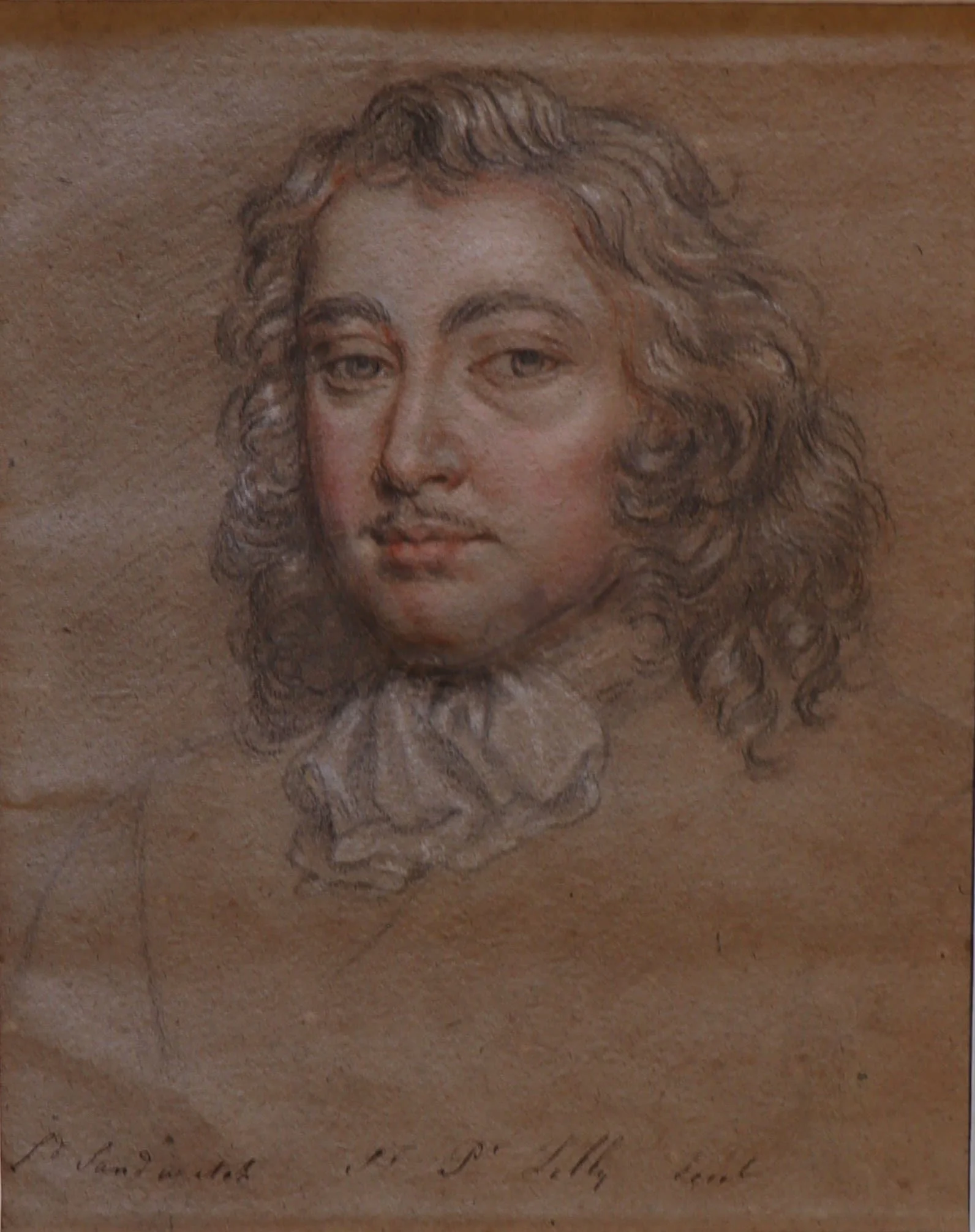
Peter Lely, Portrait of Lord Sandwich, coloured chalks on paper
In the shorter term, the Society will host a rich public programme which will heavily feature drawings. This includes Past Matters, a series of events which aim to raise funds to secure the Antiquaries’ future at Burlington House. Betti highlighted two events as particularly exciting for lovers of the graphic arts:
Drawn to Discovery at the Antiquaries, scheduled for the evening of 6 November, will offer an extremely rare opportunity to dive into a curated selection from the Society’s phenomenal collection of over 55,000 seventeenth- to twentieth-century prints and drawings.
Drawing enthusiasts will have the opportunity to have an unparalleled glimpse into the historical practice of visual documentation. The soirée will feature works by artists who merged technical draughtsmanship with antiquarian purpose, including George Vertue, William Blake, Pietro Fabris, and Giovanni Battista Falda. The collection also has great art historical importance, containing portraits and satirical prints that are comparable in quality and scope to those held by the major national museums. The evening includes a drinks reception and hourly spotlight talks in the library, giving attendees a deeper contextual understanding of these historical works.
We also have the concurrent sale of early engravings of the Society of Antiquaries, running from 21 October through December, with Abbott & Holder, offering a chance to acquire prints made from plates by the Society's first official engraver, George Vertue.
In addition to these events, from 31 October 2025 to 17 February 2026, the Society will host Inked in Memory, a temporary display which will explore how artists and antiquaries created visual records of monuments, archaeological finds, and distant locations before the advent of photography. Betti said working on the display, created in response to the excitement generated by her initial survey of the collection for the cataloguing project, was ‘one of the most exciting and unexpected aspects of [her] role’. Members of the public will be able to view it when coming to Burlington House for one of the Society’s events, such as Open Fridays.
Featuring prints and drawings alongside printing plates, woodblocks, and original objects, the multi-media display allows for novel connections to be made across the Society’s collection. Betti elucidated further:
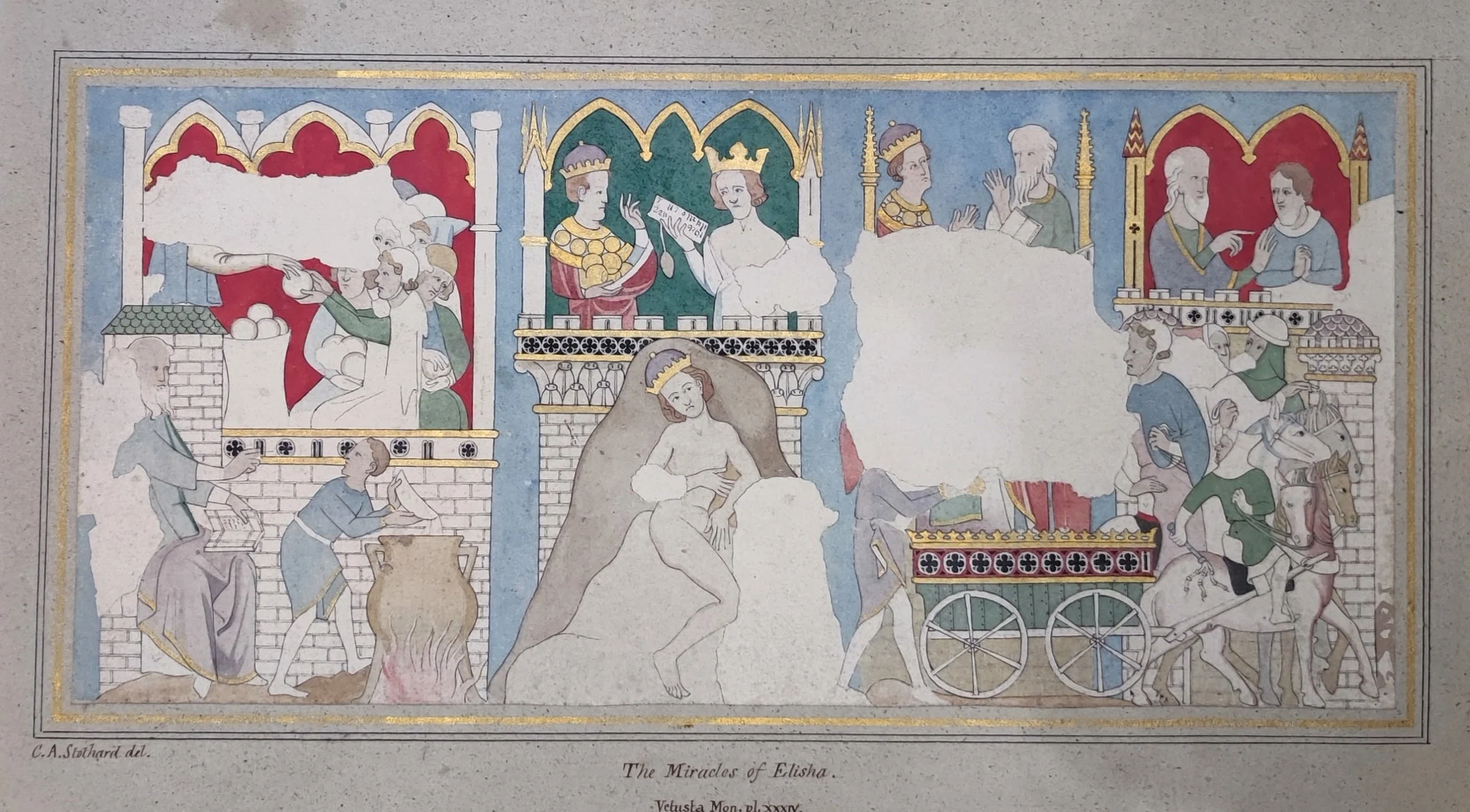
Charles Stothard, The Miracles of Elisha (from Westminster’s Painted Chamber), 1819, watercolour with gold leaf detail on paper
All of the artworks in the Society’s collection were rarely made in isolation: rather, they were commissioned, used, discussed and published by many different people over many years, creating a palimpsest of historical knowledge about a particular object or site. Although these images might appear to be about “the past”' they are very much part of a living, breathing body of knowledge to which we continue to contribute today.
Out of the numerous highlights on view, Trois Crayons set Betti the difficult task of sharing her favourite sheet from the display:
I think that would be Pietro Fabris’s tiny drawing of a street with shops in Pompeii. This piece transports us back to a time when the ancient Roman city was just beginning to reveal its secrets. Fabris made the drawing for Sir William Hamilton (1730-1803), a renowned British collector and envoy in Naples at the time, who frequently visited the excavations of Herculaneum and Pompeii. Those sites began to gain even more fame through collectors such as Hamilton, whose passion for antiquity and role as an ambassador helped introduce the cities as major attractions for travellers. As a result, Naples quickly became the second most popular city in Italy for Grand Tourists, after Rome. The drawing is part of a series of twelve small watercolours that were later published as engravings in the Society’s journal, Archaeologia. The watercolour shows what Pompeii would have looked like to an eighteenth-century visitor. It reproduces the wonderfully vibrant colours of the walls with their reds and colourful tiles, as well as the temporary roofs built to protect the wall paintings. It also shows vineyards sprawled on a hill in the background that had yet to be excavated.
In closing, Betti warmly encouraged readers to take part in the Society’s slate of projects and events.
Information about Inked in Memory can be accessed at https://www.sal.org.uk/event/inked-in-memory/, whilst details for all the Past Matters events, including Drawn to Discovery and the engravings sale, can be found at https://www.sal.org.uk/support-us/past-matters/. Those wishing to support the cataloguing project can make a donation and become a Friend of the Society's Prints and Drawings at https://www.sal.org.uk/support-us/digitise-prints-drawings/.
These exciting projects will surely produce new insight into one of London’s finest holdings of antiquarian works on paper. Trois Crayons will be sure to provide updates as they arise.
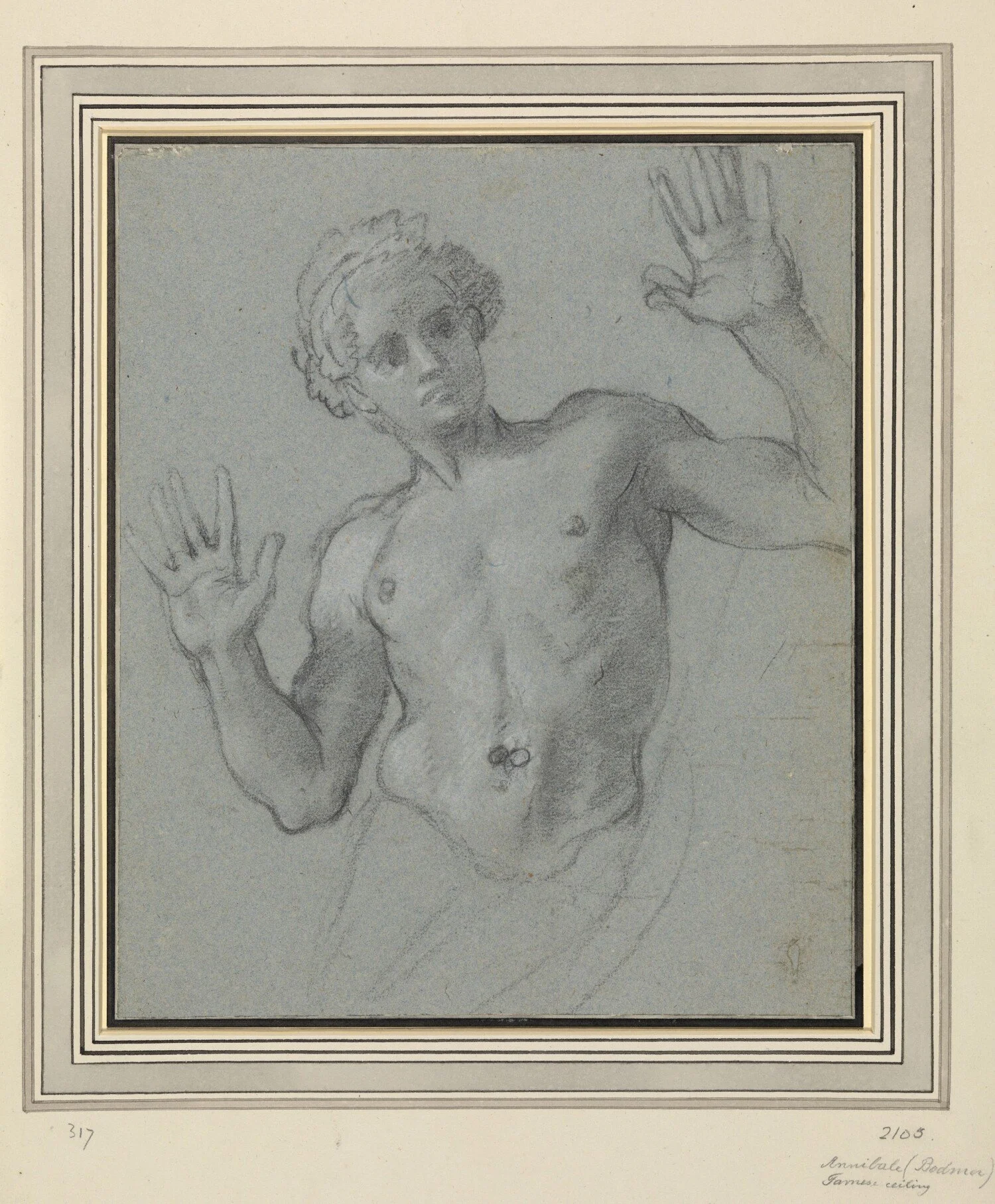
Annibale Carracci. Étude, d’après le modèle vivant © Royal Collection Enterprises Limited 2025
Can we fool you? The term “fake” may be slightly sensationalist when it comes to old drawings. Copying originals and prints has formed a key part of an artist’s education since the Renaissance and with the passing of time the distinction between the two can be innocently mistaken.
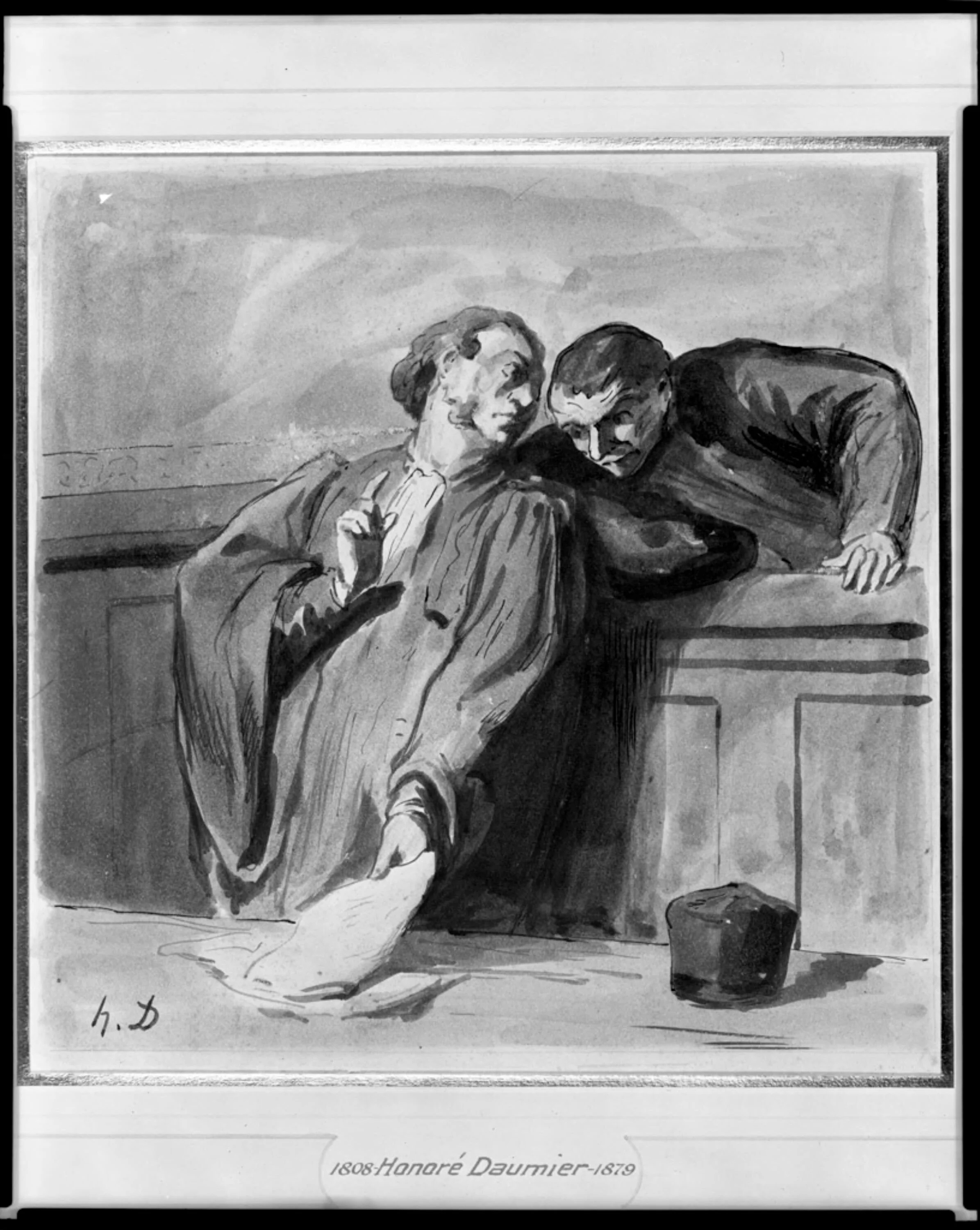
Honoré Daumier was one of the most original and brilliant artists of the 19th century. He was an astute observer of human nature who, having worked as a messenger in the law courts as a youth, regularly satirised the legal system and other elements of French society through his drawings.
Daumier was also one of the most regularly copied and plagiarised artists of the 19th century. The Daumier Register, a website and digital catalogue raisonné of the artist, claims that Daumier created a total of 1340 drawings. This compares with 1562 copies, forgeries and unconfirmed works that are listed on the website.
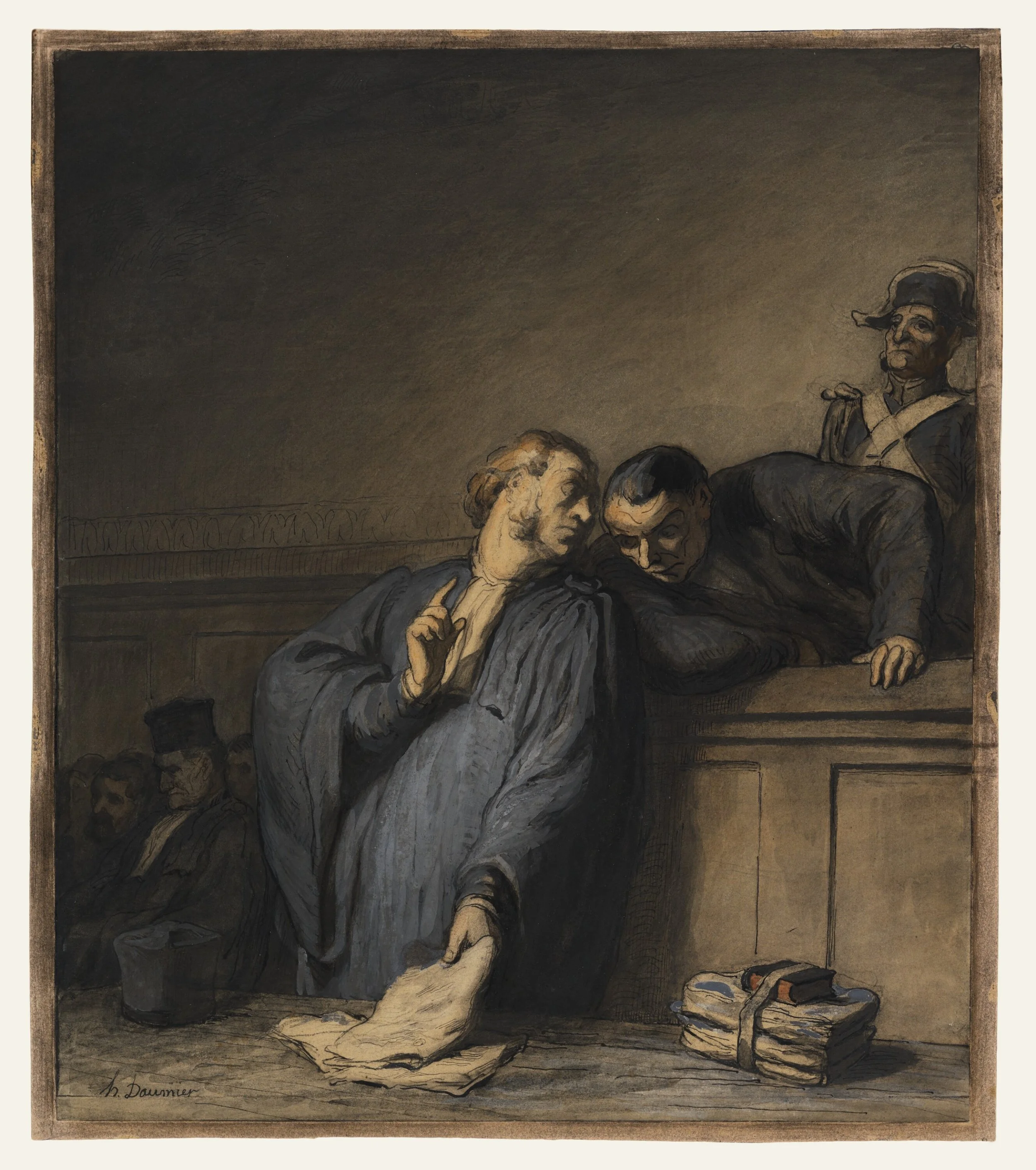
One of the two drawings shown here is an original, while the other is a deceptive copy. But which is which?
-
The original is, of course, the first/left image.
Left/Upper Image: Honoré Daumier (1808–1879), A Criminal Case, J. Paul Getty Museum, Los Angeles
Right/Lower Image: Imitator of Honoré Daumier (1808–1879), Pleaders, Harvard Art Museums/Fogg Museum, Bequest of Grenville L. Winthrop
Waldemar Januszczak and Bendor Grosvenor, a.k.a. Waldy & Bendy, are back. The art-historian double act has returned for the fifth series of its podcast, Waldy & Bendy’s Adventures in Art. Season five includes discussions of the National Gallery’s expansion plans, the sale of its benches, the art market, depictions of swans in art, and the best unfinished artwork.
For Dutch readers, a podcast from the Teylers Museum explores the life and work of Michelangelo, in conjunction with the exhibition Michelangelo and Men.
To Listen
Waldy & Bendy: Season 5
Coming to BBC Iplayer in November is a new documentary from BBC Arts which unlocks the hidden psychology of J.M.W. Turner through his 37,000 private sketches, drawings, and watercolours. Of special interest is a series of erotic sketches previously thought to have been destroyed. With unprecedented access to Tate's extraordinary archive, Turner: The Secret Sketchbooks reveals the man behind the masterpieces.
To Watch
Turner: The Secret Sketchbooks
A first-of-its-kind study launched by Art Fund’s National Art Pass provides the most compelling scientific evidence to date that viewing art has immediate, measurable benefits for our health and wellbeing. “From a scientific perspective, the most exciting outtake is that art had a positive impact on three different body systems—the immune, endocrine, and autonomic systems—at the same time,” Dr. Tony Woods, researcher at King’s College London, said in a statement. “This is a unique finding and something we were genuinely surprised to see.”