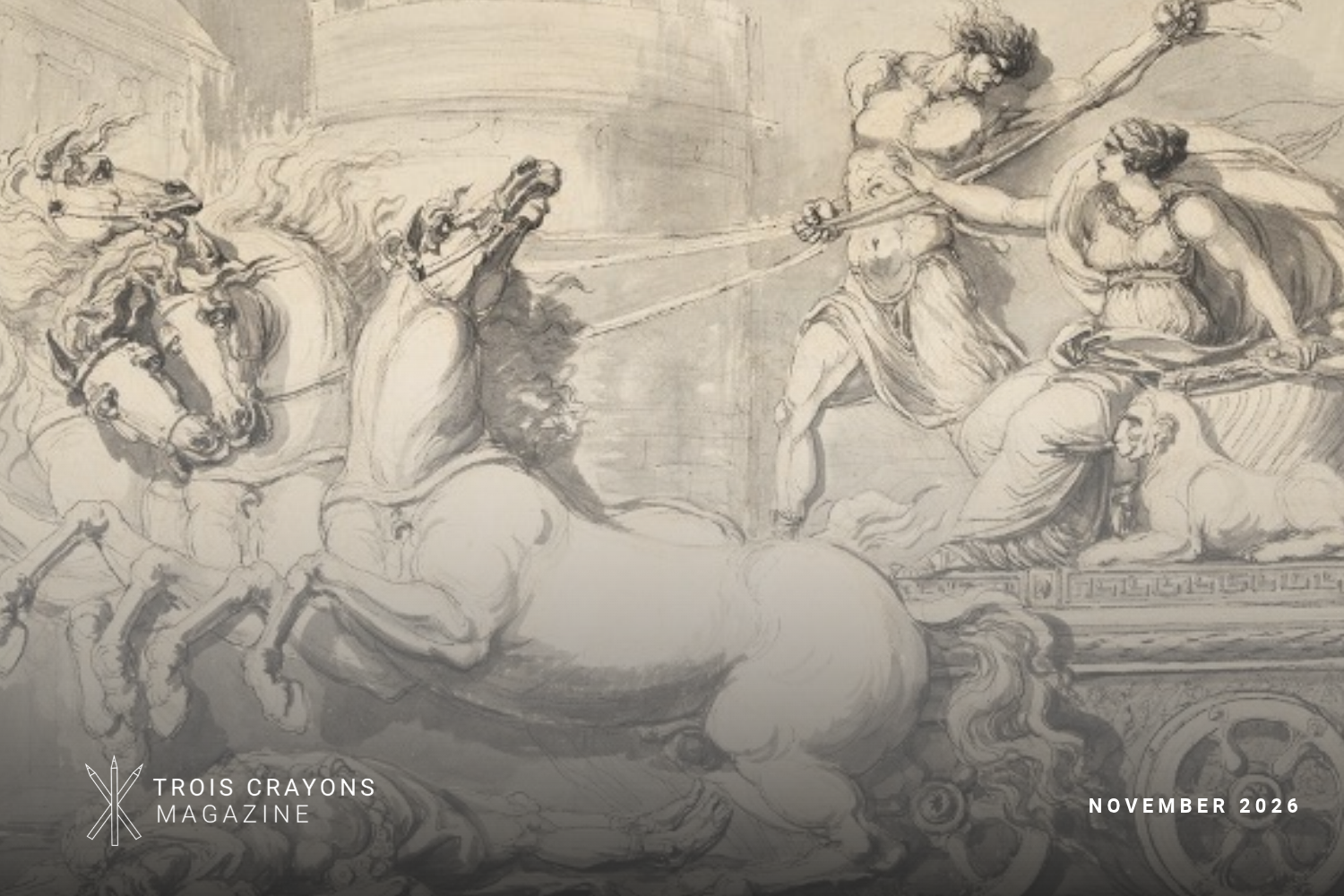
Two down, one ongoing. On Paper: Drawings from the Renaissance to the Modern Day is open for its third leg at Martha’s and entering the final days of the exhibition.
Inside this month’s magazine, we have news headlines, gallery listings, announcements, events and an overview of recent institutional acquisitions. For our Drawing of the Month, John Marciari, curator of Fantasy and Reality: The Art of Johan Tobias Sergel at Morgan Library & Museum, reflects on a personal highlight from the exhibition. For this month’s Demystifying Drawings feature, Francesco Grisolia offers a profile of the Roman priest Padre Sebastiano Resta, one of the most significant figures in the history of drawings collecting, for our “Collector Portraits” series. In the Preview section, Laurence Lhinares guides us through the newly opened exhibition at the Fondation Custodia in Paris, Mes Chers Amis: Drawings in the Collections of 19th-Century French Artists. After the month’s exhibition listings and the Real or Fake quiz, the issue concludes with a trio of audio, video and literary recommendations.
So, what am I looking forward to this month in the drawings world? Across the museum sector, it is another strong month for exhibition openings. In Boston, the Museum of Fine Arts opened Of Light and Air: Winslow Homer in Watercolor on the 2nd. In Orléans, the Musée des Beaux-Arts d'Orléans opens a major new exhibition, Drawing Egypt: Artists and Scholars in Bonaparte's Orient – designated an ‘Exposition d’intérêt national’ – on the 7th. How many drawings etc. In Paris on the 10th, the Petit Palais opens Brussels 1900, an overview of Belgian art at the dawn of the 20th century. Ranging from Symbolism to XX, the exhibition features 250 works, including paintings, graphic arts, sculptures and decorative arts. In London, Tate Britain opens a large exhibition on the Bloomsbury Group, Vanessa Bell & Duncan Grant: Inside Bloomsbury, on the 12th, bringing together over 300 paintings, works on paper,, painted furniture, ceramics, and textiles. Up the road at The National Gallery, a show dedicated to Jan van Eyck’s portraits opens on the 21st. While primarily an exhibition of paintings, Van Eyck: The Portraits includes the master's only surviving drawing alongside three other early sheets, including one by his contemporary Rogier van der Weyden. In Milan, In the Wake of Leonardo: Pupils and Followers in Milan opens on the 27th, exploring the technical and stylistic legacy of Leonardo da Vinci, the formation of a local school, and the paths forged by his followers after his departure. (are there enough drawings there?)
In the galleries, Colnaghi presents an impressive exhibition of oil sketches on paper curated by Luca Baroni, Arie di Teste: Italian Oil Paintings on Paper, 1500–1800, running from 23 November until 29 January at their London gallery. At the end of the month, Stephen Ongpin Fine Art’s Christmas Exhibition runs from 30 November until 17 December. In Paris, the newly formed partnership between Étienne Bréton and Ambroise Duchemin at Saint-Honoré Art Consulting presents its inaugural show, Vers l'abstraction - Paysage Radical dans la Peinture Française au 19e Siècle, open until 27 November. In Milan, Matteo Salamon presents an exhibition principally consisting of Lombard drawings, Dialoghi di Carta: Disegni Lombardi e Maestri d’Altrove, while Arnoldi-Livie in Munich presents The Distant Gaze - Blick in die Ferne, 1820-1920 until 10 November. In New York, Robert Simon Fine Art holds the first exhibition outside Florence devoted to the Renaissance nun-artist Plautilla Nelli. The show includes a rare drawing.
In lecture halls, at the Morgan Library & Museum in New York, John Marciari delivers a talk on Johan Tobias Sergel on the 6th. At the Society of Antiquaries, a “Collections and Research Day”, Lines of Enquiry: Graphic Arts and the Afterlives of the Material Past takes place on the 6th, available online. At the Petit Château de Sceaux, a symposium on Nicolas Poussin takes place on the 13th. In Paris, a two-day colloquium exploring the relationship between printmaking and drawing will be hosted at the Bibliothèque nationale de France on 18–19th. It is available to attend online. Finally, at the Harvard Art Museums, Susan Owens delivers a lecture entitled John Constable and the Outdoors: Writing about Drawing on 2 December.
Did I miss something? For next month’s edition, please direct any recommendations, news stories, feedback or event listings to tom@troiscrayons.art.
IN GALLERY, ART FAIR AND AUCTION NEWS
5–8 November – Fair: AmArt at Museo della Permanente (Milan).
5–10 November – Exhibition: Moving Stillness, Tradition and Experimentation in the North at J/M Gallery (London). Organised by Cadogan Fine Arts.
Until 7 November – Exhibition: The Glorious 19th Century at Chris Beetles Gallery (London).
Until 7 November – Exhibition: Holding the Line: The Art of the War Years at The Gallery, 54 Shepherd Market (London). Organised by Sim Fine Art.
Until 8 November – Exhibition: On Paper: Drawings from the Renaissance to the Modern Day at Martha’s (Dallas). Organised by Trois Crayons.
Until 8 November – Fair: PAN Amsterdam at RAI Amsterdam (Amsterdam).
Until 10 November – Exhibition: The Distant Gaze - Blick in die Ferne, 1820-1920 at Arnoldi-Livie (Munich).
10 November – 9 December 2026 – Exhibition: The Bloomsbury Group, 1910-1920: "Character Changed" at Philip Mould & Company (London).
11 November – 31 January 2027 – Exhibition: Dialoghi di Carta: Disegni Lombardi e Maestri d’Altrove at Matteo Salamon Old Masters, Palazzo Cicogna (Milan).
Until 14 November – Exhibition: Exposition d'Automne 2026 at Galerie Charvet (Paris).
16–20 November – Exhibition: Best of The Drawing Year 2026 at Christie's (London). Organised by The Royal Drawing School.
Until 21 November – Exhibition: John Berger (1926-2017): ‘A Life of Drawing’. A Centenary Celebration at Mandell’s Gallery (Norwich).
23 November – 29 January – Exhibition: Arie di Teste: Italian Oil Paintings on Paper, 1500–1800 at Colnaghi (London).
Until 25 November – Exhibition: Suor Plautilla Nelli: La Prima at Robert Simon Fine Art (New York).
Until 27 November – Exhibition: R. B. Kitaj: From Fragments at Piano Nobile (London).
Until 27 November – Exhibition: Côte d’Azur at Bernard Jacobson Gallery (London).
Until 27 November – Exhibition: Vers l'abstraction - Paysage Radical dans la Peinture Française au 19e Siècle at Saint-Honoré Art Consulting (Paris).
Until 29 November – Exhibition: Saskia Bécaud: Près du Passé at XX. Organised by Jan Six Fine Art.
30 November – 17 December – Exhibition: Christmas Exhibition at Stephen Ongpin Fine Art (London).
Until 5 February – Exhibition: La pervivència d’una mirada. 100 anys d’Artur Ramon Art at Artur Ramon Art (Barcelona).

Federico Barocci, Head of Saint John the Evangelist, after 1582, possibly c. 1607-1608, Private collection
IN LECTURE AND EVENT NEWS
6 November – Lecture: Fantasy and Reality: The Art of Johan Tobias Sergel at the Morgan Library & Museum (New York). Speaker: John Marciari. 18:00 EST. Free; advance registration encouraged.
6 November – Conference: Lines of Enquiry: Graphic Arts and the Afterlives of the Material Past at the Society of Antiquaries (London and online). 10:00 GMT. £15 in-person; free online. Organised by Anouska Lester and Chiara Betti.
11 November – Study day: An Exquisite Eye: Introducing the Aso O. Tavitian Collection at the Clark Art Institute (Online). 12:00 EST. Free. Organised in partnership with the Italian Art Society.
12 November – Event: Drawing Inspiration: Works at the Center of Recent MoMA Exhibitions at the Museum of Modern Art (New York). 10:00 EST. Free; advance registration required. Organised by The Drawing Foundation in partnership with MoMA to coincide with the inaugural presentation of Studiolo. in New York.
13 November – Study day: Ce qu’a vu Poussin. Autour des premières années françaises du peintre at the Petit Château de Sceaux (Sceaux). 10:00 CET. Free. Organised by the Centre de recherche Nicolas Poussin and the Mission de préfiguration of the musée du Grand Siècle.
13 November – Talk: Craig Hamilton: On Drawing at the Drawing Matter Archive (London). Speakers: Craig Hamilton, Ellis Woodman. 18:00 GMT. £12.50.
18 November – Conference: Félix Vallotton: Longing and Seduction at the Museum Barberini (Potsdam). 10:00 CET. €16.
18–19 November – Conference: La taille et le trait : dialogue entre dessin et estampe at the Bibliothèque nationale de France, site Richelieu (Paris and online). 09:30; 10:00 CET. Free. Organised by the Sorbonne Université, LARHRA UMR 5190, the Bibliothèque nationale de France, with generous support from the Tavolozza Foundation.
26 November – Lecture: The Metabolism of Landscape: Ecology and Natural Philosophy in the Prints of Hercules Segers at The Courtauld Institute (London). Speaker: Elizabeth J. Petcu. 17:30 GMT. Free; advance booking required.
2 December – Lecture: John Constable and the Outdoors: Writing about Drawing at Harvard Art Museums (Cambridge, MA). Speaker: Susan Owens. 18:00 EST. Free; advance registration required.
Call for papers: Pellegrino Tibaldi Between Milan and Spain: Architecture and the Arts at the Politecnico di Milano and the Università Cattolica del Sacro Cuore (Milan). Application deadline: 9 December. Conference dates: September 2027.
Call for papers: Presenting Bosch at Jheronimus Bosch Art Center (’s-Hertogenbosch). Application deadline: 15 November. Conference dates: 27–29 May 2027.
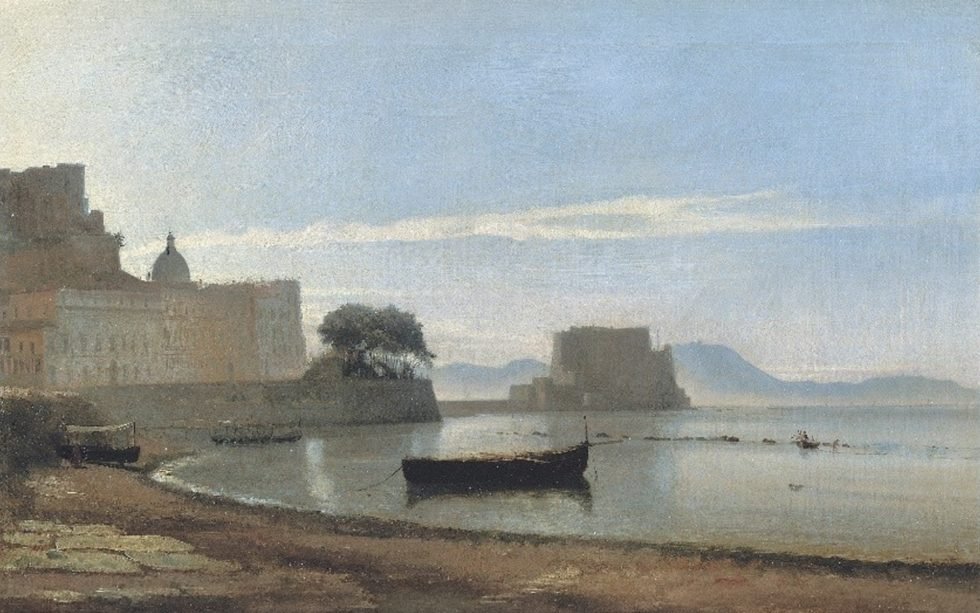
Jean-Baptiste Camille Corot (1796–1875), The Bay of Naples with Castel dell’Ovo, the Museo e Real Bosco di Capodimonte, Naples
IN LITERARY, MUSEUM AND ACADEMIC NEWS
Johann König works on paper sought for catalogue raisonné: Dr Gode Krämer, former head of the Graphic Art Collection at the Kunstsammlungen & Museen Augsburg, is preparing to publish the catalogue raisonné of drawings, gouaches and miniatures by Johann König (1586–1642). He would be most grateful if owners of works by König in private or public collections would contact him directly at gode.kraemer@gmail.com.
New research project: The Royal Museums of Fine Arts of Belgium are launching an interdisciplinary research project on the Errera Sketchbook. The project will investigate an exceptional collection of more than 150 drawings produced in Antwerp in the early sixteenth century. Its findings will be presented in a major exhibition at the RMFAB in 2030–2031, accompanied by a scholarly catalogue.
New publication: Liotard & Marie-Antoinette: Faces Under Scrutiny edited by Marie-Eve Celio and Catriona Seth. Scheidegger & Spiess. CHF 49.
New publication: Pontormo edited by Cristina Acidini Luchinat. Electa. €48.
New publication: Magic and Mess: The Artist's Studio Revealed by James Hall, Anita Sganzerla, Esner Rachel, Isabelle Sagraves, Daniel Robbins and Hannah Lund. Paul Holberton Publishing. Distributed by Yale University Press. £30.
New publication: Paper Marbles: Design, Antiquarianism and Geology in Pier Leone Ghezzi's Studio di Molte Pietre (1726) by Adriano Aymonino. The Burlington Press. Yale University Press. £45.
Recent publication: I disegni di Michelangelo: Nuove prospettive su alcuni capolavori della Casa Buonarroti edited by Alessandro Cecchi. Officina Libraria. €30.
Recent publication: Drawings in Books in Medieval Britain from the Ninth Century to the Reformation by Julian Luxford. Boydell & Brewer. £160.
New appointment: Tom van der Molen has been appointed Curator of Prints and Drawings at Leiden University Libraries.
Fellowship opportunity: YCBA research fellowships, Yale Center for British Art (New Haven). Awards of $5,000 are available for a four-week research period, with funding prorated for stays of two or three full weeks. Application deadline: 30 November.
Prize: Prix Nicole 2027, Société de l’Histoire de l’Art français (Paris). €5,000 will be awarded to the author of a doctoral thesis defended in France on French art of the sixteenth, seventeenth or eighteenth centuries, particularly painting. Application deadline: 8 November.
Prize: Amy P. Goldman Fellowship in Pre-Raphaelite Studies, the University of Delaware Library and the Delaware Art Museum (Delaware). $3,000 will be awarded for the one-month Fellowship. Application deadline: 16 November.
IN ACQUISITION NEWS
Adriaen de Vries (c. 1556–1626), Reclining Female Nude, Seen from the Back, c. 1582–86. Acquired by the Teylers Museum, Haarlem, with the support of Matthijs de Clercq (via @mrlnram).
School of Rembrandt van Rijn (1606–1669), Moses and Aaron before Pharaoh. Acquired by Herbert F. Johnson Museum of Art, Cornell University, New York, from Christie’s, New York (sale: 5 February 2026).
John Hamilton Mortimer (1740–1779), Grotesque design with three ewers and decorative frieze. Acquired by the British Museum, London, from Rick Scorza, London.
Joseph Anton Koch (1768–1839) The Meeting of Jacob and Rachel. Acquired by the British Museum, London, from Day & Faber, London.
Jean Constantin Protain, called Protain fils (1769–1837), Le Champ d'Exécration. Acquired by the Bibliothèque-musée de l’Opéra de Paris, Paris, from Galerie La Nouvelle Athènes, Paris.
Jean-Baptiste Camille Corot (1796–1875), The Bay of Naples with Castel dell’Ovo. Acquired by the Museo e Real Bosco di Capodimonte, Naples.
Eugène Delacroix (1798–1863), Two Studies of Horses, c. 1822–23. Acquired by the Musée Delacroix, Paris.
George Sand (1804–1876), Dendritic Landscape. Acquired by The Metropolitan Museum of Art, New York, from Galerie de Bayser, Paris.
Émile Signol (1804–1892), Pythias et Damon chez Denys le Tyran. Acquired by the musée des beaux-arts de Tours, Tours, from Galerie La Nouvelle Athènes, Paris.
John Frederick Lewis (1805–1876), A Spy of the Christino Army brought before the Carlist General-In-Chief Zumalacarregui. Acquired by the British Museum, London, from Karen Taylor Fine Art, London.
50 Anglo-Indian artworks, including oil paintings, watercolours and miniatures, by artists such as Johan Zoffany, Rudolf Swoboda, Sita Ram, William Hodges and Thomas Daniell have been gifted to the Tate by Charles Greig.

Unknown Artist working for William Fraser, A Herdsman Leading a Buffalo, c.1815–16, Presented by Charles Andrew Greig to the Tate, 2026
Johan Tobias Sergel (1740–1814)
Tullia Directs Her Chariot over the Corpse of Her Father, c. 1770
Pen and black ink and grey wash, over black and red chalk, 432 x 559 mm, Collection of Mr. & Mrs. Howard Lepow, New York
Johan Tobias Sergel (1740–1814), Tullia Directs Her Chariot over the Corpse of Her Father, c. 1770, Collection of Mr. & Mrs. Howard Lepow. Photography courtesy of The Morgan Library & Museum, Photography by Janny Chiu
John Marciari, Director of Curatorial Affairs, Charles W. Engelhard Curator and Department Head, Drawings and Prints, The Morgan Library & Museum, New York, has kindly chosen our drawing of the month
Fantasy and Reality: The Art of Johan Tobias Sergel is now on view at the Morgan Library & Museum, through 31 January 2027. Although little known today, in large part because few of his works are in collections beyond Scandinavia, Sergel is a deeply engaging artist. Born and trained in Stockholm, he spent a decade in Rome from 1767-78 where he was a pioneer in the creation of Neoclassicism. A sculptor by trade, he was also a draughtsman by whom hundreds of drawings survive, not only studies for sculpture but also a brilliant corpus of caricatures. His close associates included an amazingly international group of artists: Clodion, François-André Vincent, Henry Fuseli, Nicolai Abildgaard, Jacob Philip Hackert, Giuseppe Cades, Louis Jean Desprez, Thomas Banks, and many more. The Morgan’s exhibition thus seeks not only to reintroduce Sergel to a new audience but also to show how artistic friendships led to new developments in the great melting pot of late eighteenth-century Rome.
Tullia Directs Her Chariot over the Corpse of Her Father is one of the largest, most finished, and most spectacular of Sergel’s surviving drawings and it thus occupies a prominent place in the Morgan’s exhibition. The drawing was published in Ragnar Josephson’s magisterial Sergels Fantasi of 1956 and was even turned into a Swedish postage stamp in 1972, but it remained in private hands and, having been sold several times, was lost to recent scholars. The sheet occupies a prominent position in the Morgan’s installation, but it was “rediscovered” too late to be included in the exhibition catalogue, so it seems particularly worth drawing attention to it here.
Tullia was the daughter of the ancient Roman king Servius Tullius, but she arranged his murder so that her husband could usurp the throne. Here, in triumph, she directs her chariot to be driven over her father’s dead body. The subject had been given to French artists competing for the Prix de Rome in 1765, and the winner, Jean Bardin, arrived in Rome in 1768. Trained in Stockholm and France by Pierre Hubert L’Archevêque (who had himself studied under Edme Bouchardon), Sergel associated himself with the Académie de France upon his arrival in Rome, and it was presumably after meeting Bardin at Palazzo Mancini that Sergel created his own version of the theme.
The style that Sergel employed for his Tullia, however, is not the Bouchardonesque manner of drawing in red chalk that characterises his early works. Instead, his expressive bodies, bold forms, and extensive use of wash reflect a manner of drawing that he developed alongside his closest companion in Rome, Henry Fuseli, who arrived in 1770: one can make easy comparisons between the Tullia and the drawings in Fuseli’s Roman Album at the British Museum. In a poignant passage of his autobiography, Sergel wrote that, after a short time in Rome, he realised he had lost twelve years to training in “the abominable French manner”. He set out to learn all afresh, with antiquity and nature as his guides.
In addition to nature and antiquity, of course, Sergel had the inspiration of his fellow artists in Rome, and atop his links to French and British artists, we can also add Roman influences: The Egyptian lion on Tullia’s chariot is clearly based on one of the pair that sit at the foot of the Campidoglio ramp. Yet, when we see an artist in Rome adopt an Egyptian motif in years around 1770, we have to think of Giovanni Battista Piranesi’s then-new Egyptian interior of the Caffè degli Inglesi, loved by a few but reviled by many. Sergel, however, must have been an enthusiast, for not only do we see his Egyptian lion in the Tullia, but the Morgan exhibition also includes a caricature of Sergel in Rome by Hackert, showing our artist in a fanciful Egyptian costume.
A brilliant drawing in its own right, full of verve, the Tullia is one of many works that also document Sergel’s artistic friendships, influences, and connections, and as such, is a teaser for an exhibition that we hope will be of interest to many, even those who have never heard of Sergel himself.
Fantasy and Reality: The Art of Johan Tobias Sergel is open at the Morgan Library & Museum, New York, from 30 October 2026 – 31 January 2027.
Collector Portrait: Padre Sebastiano Resta (1635–1714)
Francesco Grisolia, Associate Professor at the University of Rome 'Tor Vergata
Padre Sebastiano Resta did not own a collection in the usual sense of the word, yet the drawings that passed through his hands, many of them still recognisable by his inscriptions and their mounts, are now scattered through print rooms across the world. On the last day of March 1689, as Resta was consulting one of his albums, Carlo Maratti drew him in red chalk, and the sheet was promptly added to that very volume, with an inscription that records the occasion and calls it ‘furto e dono dell’autore’, the artist’s theft and gift (fig. 1). For half a century this Milanese priest of the Roman Oratory gathered, studied, annotated and arranged thousands of drawings. Posterity proved less generous. In 1786 Girolamo Tiraboschi, who suspected that commerce lay behind his attributions, judged ‘this good priest’ all too ready to give Correggio ‘works that no one else attributes to him’, and in his pioneering essay of 1936–37 A. E. Popham could still introduce him, not without sympathy, as ‘that singular, but not unattractive, charlatan, as his detractors would call him’.

Carlo Maratti, Padre Sebastiano Resta consulting one of his albums of drawings, 1689, red chalk. Chatsworth, Devonshire Collection, inv. 584. © Devonshire Collection, Chatsworth
His father Filippo, a Milanese painter and collector, steered him towards the arts: after studying philosophy and law, Resta spent time in the workshop of Ercole Procaccini the Younger, though he never became a painter. Around 1661 he settled in Rome, becoming a full member of the Congregation in 1668. From his rooms at the Chiesa Nuova he travelled in search of drawings and information, and built up a dense web of relationships with artists, scholars, collectors and dealers that reached across Italy and beyond: Maratti, Giuseppe Ghezzi and Giuseppe Passeri; Giovan Pietro Bellori and Carlo Cesare Malvasia; Queen Christina of Sweden; the seventh Marqués del Carpio, Spanish ambassador in Rome and later Viceroy of Naples, whose drawings he arranged in volumes; correspondents such as Giuseppe Magnavacca in Bologna, Filippo Baldinucci and Francesco Maria Niccolò Gabburri in Florence, and Agostino Scilla in Messina; and a number of Englishmen, among them John Talman, Charles Jervas and Henry Newton.
Resta bought, exchanged and received drawings in order to mount them in albums destined for others, and the proceeds went to the charities of the Oratory. He assembled more than thirty albums holding no fewer than 5,000 drawings, and both figures rise if one counts the volumes he arranged for other collectors, such as those of the Marqués del Carpio. Each was a book with an argument. Titles such as Parnaso de’ pittori, Senatori in gabinetto or L’arte in tre stati proclaim the ambition to narrate the history of Italian art through drawings. Other volumes were monographic, among them the Libro d’arabeschi, devoted to ornament and sent to Palermo in 1689. Among the masters, Correggio came first – an admiration Resta had brought with him from Milan. All his life he hunted for Correggio’s drawings and paintings and for information about his life; he devoted several volumes to him, including the Correggio in Roma (part of which survives in the British Museum).
Beyond the many ways Resta sought to narrate and depict the history of Italian art through drawings, what sets these books apart is the page itself. Resta pasted his drawings onto album leaves, surrounded them now with a gold fillet, now with ruled borders drawn in pen, and often filled every remaining space with writing: attributions, provenances, biographical notes, digressions and family trees of schools, with frequent corrections to Vasari, Baglione and the other writers whose books he annotated with equal density.
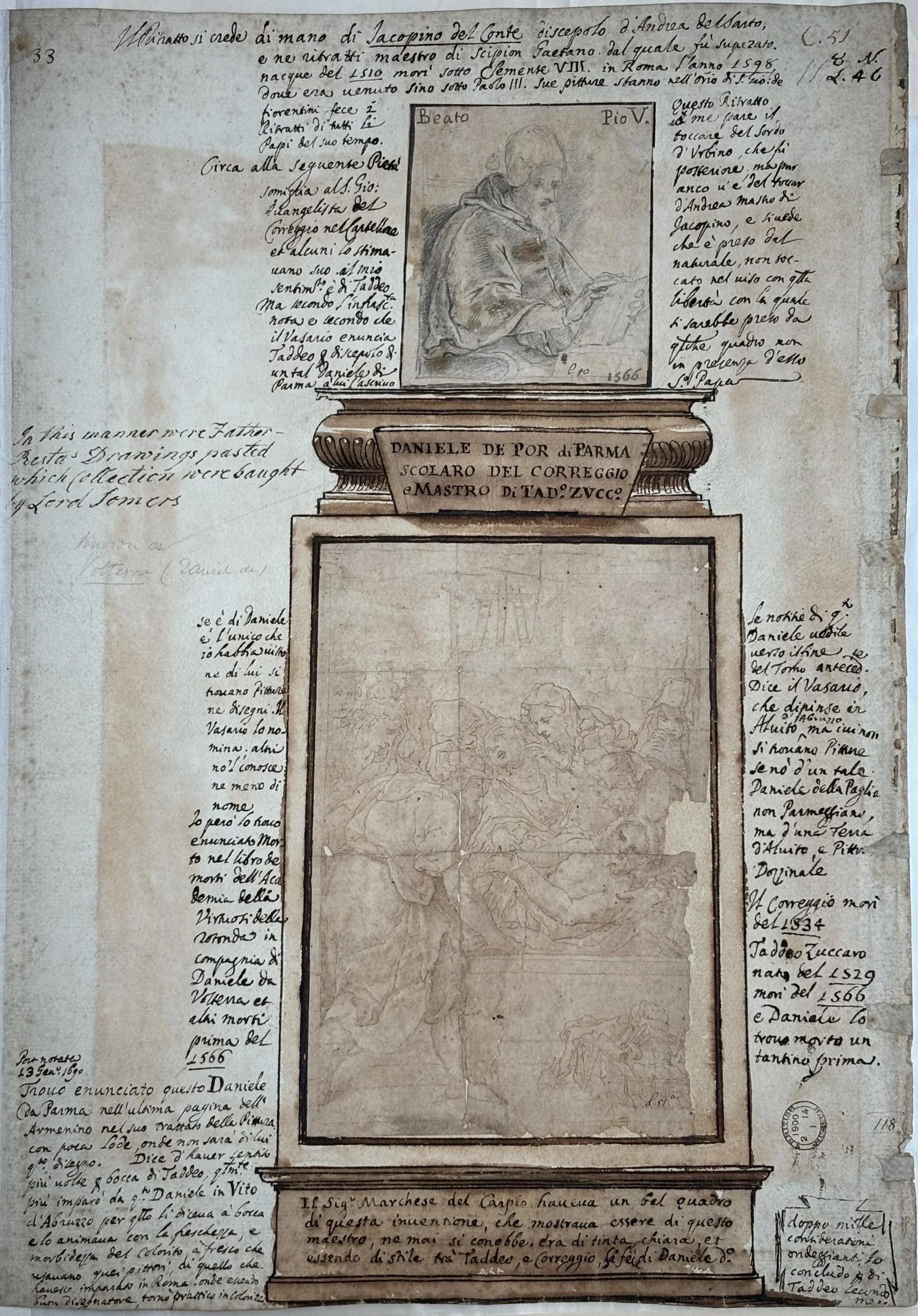
Page from Resta’s album Secolo pratico, with his mount and inscriptions, holding two drawings: above, Anonymous (formerly attributed to Jacopino del Conte), Portrait of Pope Pius V, black chalk, 108 × 94 mm; below, copy after Taddeo Zuccaro, Entombment, pen and brown ink, 220 × 148 mm; album leaf 490 × 340 mm. London, British Museum, 1900,0214.1. © The Trustees of the British Museum
A page from the Secolo pratico, now in the British Museum, is one of the best-known examples, chosen by Popham himself to show Resta’s handwriting and his method of mounting drawings (fig. 2). Within an architectural setting designed for the purpose sit two sheets of different sizes and by different hands: above, a Portrait of Pope Pius V, which Resta attributed to Jacopino del Conte; below, an Entombment that he assigned to Taddeo Zuccaro only ‘after a thousand wavering considerations’, noted at different times in the cartouche and on the plinth and ranging from Daniele da Parma to Correggio. Resta’s attributions could be wildly optimistic, above all where Correggio was concerned; yet the same eye could be remarkably acute: in a rapid pen sketch, now in the famous album known as the Galleria portatile in the Biblioteca Ambrosiana in Milan, he recognised the ‘embryo’ of Raphael’s Disputa.
Mariette, Resta sought out and studied periods and schools that the collectors and critics of his day neglected or dismissed: medieval art and the painters of the fifteenth century, the Lombard, Venetian and Neapolitan schools, artists from north of the Alps, decorative drawing, and the Mannerists, to whom he devoted his most extensive known album, the Secolo pratico, with no fewer than 344 drawings, at a time when Bellori’s circle held the Maniera in low esteem. In the Galleria portatile a Bust of Christ then believed to be by Piero della Francesca, and now given to the school of Perugino, heads Resta’s life of Piero and a family tree of his school (fig. 3): such genealogical trees of artists and styles were a crucial tool for him, and one that Baldinucci also adopted in those same years.

School of Perugino (attributed by Resta to Piero della Francesca), Bust of Christ, with Resta’s life of Piero della Francesca and a family tree of his school; page from the album Galleria portatile. Milan, Biblioteca Ambrosiana, F 261 inf. n. 10, p. 5. © Veneranda Biblioteca Ambrosiana
Between 1698 and the early years of the new century, Resta sent some nineteen volumes to Marchetti, who died in 1704 without having settled his debt. Most of the Marchetti volumes went north. In 1710, Talman described them as the work of ‘a person so well known in Rome and all over Italy for his skill in drawings’, designed ‘to shew the rise and fall of painting in diverse periods of time’. Through Talman they passed from the bishop’s heirs to Lord Somers, and Henry Newton later bought further albums from Resta himself. Burdened by debt, Resta died in poverty at the Chiesa Nuova in 1714.
In England the albums had a short life, but they left traces that collectors and dealers can still read today. Richardson, who arranged the Somers collection, had each drawing marked with a lower-case letter for its album and a number for its place within it (Lugt 2981): ‘b 36’, for instance, is no. 36 of the Saggio dei secoli, and the order is sometimes reversed, as in the ‘59 n’ on a Sibyl by Taddeo Zuccaro in the British Museum (fig. 4). He also had Resta’s notes copied before the London auction of 1717, and that transcript, now Lansdowne MS 802 in the British Library, turns such a mark into a provenance and often into Resta’s own comment, which in many cases is otherwise lost: under no. 36 of book B one reads that the sheet ‘was noted in Bellori’s studio as by Raphael’; under no. 59 of book N one finds the biography of Pellegrino da Modena, to whom the Sibyl was then attributed. On the mount of Polidoro’s Triumphal Arch for the Emperor Charles V in the Victoria and Albert Museum the inscription repeats, almost word for word, the entry recorded under no. 202 of book K. Popham warned, however, that the writing on some later mounts and on the backs of these sheets is Richardson’s copy, not Resta’s hand. That hand, unmistakable once seen, survives on the intact albums and pages and on sheets that travelled by other routes, and often records where a drawing had come from.
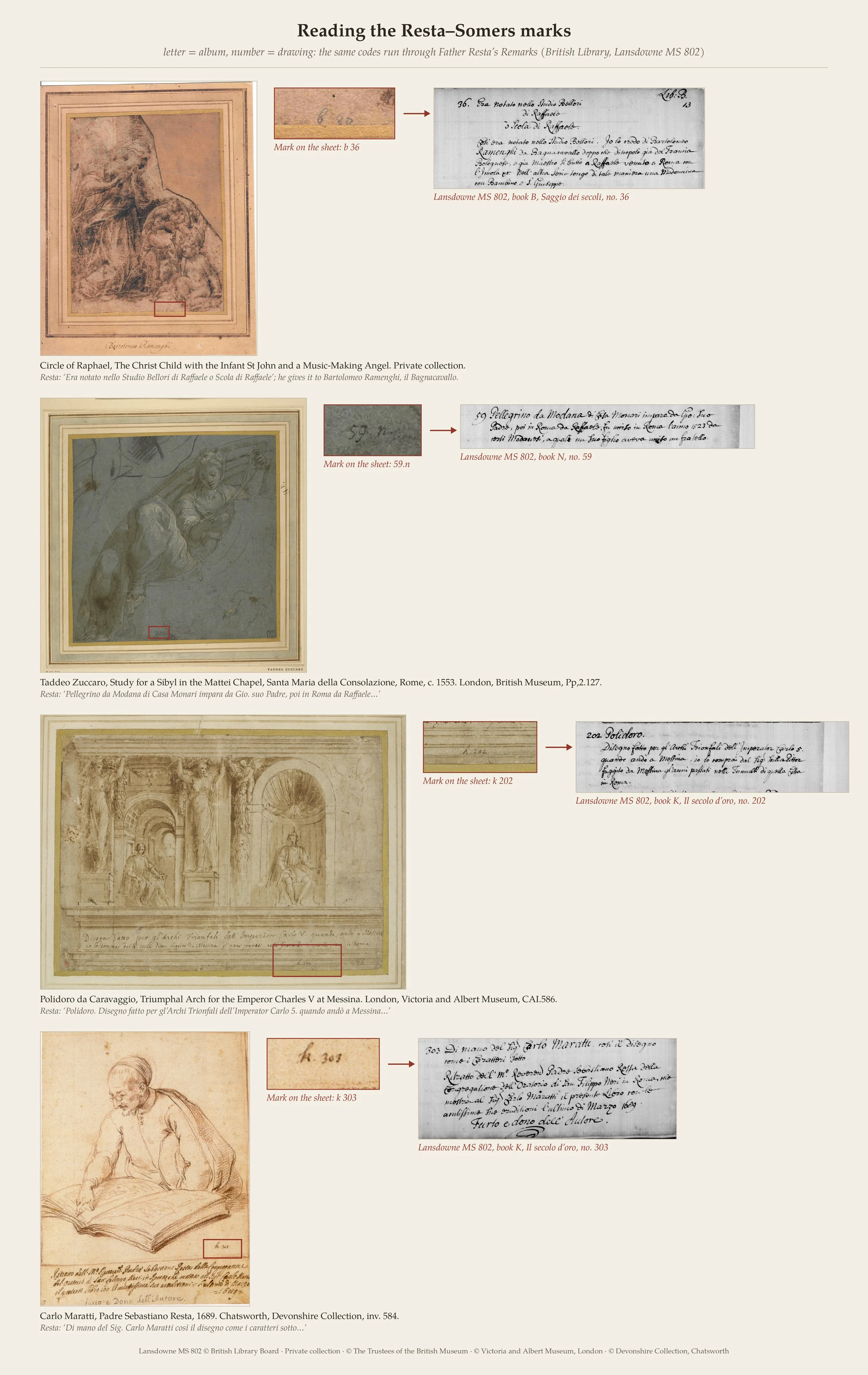
Resta–Somers marks and the corresponding entries in Lansdowne MS 802 (London, British Library): b 36, circle of Raphael, private collection; 59.n, Taddeo Zuccaro, Sibyl, London, British Museum, Pp,2.127; k 202, Polidoro da Caravaggio, Triumphal Arch for the Emperor Charles V at Messina, London, Victoria and Albert Museum, CAI.586; k 303, Carlo Maratti, Portrait of Padre Resta, Chatsworth, Devonshire Collection, inv. 584
Richardson, while his Two Discourses (1719) were taking shape, drew from the Somers albums a chronology of painters. Resta’s albums offered a new model: a collection that aspires to completeness, ordered by school and by period, in which every sheet carries its own commentary beside it and the whole tells a history of art. Born in the rooms of the Chiesa Nuova in the late seventeenth century, this is the same model that the great collectors of the eighteenth century would make their own, from Richardson himself to Mariette in Paris and Francesco Algarotti in Dresden, with their ambitions of completeness and their geographical and historical criteria. The rehabilitation of Resta and of this legacy, begun by Popham and carried forward by Giulio Bora, Simonetta Prosperi Valenti Rodinò, Jeremy Wood, Genevieve Warwick and others, has recently been taken up by two research programmes: the Padre Resta Project, led by the present writer at the University of Rome Tor Vergata (www.padrerestaproject.eu); and the Mainz project led by Elisabeth Oy-Marra.
Anyone today, who comes across one of those sheets, with its letter and number, can still trace it back to the page from which it was removed and to the voice of the man who assembled it. Most of those albums have not survived intact, but the history of art that Resta wrote in them can still be read, and rebuilt, one entry at a time.
Grisolia’s biography of Padre Resta, Padre Sebastiano Resta (1635 - 1714): Milanese, oratoriano, collezionista di disegni nel Seicento a Roma, co-edited with Alberto Bianco and Simonetta Prosperi Valenti Rodinò, was published with Edizioni Oratoriane in 2017.
Mes Chers Amis: Drawings in the Collections of 19th-Century French Artist
Fondation Custodia, Paris
17 October 2026 – 17 January 2027
Previewed by Laurence Lhinares, curator, research associate at the Fondation Custodia, Paris
At the Fondation Custodia in Paris, a new exhibition explores nineteenth-century French artists’ drawings collections, revealing friendship, admiration and artistic exchange. For this month’s Preview, the exhibition curator, Laurence Lhinares, joins the editor to discuss the history of artists as collectors, artistic kinship, and unexpected associations.
TN: From Giorgio Vasari and Jonathan Richardson to the traditional album amicorum, artist-collectors occupy a significant place in the history of drawings collecting. In nineteenth-century France, however, personal exchanges between artists surged dramatically. How and why did artists’ collecting practices evolve during this uniquely fertile period?
LL: In the nineteenth century, collecting took on a new dimension against a particularly favourable backdrop, marked by a boom in artistic production and the art market. The creation of the Musée du Luxembourg, dedicated to contemporary art, the popularity of visits to artists’ studios and galleries, and the central role of the Paris Salon all contributed to this craze. In the middle of the century, the opening of the Hôtel Drouot, which succeeded the auction houses on the Place de la Bourse and the Rue des Jeûneurs, encouraged a proliferation of sales and the growing prominence of modern art. Modern drawing benefited from this effervescence: more frequently offered as a gift, exchanged or sold than a painting or sculpture, it found its way into artists’ portfolios or onto the walls of their studios or homes. Artists fully understood a drawing’s value and assembled collections that reflected their personal taste and their friendships with fellow artists.
TN: Could you walk us through the layout and structure of the exhibition? Around which narrative or social threads – from the Villa Medici in Rome to the studios of Paris – has the display been curated?
LL: The exhibition opens with souvenirs of friendship and collaboration preserved by painters, sculptors, printmakers, architects and musicians. We then explore bonds of loyalty through sheets kept by artists who belonged to the same circle of friends or pursued similar artistic paths. A specific section is devoted to the two great artists of the century, Ingres and Delacroix. The exhibition concludes with a presentation of a number of artists who assembled significant collections of drawings by their contemporaries, including Léon Bonnat and Edgar Degas. We present an intimate history of drawing in nineteenth-century France, rich in anecdotes, personal stories, enthusiasm, admiration and friendship.
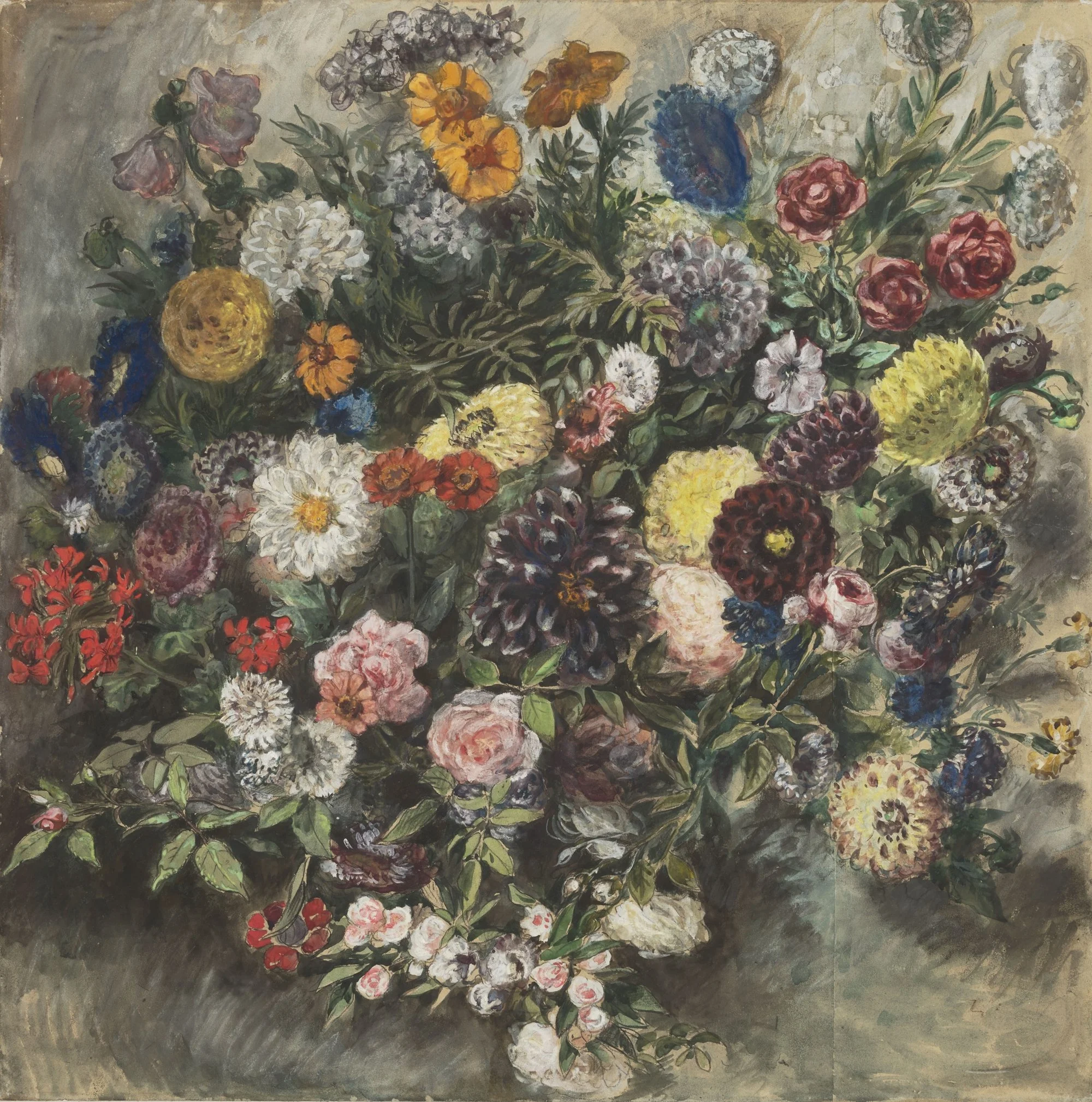
Eugène Delacroix (1798–1863), A Bouquet of Flowers, c. 1849–1850, Musée du Louvre, Paris, inv. RF 31 719 © GrandPalaisRmn (musée du Louvre) / Michel Urtado. Formerly owned by Paul Cézanne (1839–1906)
TN: The exhibition reunites nearly 100 works from the Frits Lugt Collection at the Fondation Custodia, as well as loans from major international institutions, regional museums and private collections. How did you arrive at your selection, and how do these loans allow you to reconstruct collection ensembles that have remained dispersed for over a century?
LL: In order to showcase these souvenirs and significant collections, we have been able to benefit from the exceptional participation of the Musée du Louvre and the Musée d’Orsay, as well as the generosity of French museums, the Metropolitan Museum of Art in New York and private collections.
Donations and bequests made by the artists, often to their hometowns, led us to approach the museums that now house their works and collections: those of David d’Angers and Turpin de Crissé at the Musée des Beaux-Arts in Angers, of Jean Gigoux in Besançon, and of Léon Cogniet in Orléans. The Louvre, the Musée d’Orsay and the Metropolitan Museum of Art in New York, thanks to the richness and diversity of their collections, have also enabled us to present or supplement certain groups of works. It is worth emphasising the decisive contribution made by regional museums, which give us the opportunity to showcase beautiful sheets that are rarely on display.
Thus, four spectacular drawings by Géricault from the collection of his pupil Pierre-François Lehoux, now divided between the Louvre, Rouen and Lille, are reunited in the “Loyalties” section. The portraits of Lancelot Théodore Turpin de Crissé and his wife, on loan from the Metropolitan Museum, are displayed alongside works from his collection, which is today mainly preserved in Angers. Loans from the Musée de Poitiers and the Musée d’Orsay have made it possible to reunite two exceptional sheets by Daumier and Doré from the Giacomelli collection, which was dispersed at his sale in 1905.
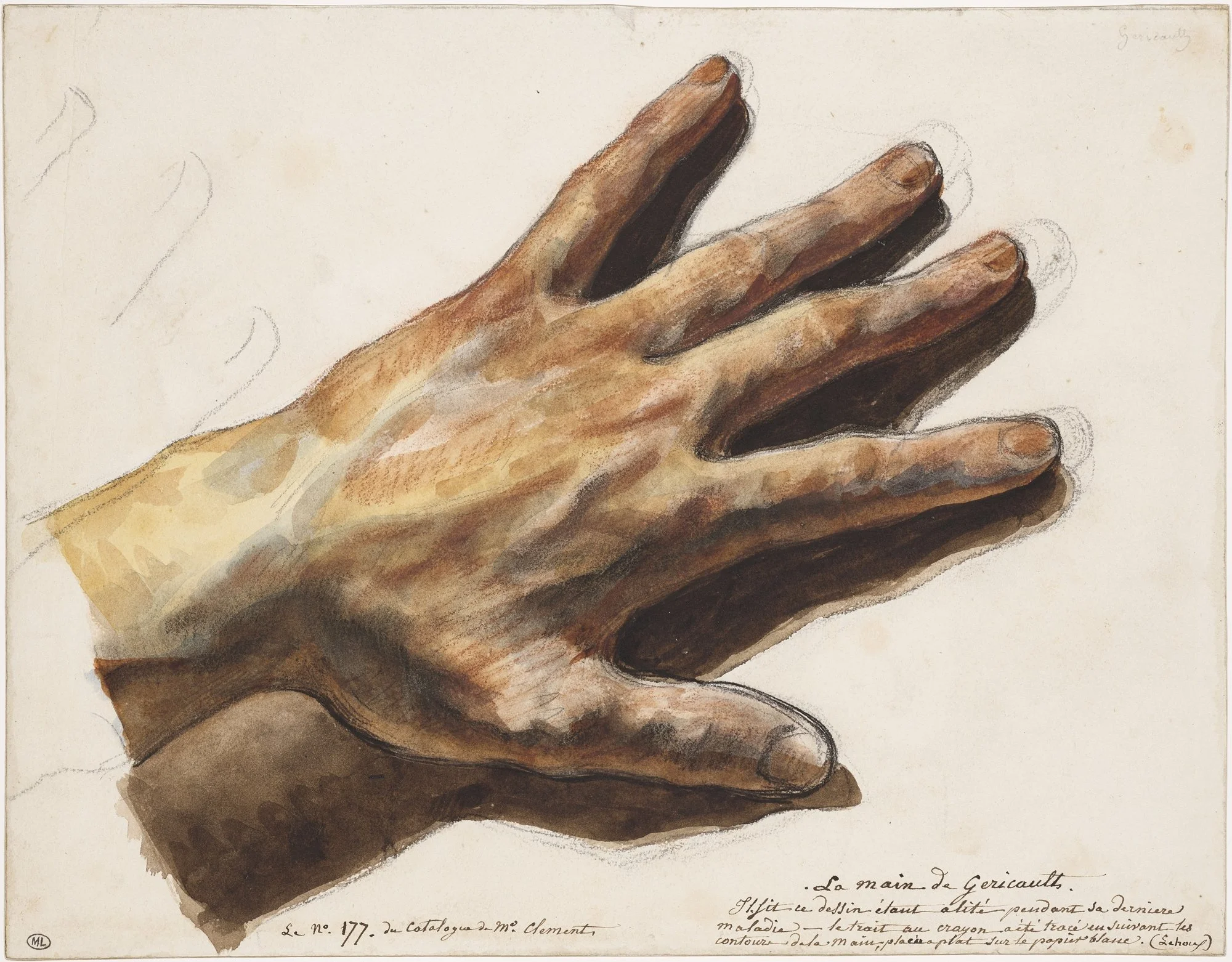
Théodore Géricault (1791–1824), The Artist’s Left Hand, c. 1823-1824, Musée du Louvre, Paris, inv. RF 1397 © GrandPalaisRmn (musée du Louvre) / Sylvie Chan-Liat. Formerly owned by Pierre-François Lehoux (1803–1889)
TN: Jean-Auguste-Dominique Ingres and Eugène Delacroix form the core of the show. Why were their works so widely collected by their peers, and what do these sheets reveal about the fascination surrounding both figures?
LL: Ingres, a leading figure among his friends and acquaintances, gave away numerous drawings which became tokens of friendship and esteem. The fact that his colleagues preserved these drawings reveals the significance of the artistic circle he had built around himself, which helped to promote his work as a draughtsman. The portrait of Auguste Boucher-Desnoyers, which remained in the model’s family until its rediscovery in 1993, illustrates this personal dimension. Executed in 1825, a landmark year for both artists, it bears witness to the mutual esteem that bound them together.
Eugène Delacroix, for his part, was widely collected by his peers. Generous towards those close to him, he gave or bequeathed several of his own works, as well as a few pieces by fellow artists that he had chosen to keep for himself. Through the names of Auguste, Charlet, Riesener, Bonington, Huet and George Sand, Delacroix’s entire circle of friends comes to life once more. His posthumous sale attracted the entirety of the Paris art world. Many of his contemporaries were keen to acquire a souvenir of the master. This fascination extended beyond his own generation. Paul Cézanne, who kept no works by his contemporaries, hung the master’s marvellous Bouquet of Flowers in his bedroom.
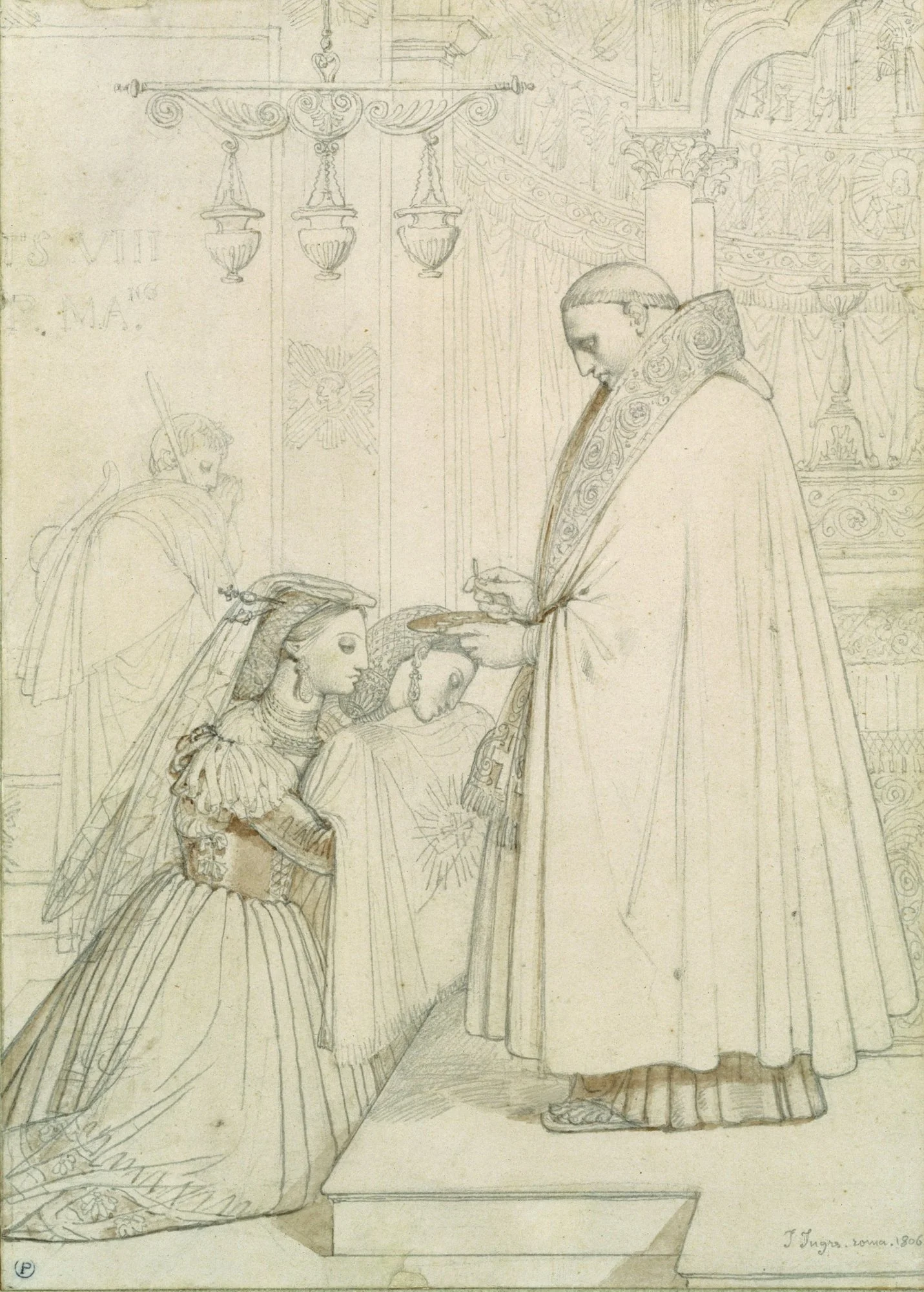
Jean Auguste Dominique Ingres (1780–1867), A Communion in Rome, 1806, Prat Collection, Paris. Formerly owned by Anne-Louis Girodet-Trioson (1767–1824)
TN: Many of these sheets were gifted or exchanged as tokens of admiration and friendship. Did the research process reveal any unexpected alliances and are there any stories of artistic friendship that you were particularly keen to highlight?
LL: Artists generally kept works by contemporaries who belonged to their circle and with whom they were on friendly terms. For example, the Barbizon artists kept only works by those close to them. It is therefore hardly surprising that no drawings by Ingres are to be found in Narcisse Diaz’s collection, as a journalist pointed out regarding the painter’s personal collection at the time of his posthumous sale.
We wished to highlight certain artistic friendships. That of Léon Cogniet, who reserved a place of honour for his friends and those he admired in his drawing room and in his portfolios, notably for Michallon, his “friend for life”. We also wished to devote space to a more unexpected circle of friends: that which surrounded le beau Mélingue, a painter and sculptor best known as a successful actor. Together with his wife, the actress Théodorine Mélingue, he entertained numerous Romantic artists in their salon-museum on Rue Levert in Belleville. Paul Gavarni, Henry Monnier, Diaz and Raffet were also among the couple’s most loyal friends.
TN: If you had to choose one drawing from the exhibition that best embodies this sense of intimacy and artistic loyalty among nineteenth-century peers, which sheet would it be and why?
LL: The double effigy of the brothers Paul and Hippolyte Flandrin. These portraits, each drawn by the other and dedicated to their friend, the composer Ambroise Thomas, celebrate a friendship forged at the Villa Medici. The two brothers pay mutual tribute to each other’s talent as draughtsmen, presenting the sheet to the musician before his departure from Rome. This drawing captures the fraternal and artistic bond that united these three artists. We have chosen it for the cover of the catalogue.
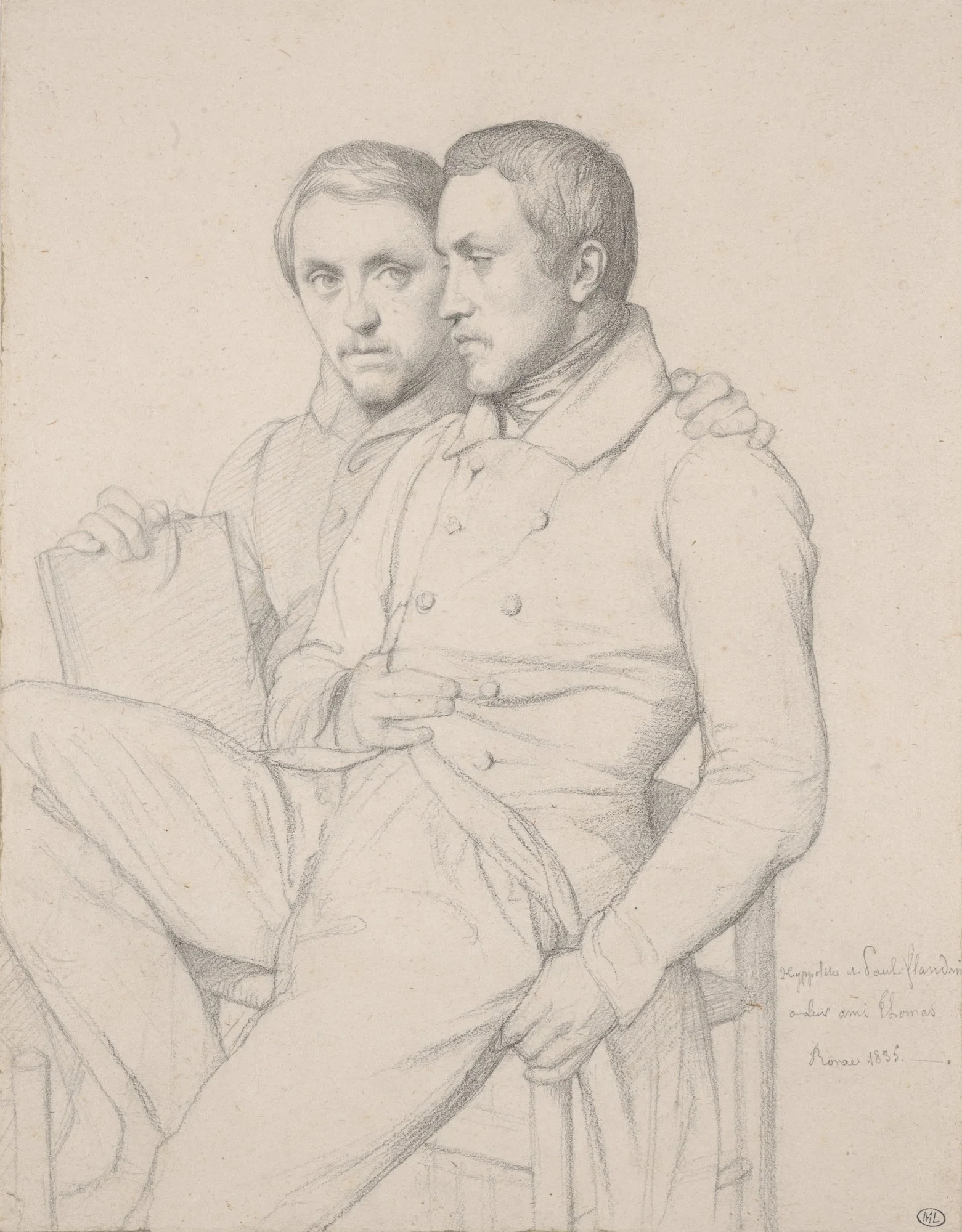
Hippolyte Flandrin (1809–1864) and Paul Flandrin (1811-1902), Double Self-Portrait, 1835, Musée du Louvre, département des Arts graphiques, Paris, inv. RF 4021 © GrandPalaisRmn (musée du Louvre) / Michel Urtado. Formerly owned by Ambroise Thomas (1811–1896)
Mes Chers Amis continues at the Fondation Custodia until 17 January 2027. The exhibition catalogue is available now.
JUNE HIGHLIGHTS
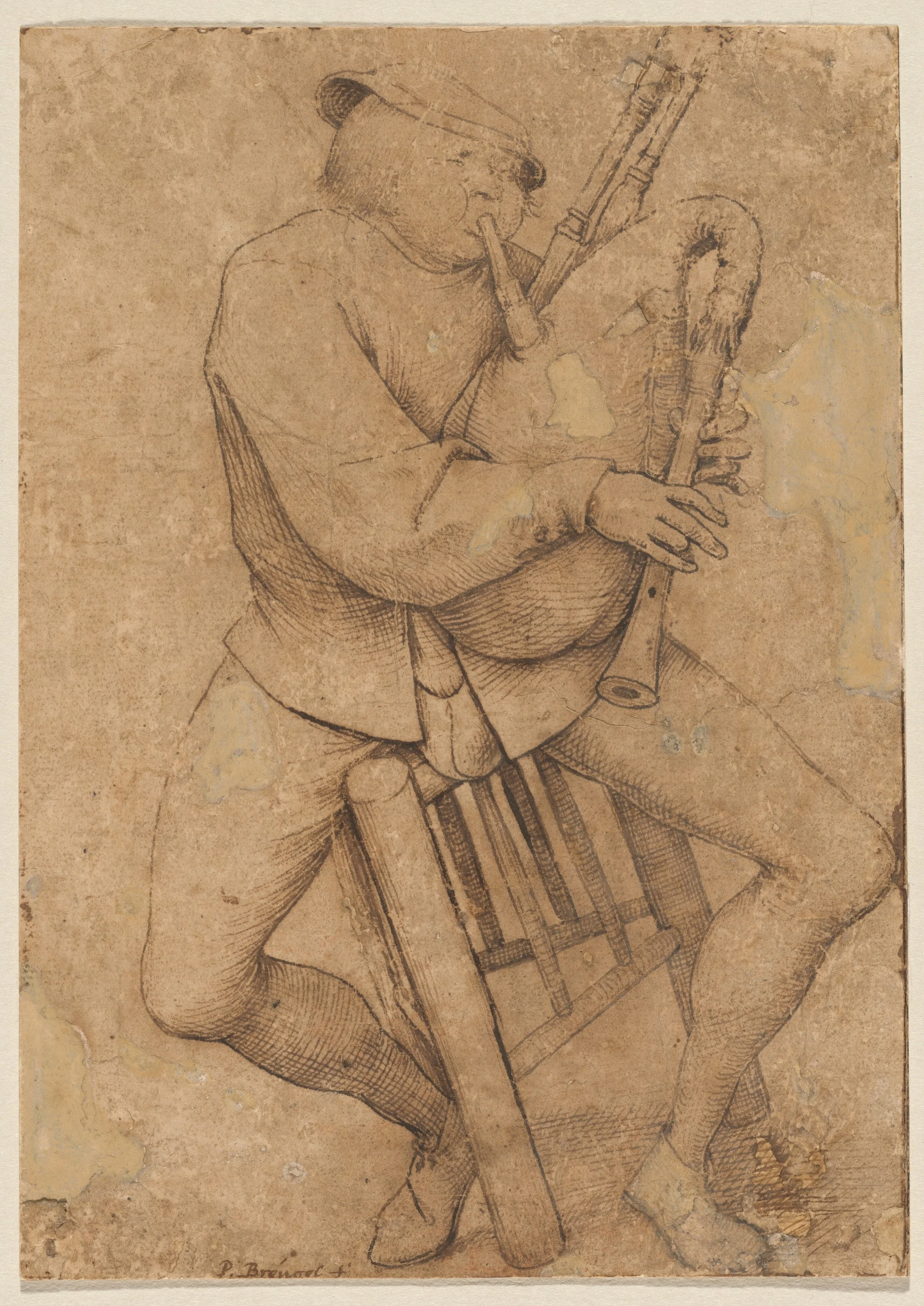
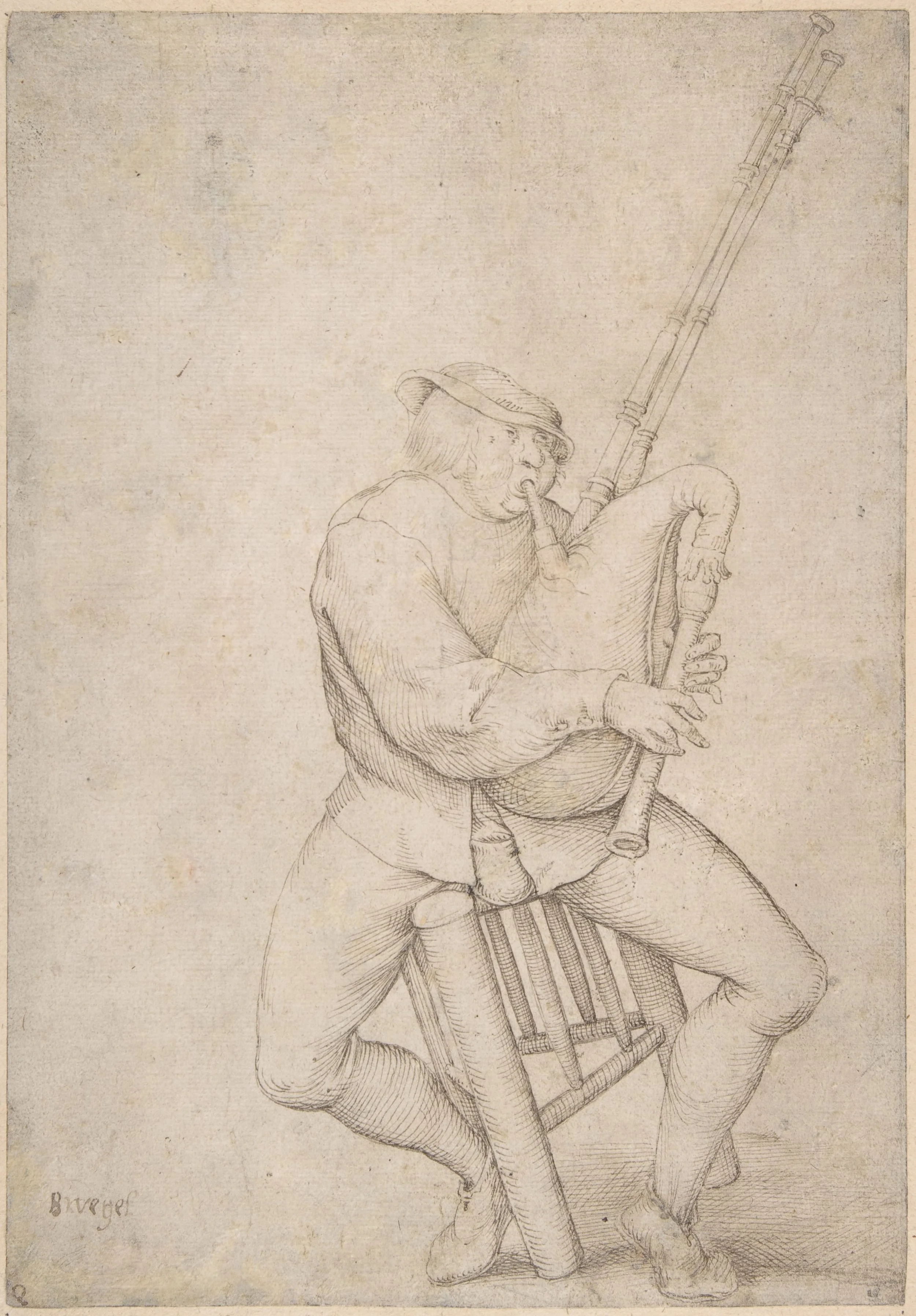
This month’s Real or Fake quiz follows on from last month’s pair related to Pieter Bruegel the Elder (no points for guessing the artist’s name as both sheets are helpfully inscribed!). Although the bagpipe player tipping precariously on a three-legged stool is a wholly typical subject for Bruegel, as a study of a single figure, it is a relatively rare survival. One of these two drawings is Bruegel’s original, while the other is a copy – a product of the so-called Bruegel ‘renaissance’ in the Netherlands around 1600. Can you determine which is which?
-
The original is the upper (left) image.
Upper (Left) Image: Pieter Bruegel the Elder (c. 1525/30–1569), The Bagpipe Player, c. 1562, the National Gallery of Art, Washington, inv. no.: 2016.127.2
Lower (Right) Image: Netherlandish, 16th century, Seated Man, Precariously Balanced, Playing Bagpipes, the Metropolitan Museum of Art, New York, inv. no.: 1975.131.172Although in a poorer state of preservation and visibly cropped along the upper edge, Bruegel’s original drawing is the upper sheet. The copy can be distinguished by its overly formulaic hatching. Despite being an anonymous copy, the drawing retains considerable value: first, it reveals the entire composition, showing the full length of the pipes; second, early copies such as this offer insights into the reception of Bruegel’s drawings, testifying to his early recognition as the greatest sixteenth-century Netherlandish artist.
In dulcet tones, Bendor Grosvenor reads from Raffaele Soprani’s 1674 biography of Renaissance painter Sofonisba Anguissola (c. 1532–1625). The translation of the original Italian is taken from Julia K. Dabbs’ Life Stories of Women Artists, 1550–1800: An Anthology (2009). Produced during the 2020 Covid lockdown, Grosvenor’s twelve-part series features readings from art historical texts by Giorgio Vasari, Michelangelo and Horace Walpole.
In 2024, the artist couple Marie and Félix Bracquemond enjoyed a major resurgence of interest following a series of auctions at Artcurial in Paris and the generous donation of nearly 200 works to the Musée d’Orsay by their descendants. In this lecture, Ashley E. Dunn, Curator of Drawings & Prints at The Metropolitan Museum of Art, reflects on the new light these discoveries have shone on Marie’s drawing practices, and the subtle differences in her technique when preparing drawings for etchings, photomechanical reproduction, or as independent works for exhibition.
As part of the Harvard Art Museums’ series highlighting the work of its conservation and curatorial fellows, conservation fellow Valeria Pesce describes her extensive preparation, research, and eventual treatment of Camille Pissarro’s Eclipse of the Sun, c. 1854, accompanied by interactive before, during, and after images.
TROIS CRAYONS RECOMMENDS
*As an Amazon Associate we earn from qualifying purchases