
Demystifying Drawings #26
Saturday, 1 November 2025. Newsletter 26.
Exciting things are afoot for drawing lovers at The Society of Antiquaries of London. True to its mission of fostering access to its storied collection, the learned society is currently running a series of innovative events, fundraising campaigns, and projects, all which deeply engage with its holdings of works on paper. Trois Crayons sat down with Chiara Betti, Curatorial Research Assistant at the Society, to know more about these exciting developments.
By means of introduction, Betti began by highlighting the history and mission of the organisation:
Founded in 1707, the Society of Antiquaries of London is the oldest independent learned society dedicated to the study of heritage. Its mission is to encourage, promote, and expand the study and understanding of antiquities and history.
The Society has been housed at Burlington House on Piccadilly since 1874. This historic building serves as the hub for our global research and houses our renowned Library and collections. Drawing has been central to our history, as the Society immediately began commissioning artists to create precise visual records of sites and monuments across Britain before they were lost.
Today, the Society's activities maintain a dual focus: research and public accessibility, driven by our extraordinary collections. We preserve one of the world’s most significant independent research libraries, featuring approximately 100,000 printed titles, including incunables and unique broadsides, alongside historical manuscripts and archives dating from the tenth century. This is complemented by diverse visual and material culture holdings, notably a collection of over 55,000 prints and drawings (dating from the late seventeenth to the twentieth centuries) and 40,000 museum objects that encompass everything from paintings and seal casts to one of the largest collections of brass rubbings in the UK.
We have some true treasures in our holdings, like a 1562 watercolour with a design for a new spire for St Paul’s Cathedral to replace the previous one that was struck by lightning, or William Blake’s drawings of the monuments in Westminster Abbey made during his apprenticeship in the workshop of James Basire. The collection was assembled over centuries, largely through bequests. The gift of seven albums containing about 1,200 prints and drawings donated by Lord Coleraine in 1749 can be seen as the foundation of the graphic arts collection of the Society. In its early days, it also actively commissioned drawings and engravings to illustrate artworks and monuments at risk of destruction. The multi-volume series Vetusta Monumenta is perhaps the greatest testament to the Antiquaries’ commitment to creating visual records of fragile heritage.
The Society has developed a multi-front strategy to broaden both specialist and public knowledge of its collection of works on paper, with an exciting cataloguing and digitisation project at the heart of this renewed push. Betti informed Trois Crayons that at the moment, less than 6% of the Antiquaries’ collection is catalogued in their internal database, and even less is digitised. She stressed that collaboration is at the heart of this new campaign: the project, which will unfold over many years, constitutes an opportunity for the Society to ‘engage with local organisations, undergraduate students, and scholars all over the country to create thoroughly researched records for our topographical prints and drawings’. During the first year of the project, Betti ‘will focus on researching a selection of fifty treasures, some of which will be displayed at Burlington House in summer 2026, that will provide the foundation for a catalogue of [the Society’s] Prints and Drawings collection’.
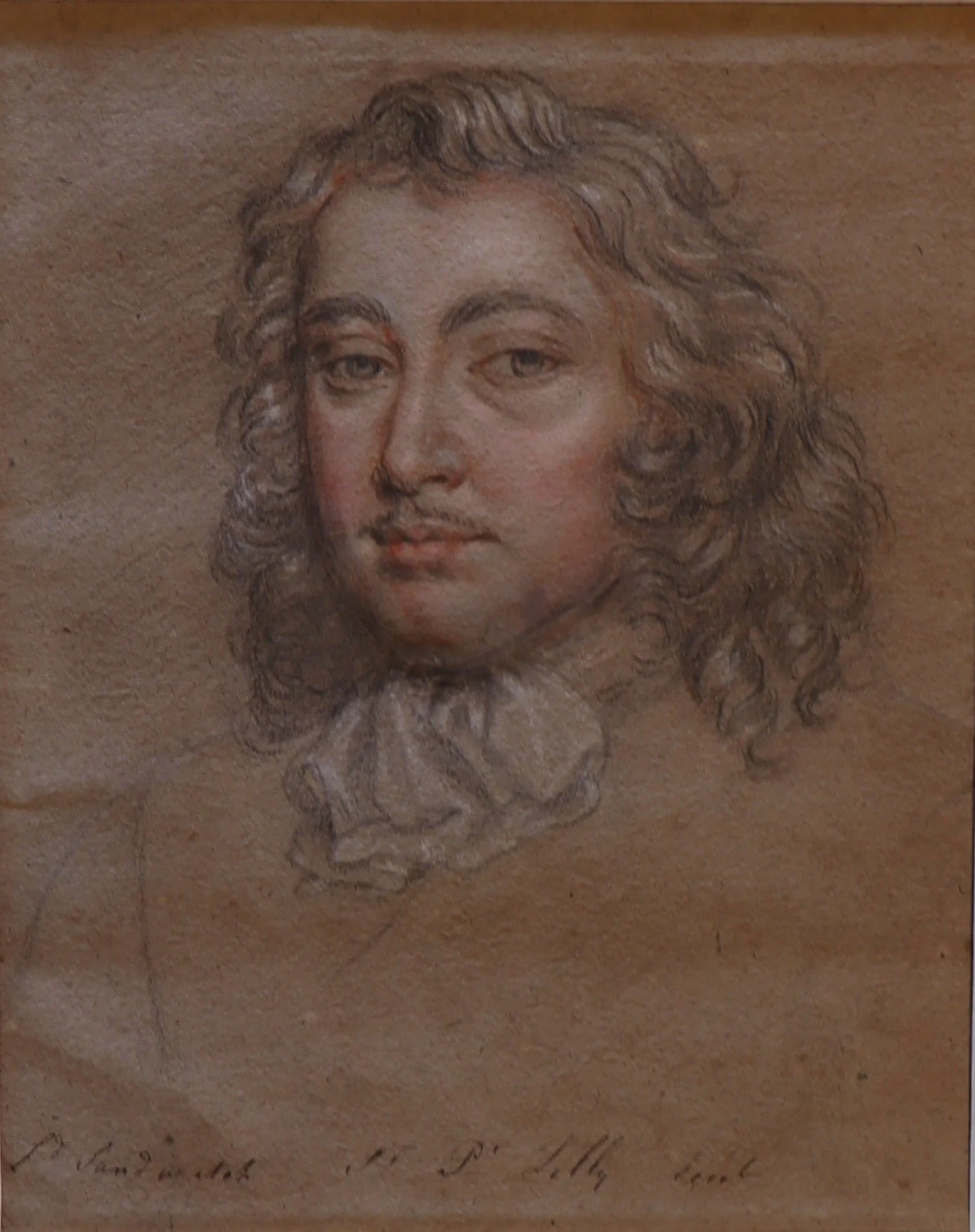
Peter Lely, Portrait of Lord Sandwich, coloured chalks on paper
In the shorter term, the Society will host a rich public programme which will heavily feature drawings. This includes Past Matters, a series of events which aim to raise funds to secure the Antiquaries’ future at Burlington House. Betti highlighted two events as particularly exciting for lovers of the graphic arts:
Drawn to Discovery at the Antiquaries, scheduled for the evening of 6 November, will offer an extremely rare opportunity to dive into a curated selection from the Society’s phenomenal collection of over 55,000 seventeenth- to twentieth-century prints and drawings.
Drawing enthusiasts will have the opportunity to have an unparalleled glimpse into the historical practice of visual documentation. The soirée will feature works by artists who merged technical draughtsmanship with antiquarian purpose, including George Vertue, William Blake, Pietro Fabris, and Giovanni Battista Falda. The collection also has great art historical importance, containing portraits and satirical prints that are comparable in quality and scope to those held by the major national museums. The evening includes a drinks reception and hourly spotlight talks in the library, giving attendees a deeper contextual understanding of these historical works.
We also have the concurrent sale of early engravings of the Society of Antiquaries, running from 21 October through December, with Abbott & Holder, offering a chance to acquire prints made from plates by the Society's first official engraver, George Vertue.
In addition to these events, from 31 October 2025 to 17 February 2026, the Society will host Inked in Memory, a temporary display which will explore how artists and antiquaries created visual records of monuments, archaeological finds, and distant locations before the advent of photography. Betti said working on the display, created in response to the excitement generated by her initial survey of the collection for the cataloguing project, was ‘one of the most exciting and unexpected aspects of [her] role’. Members of the public will be able to view it when coming to Burlington House for one of the Society’s events, such as Open Fridays.
Featuring prints and drawings alongside printing plates, woodblocks, and original objects, the multi-media display allows for novel connections to be made across the Society’s collection. Betti elucidated further:
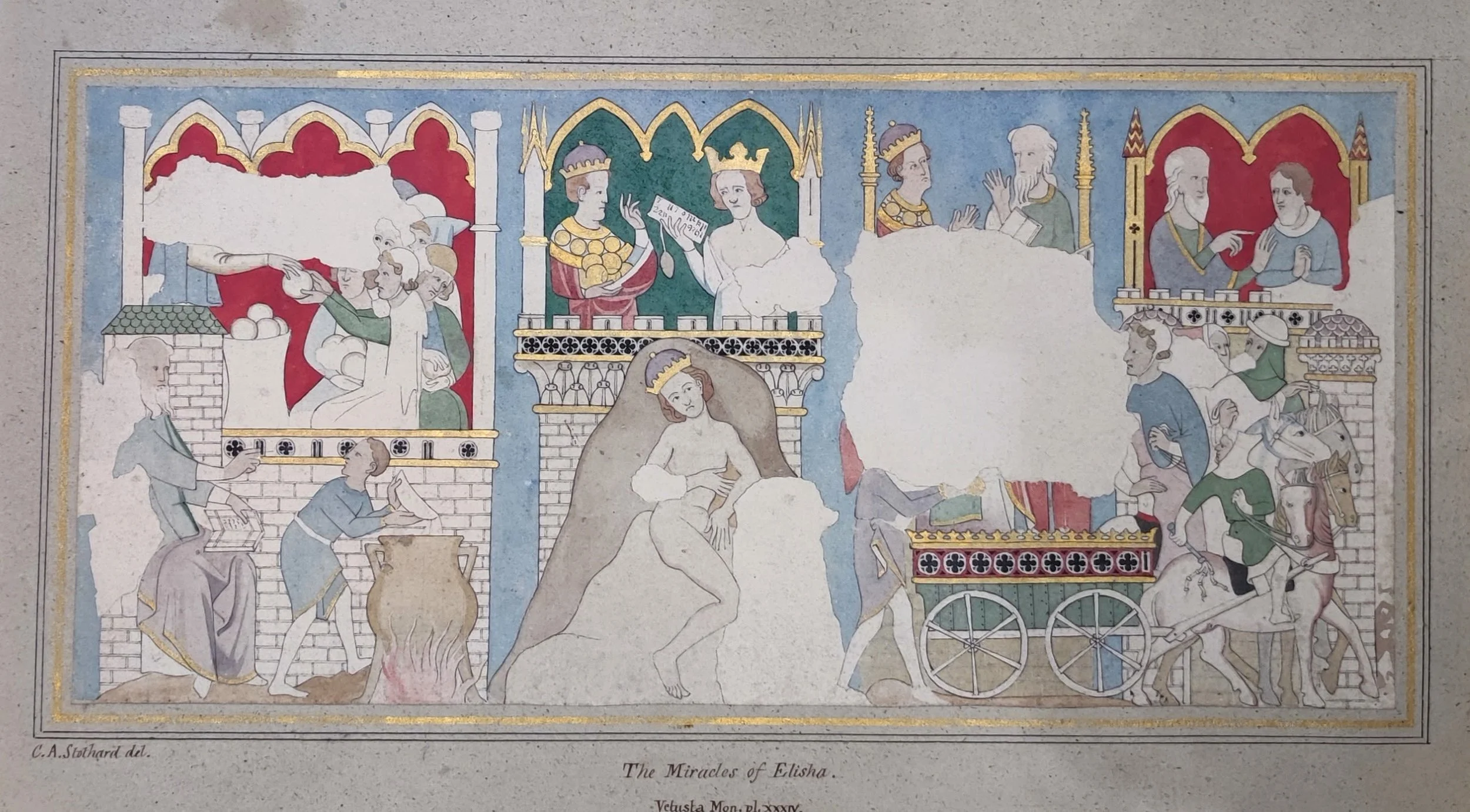
Charles Stothard, The Miracles of Elisha (from Westminster’s Painted Chamber), 1819, watercolour with gold leaf detail on paper
All of the artworks in the Society’s collection were rarely made in isolation: rather, they were commissioned, used, discussed and published by many different people over many years, creating a palimpsest of historical knowledge about a particular object or site. Although these images might appear to be about “the past”' they are very much part of a living, breathing body of knowledge to which we continue to contribute today.
Out of the numerous highlights on view, Trois Crayons set Betti the difficult task of sharing her favourite sheet from the display:
I think that would be Pietro Fabris’s tiny drawing of a street with shops in Pompeii. This piece transports us back to a time when the ancient Roman city was just beginning to reveal its secrets. Fabris made the drawing for Sir William Hamilton (1730-1803), a renowned British collector and envoy in Naples at the time, who frequently visited the excavations of Herculaneum and Pompeii. Those sites began to gain even more fame through collectors such as Hamilton, whose passion for antiquity and role as an ambassador helped introduce the cities as major attractions for travellers. As a result, Naples quickly became the second most popular city in Italy for Grand Tourists, after Rome. The drawing is part of a series of twelve small watercolours that were later published as engravings in the Society’s journal, Archaeologia. The watercolour shows what Pompeii would have looked like to an eighteenth-century visitor. It reproduces the wonderfully vibrant colours of the walls with their reds and colourful tiles, as well as the temporary roofs built to protect the wall paintings. It also shows vineyards sprawled on a hill in the background that had yet to be excavated.
In closing, Betti warmly encouraged readers to take part in the Society’s slate of projects and events.
Information about Inked in Memory can be accessed at https://www.sal.org.uk/event/inked-in-memory/, whilst details for all the Past Matters events, including Drawn to Discovery and the engravings sale, can be found at https://www.sal.org.uk/support-us/past-matters/. Those wishing to support the cataloguing project can make a donation and become a Friend of the Society's Prints and Drawings at https://www.sal.org.uk/support-us/digitise-prints-drawings/.
These exciting projects will surely produce new insight into one of London’s finest holdings of antiquarian works on paper. Trois Crayons will be sure to provide updates as they arise.